
Swing Voters Describe Corruption in Their Own Words
In early June, the Searchlight Institute and Impact Research conducted two focus groups with swing voters in Virginia, one composed entirely of women and the other of men; the goal was to understand how they perceived corruption in American politics.
Our previous research found that voters had a broad understanding of corruption, which included voting the way that campaign donors want (80%), giving government contracts to companies owned by family and friends (67%), and spending most of their time raising money for campaigns instead of governing (55%). We wanted to know how these answers might change in an environment where respondents were not confined to closed-ended multiple-choice questions.
The voters we spoke to had clear ideas about government corruption, its prevalence in our political system, and who is complicit (short answer: everyone).
Corruption is not a top issue, but voters are worried about it
Even before the topic of corruption was introduced by the moderator, voters brought it up in their answers. When asked if Congress was addressing the issues that matter most to her, one woman quickly remarked, “No. I feel like there are maybe three people in all of Congress, both houses, that are striving to help their people.” Instead, they see members of Congress as working for themselves and their special interest donors. Consistent with our previous research, voters had a broad understanding of corruption, but surprisingly, don’t describe it using specific examples.
While corruption doesn’t come up organically as a top-line issue, it operates underneath the surface of many people’s primary voting issues. When asked about their top concerns facing the country today, the primary responses were about the rising cost of housing, gas, and groceries, healthcare, and immigration. The women’s group, in particular, discussed the Trump administration’s handling of ICE and the immigration system as “demoralizing” and “depressing.” One possible conclusion is that voters don’t see corruption as a distinct issue. Instead, they see it as driving the main problems with the country, which they are more likely to name.
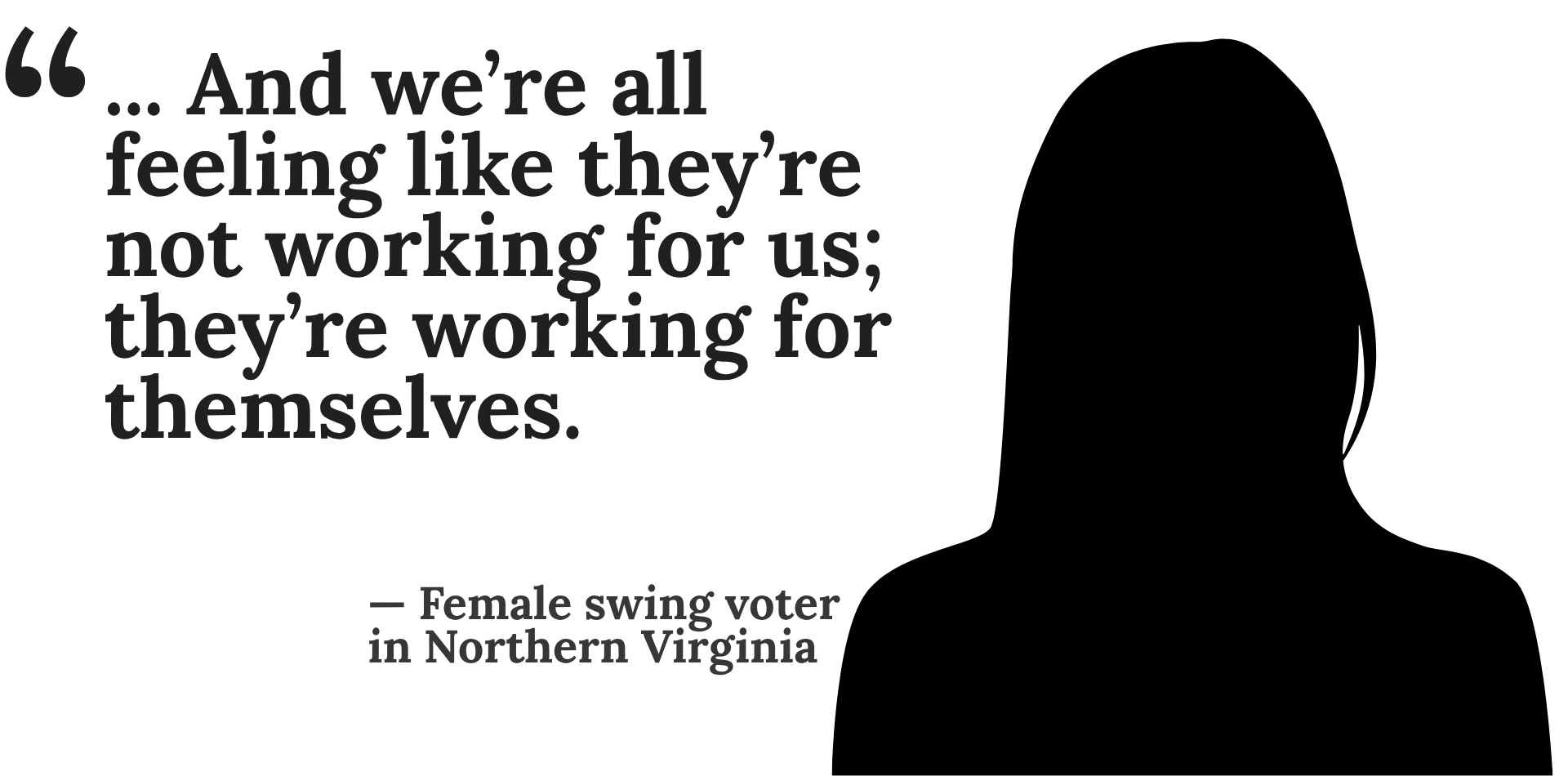
Once prompted, voters very quickly agreed that corruption is exacerbating most of America’s most pressing problems. They cited the high cost of living, unresponsive government programs, misappropriation of funds, and uninspiring candidates as symptoms of a corrupt system. Importantly, they see corruption as a mechanism by which politicians undermine the middle class, as one woman noted.
One man remarked that he believes that his rising electricity bill is a downstream effect of corruption. He sees tech CEOs cozying up to Trump as a main reason why they are able to build data centers, which drive up electricity bills. Another man noted that he thinks that the government is funding unnecessary special projects rather than funding programs for all Americans: “We don’t know where our tax dollars go, but we do see so much waste. And knowing that it could go to things like education, healthcare. We have the money to do these things, but seeing it just being burned for other use cases is frustrating.”
One woman discussed navigating the Medicaid system on behalf of her parents, whose drug prices have doubled over the past two years. “It feels like the structure is corrupt,” another woman put it plainly.
The primary form of corruption voters identified was explicitly financial. Many participants mentioned Congressional stock trading as a widespread example of corruption. One man said, “I think a big part of it is that a lot of people live their lives by playing by the rules. And in this instance, and a lot of others, the people in charge are not playing by the same rules we do. That’s unfair. That’s unjust.”
Gerrymandering was also broadly seen as a corrupt grab at political power. All eight women and seven of the eight men agreed that drawing congressional maps to benefit your own party counts as corruption. Importantly, these focus groups were conducted in the immediate aftermath of the vote to redraw Virginia’s congressional maps and the ensuing state Supreme Court decision. The voters took the court’s reversal of the vote as further proof that the government is not actually responsive to the peoples’ preferences. “We voted for the redistricting and it passed but because of the lawsuit it is getting reversed,” one woman said. “So, are you really listening to what we have to say?”
By contrast, behaviors without a clear financial or personal benefit were less likely to be viewed as corruption. Participants were divided on whether a member of Congress who is too old to do their job effectively but refuses to retire is corrupt. Instead, most labeled that as downstream, “a symptom of a corrupt system.”
Golfing instead of legislating was also seen as a gray area; “It’s not corruption, it is waste.” One man noted, “The waste is me paying this person’s salary so they are effectively an employee of mine. That’s how I see it. That’s what the president does. He serves at the pleasure of the people. And he’s golfing. Like, come to work dude.”
This was the largest divergence from our previous polling results. When asked about our previous poll, voters agreed that nearly all examples were corrupt. In the focus group, they took a much narrower view. Corruption was tied explicitly to financial and personal benefit. Some participants did tend to see financial interests underlying broken systems or inefficiencies, which allowed them to define things like Medicare dysfunction as corrupt.
We also wanted a broader understanding of what these voters viewed to be the worst forms of political corruption. So we asked both focus groups to name three of the most concerning forms of corruption.
Voters believe corruption is getting worse and more pervasive across both parties
Voters see corruption everywhere and believe that it is getting worse, not better. According to one man, “I think corruption has gotten worse, especially when people feel that they can get away with it. And they just keep pushing the envelope. The only good news is that corruption in the U.S. is much better than corruption around the globe, but it’s not trending in the right direction.”
While they generally agree that corruption was a problem long before Trump arrived on the political stage, voters believe that his blatant corruption has made the issue worse. They pointed to his crypto schemes, the airplane from Qatar, his slush fund, the ballroom, no-bid contracts, DOGE, and deals benefitting his family and inner circle as some examples of his corruption. Participants believe that Trump’s blatant corruption has empowered other elected officials to be corrupt and use their offices to enrich themselves. “Previously, [corruption] was very, very discreet but now it is just so open. And honestly, they don’t even care anymore,” one man noted.
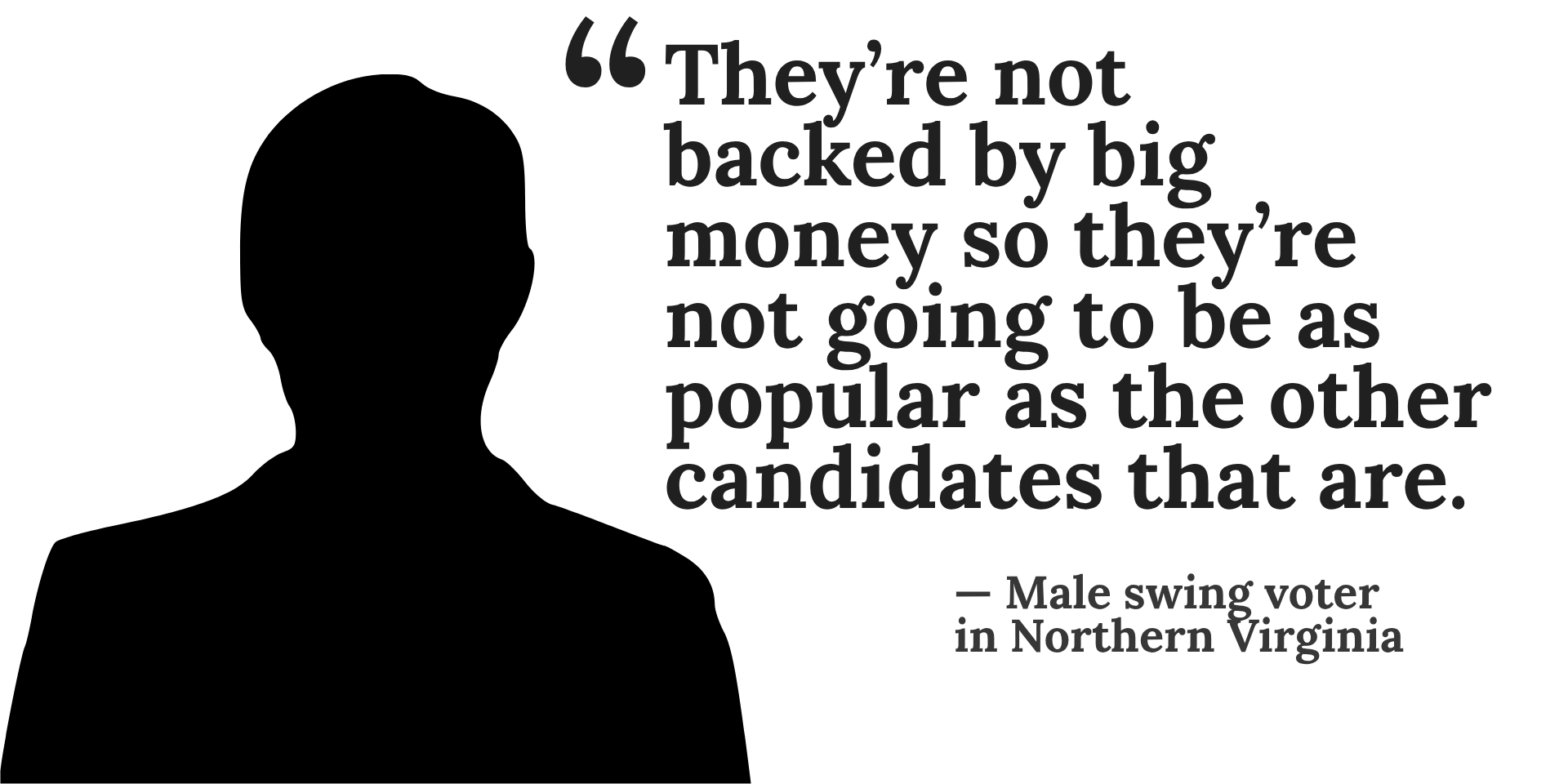
Voters don’t see corruption as a single-party problem. One woman aptly remarked, “It takes two to tango.” Many see corruption as systemic, especially given the role that money plays in the electoral system. As one man put it, “Once you’ve accepted a donation from a private entity, corporation, or lobbying group, you have to fulfill those promises. And more often than not, those promises are not in the best interest of the people.” Another participant widened the spectrum, “You gotta work for where the money is coming from. If you’re a politician or not. I mean, that’s the way the system works.”
Voters want corruption to be addressed
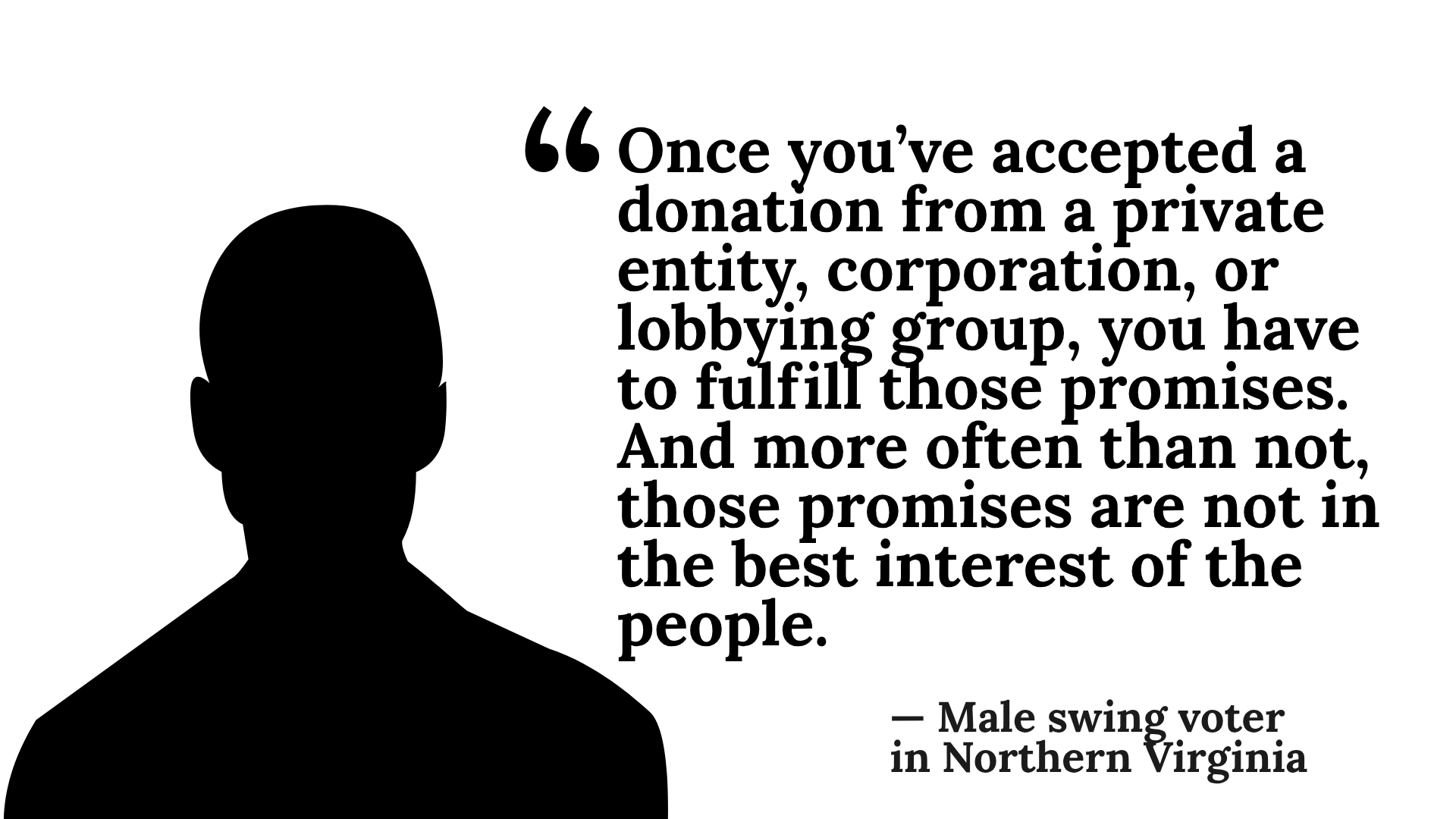
Voters are skeptical that politicians would be rewarded for tackling corruption. One man remarked, “I feel like those guys don’t get a voice. They’re not backed by big money so they’re not going to be as popular as the other candidates that are.” Participants were also skeptical that anyone could stay in Congress without getting corrupted. They worried that even politicians with the best intentions would eventually become part of the problem. This matches the result of our earlier poll where duration of time in Congress was seen as a prime marker of corruption.
We gave both focus groups a list of corruption reforms and asked them to identify the three that would make them most likely to vote for a candidate.
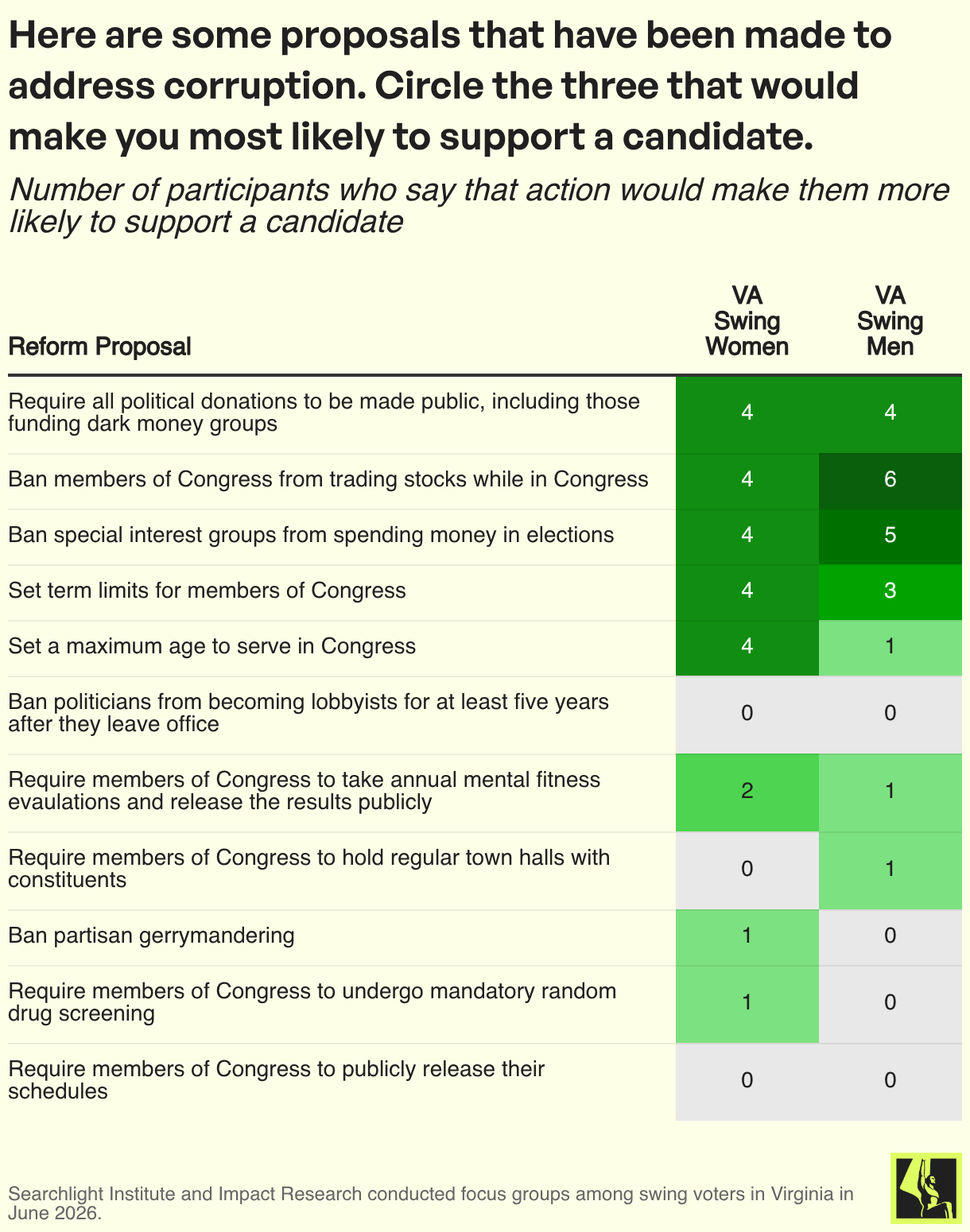
Voters also want candidates to take specific steps to show that they are not corrupt. As one man noted, “transparency is an important characteristic” for elected officials.
Voters want candidates to release their tax returns, refuse money from powerful influence groups, and take positions on issues that may be unpopular with their party leadership. When asked whether they could name any politicians who were not corrupt, the men pointed to Rep. Thomas Massie and said his willingness to speak out on the Epstein files, even while his party leadership was trying to silence him, proved to them that he is looking after the voters’ best interests rather than working just for himself. On the left, the men believed that Bernie Sanders was a standout given the fact that he has been in Washington, DC for over 30 years without changing his tune. “That’s coming from his personal conviction. Whether you like it or not, that’s his message,” one man added.
Voters see corruption as an action that currently has no repercussions for politicians. When asked what bothered her the most about corruption, one woman said, “There’s no consequences for it. It’s so open, and you just sit there.”
Participants supported a range of proposals to address corruption, but noted that the people who would have to vote for them are the very people who benefit from corruption.
Since they see the presence of special interest groups in politics as a corrupting force, voters are eager for reforms that minimize money in politics, but are also pessimistic about these reforms’ chances. Yet, despite this pessimism, voters still believe that candidates should discuss these proposals, as it signals that they recognize the problem and will hopefully work to address it.
One belief that was identified across both focus groups was that voters want candidates to do what voters want, rather than what they think is best.
What we learned
Voters see politicians playing inside baseball and leaving them out of the decision-making process. While they are particularly upset about egregious displays of self-interest (by Trump, for example), they believe that the main reason the government and society aren’t working better is because self-interested legislators are making corrupt choices.
Instead of experiencing corruption as a single issue in a laundry list of things they want Congress to address, participants say corruption is the thread that ties all of those issues together. It is the reason they can’t afford to buy homes, why their medicine is so expensive, why tax dollars are wasted on forever wars, and why they are stuck with old and uninspiring candidates. In voters’ eyes, corruption is not just a case of a few bad apples but the structure of the system itself.