
Voters Want to Put an End To Corruption in Government
Key Findings
- Voters believe most politicians are corrupt and have a broad definition of the term, grouping together explicit transactional misconduct — like bribery — with more implicit dynamics, such as donor influence, under the single umbrella of “corruption.”
- One of voters’ biggest concerns is a politician’s time spent in government: Voters seem to think that being in office longer inherently corrupts leaders over time, and they strongly support term limits.
- Voters continue to believe in the power of voting, identifying it as by far the most effective way to make a positive change in this country.
- All anti-corruption reforms we tested enjoy popular support, with voters most interested in measures that hold elected leaders to certain mental and physical standards and provide greater transparency over how leaders spend their time in office.
How Do Americans Define Corruption?
Before we dive in and explore likely voters’ attitudes toward corruption in politics and potential reforms, let’s establish what voters mean when they describe a politician as “corrupt.” Are they picturing smoke-filled rooms where the most important decisions in the country are being made without input from the public, or are they thinking about back-alley exchanges of paper bags stuffed with cash?
Voters mostly associate political corruption with money. Nearly a third of voters (31%) say that corrupt politicians “use public office for personal financial gain.” The second-most chosen association is that corrupt politicians rig the rules so they can retain their power. Notably, Democrats are more likely than Republicans or Independents to select this option — likely a reaction to the Trump administration’s actions regarding election integrity.

There is broad agreement that explicitly transactional behaviors — like taking cash for voting a certain way (86%), using insider information for stock trading (84%), or taking trips paid for by companies that want government favors (83%) — constitute corruption.
Notably, voters also view softer forms of influence as corruption. Over three-quarters of voters (78%) consider a politician corrupt when they vote the way that elites in their social group want, instead of what most people want.
The most common corrupt behaviors voters think government officials engage in are related to their campaigning — spending more time with donors than with regular voters and spending most of their time raising campaign donations instead of working on legislation. Explicit “favor-trading,” bribery, and profiting from insider information are seen as less common, though over 40% of voters think that at least “most” politicians engage in all of the corrupt activities that we listed.
Who is corrupt?
As a benchmark, 71% of voters think that “the typical politician” is at least somewhat likely to be corrupt. On par with “the typical politician” are long-term elected officials, whom 72% of voters think are at least somewhat likely to be corrupt (37% think that it is very likely). Meanwhile, independently wealthy politicians are seen as slightly less likely to be corrupt than typical politicians.
Each party is more skeptical about its opponents: Democrats say Republicans are more likely to be corrupt, and vice versa. Republicans are more skeptical about their own party, with a majority (52%) saying a typical Republican is at least somewhat likely to be corrupt, compared with only 42% of Democrats who say the same about candidates from their own party.
Newly elected officials and members of the middle class are seen as less likely to be corrupt by a significant margin. This finding may reflect an overall preference for “outsider” candidates, and a sense that time in office makes you more corrupt.

Cynicism and Distrust in Government
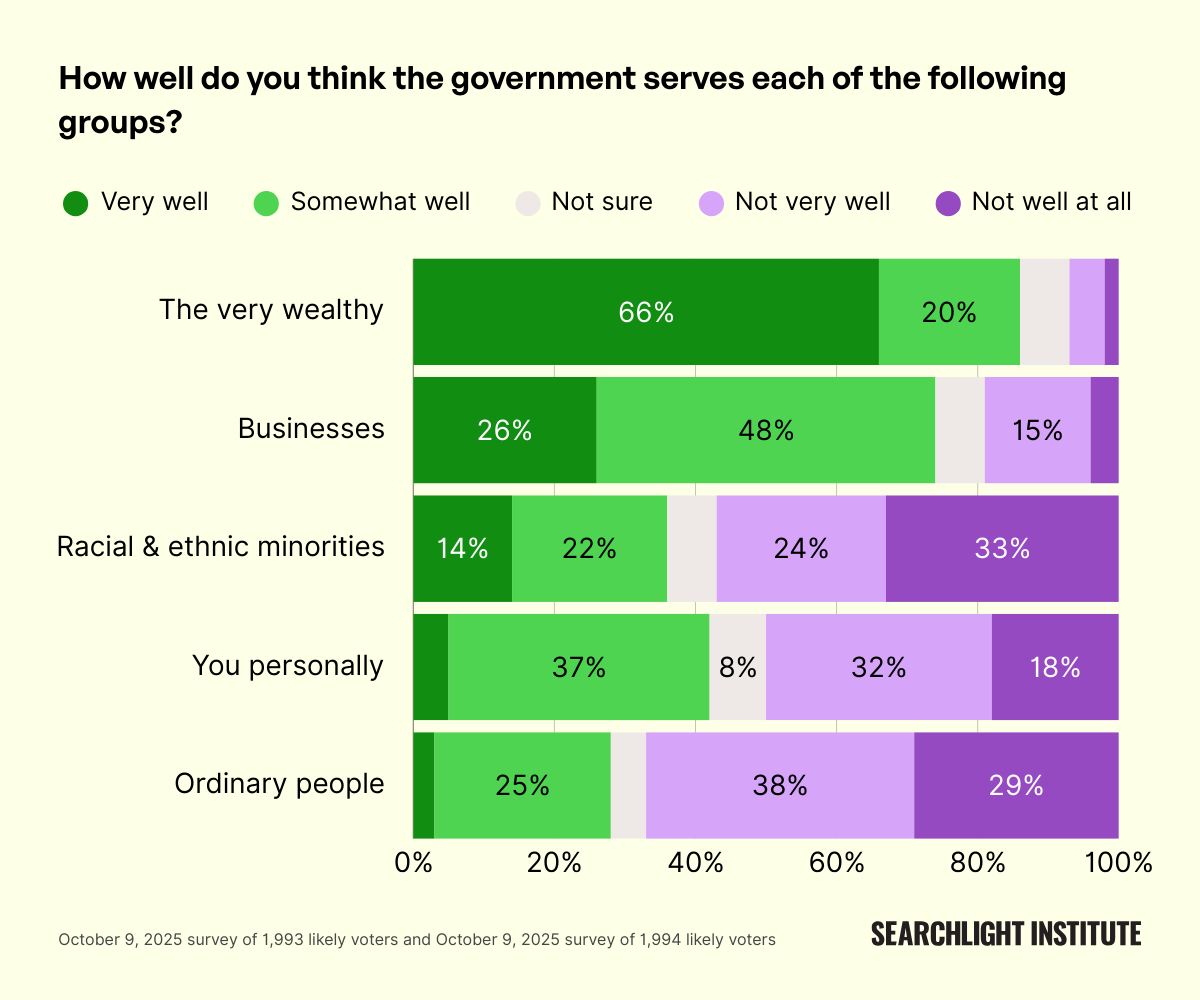
Voters are deeply cynical about whom the government cares about and serves. While two-thirds of voters think the government serves the very wealthy “very well,” only 3% say the same about “ordinary people.” At the same time, most believe the government personally serves them slightly better than it serves ordinary people.
Voters also think the wealthy exert the greatest influence over the Democratic Party, closely followed by ordinary people. There’s partisan cheerleading happening here, with 40% of Democrats saying that “ordinary people” have the most influence on their party. Voters also think the wealthy have the most influence over the Republican Party, and significantly more so than Democrats (21% versus 37%). Republicans are less optimistic about their party’s responsiveness to everyday Americans: 22% say “ordinary people” have the most influence over the GOP, while 19% say “wealthy individuals” do.
Specific interest groups are seen as having much less influence on either party. Only 12% think that either environmental groups or labor unions have the most influence on the Democratic Party. Instead, there’s a focus on the influence of the wealthy, over and above more specific groups.
Respondents are not very optimistic about responsiveness from their elected representatives. Only 26% of voters think that if they contact their representative, their views will be seriously considered, a sentiment shared across party lines. This avenue of interaction with the government is seen as reserved for wealthy donors and those with potential business interests.
This is not to say voters no longer believe that they can effect change. They do: 39% say that voting in elections is “very effective” at changing the country for the better. Voting is, by a wide margin, seen as the most effective of the possible activities. Protesting, attending rallies, and volunteering with campaigns are seen as the least effective. Democrats are much more likely than Republicans to believe in the effectiveness of protests, but even among Democrats, only 46% think attending a political protest is very or somewhat effective. Online cynicism about whether voting does anything is not shared by the electorate at large.

Trust in government has crumbled over time, and is at “near historic lows,” according to Pew. This decline is reflected in responses to our question of “how your trust in government changed” over the last 20 years, although respondents are, per usual, more pessimistic in their one-off response to us than is reflected in Pew’s aggregate numbers. 71% of our respondents say their trust in the federal government has declined over the last 20 years.
This leaves less and less room for government as a positive force in people’s minds. Even Democrats are more likely to say that the government’s problem is too much interference in people’s lives (48%), as opposed to being too weak to solve problems (37%). Without serious anti-corruption reforms, Americans may continue to lose faith in the very idea of government as an institution.
Reforms
Internal guardrails are not seen as enough to fight government corruption. Only 27% think that government oversight boards can effectively combat corruption, and a plurality (47%) think that these boards are ineffective due to being made up of (potentially corrupt) officials.
Since the usual methods are seen as insufficient, we tested a broader set of potential reforms to see what — if anything — resonates with voters.
Voters widely support a broad suite of potential pro-trust and pro-transparency reforms, including more off-the-wall options like drug testing. The reforms we tested fall into two broad categories: removing politicians from office and requiring politicians to follow practices in line with many other kinds of employment. Ideas like drug testing and the tracking of one’s work hours are common among jobs where professionals are entrusted with people’s safety — like air traffic controllers, bus drivers, and police officers. Voters seem interested in the effort to treat elected officials more like public employees in this manner.
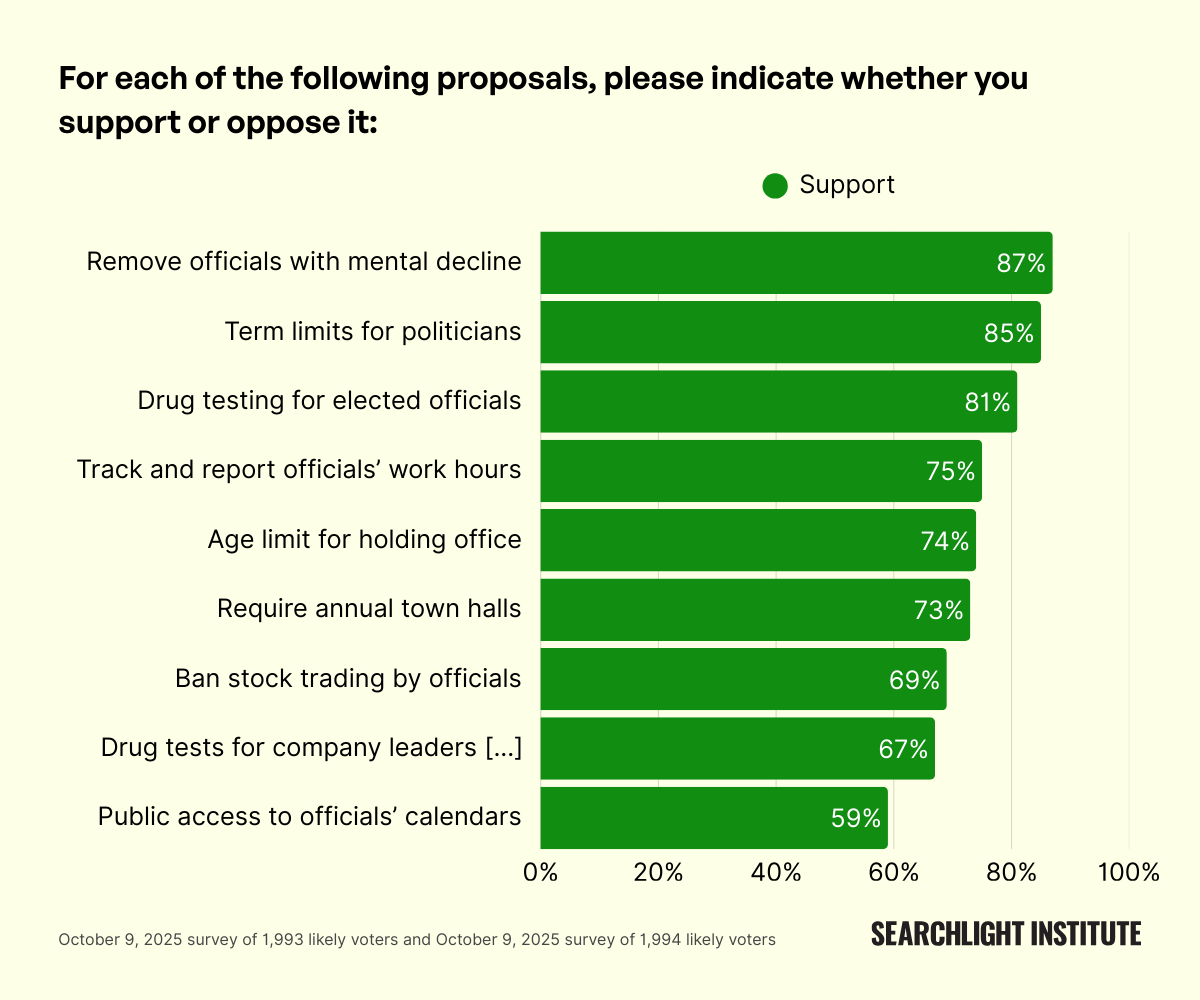
Mental decline mechanisms and term limits are clearly top of mind for Americans. The much-debated ban on stock trading is less popular, but still well above water (as is literally every reform we tested). Age limits are significantly less popular than term limits, potentially showing more concern with tenure of officials (and thus, their exposure to a corrupt institution) and less with their literal age.
Work Hour Tracking
One of the most interesting findings is the strong support for requiring elected officials to track and record their work hours. As we suggest in our accompanying policy memo, a congressional office could implement this policy, releasing “time sheets” or a similar log, without needing additional approval or risking the security of the member. Notably, this reform is more popular than releasing elected officials’ calendars or banning stock trading.
If you ask voters if any of these reforms will actually pass, none of the proposals get a majority of voters saying it’ll happen. This makes sense: Given voters’ cynicism, it is difficult for them to imagine an anti-corruption reform passing a body they believe to be immensely corrupt. This presents a huge opportunity for elected leaders to counter voter expectations.
Americans self-report that most of these reforms would increase their trust in government, with at least a plurality of voters reporting that each proposal would make them trust the government more, if implemented. By this metric, the most impactful reforms are removing members who are suffering from mental decline and imposing term limits, followed by requiring reporting on work hours (the public calendar idea is less popular). Notably, gains in public trust may well depend on which party champions the change. In other words, there is no guarantee that trust in government will improve broadly when reforms incorporate a partisan lens.
The fact that our respondents support all the reforms we tested may also tell us something else: That it’s the act of reform, rather than the details, that they’re really looking for.
Biden’s Legacy
You can clearly see reactions to Joe Biden, Donald Trump, and the “gerontocracy” backlash in our data. Term limits and the removal of politicians undergoing mental decline are popular reforms, and elected leaders who have been in office for a long time are seen as the most corrupt.
Asking about Biden (or Trump) in particular is difficult, since mentioning a specific president tends to prompt respondents to respond according to their own partisan allegiances. Accounting for the heavy impact of partisanship, there are still some interesting findings.
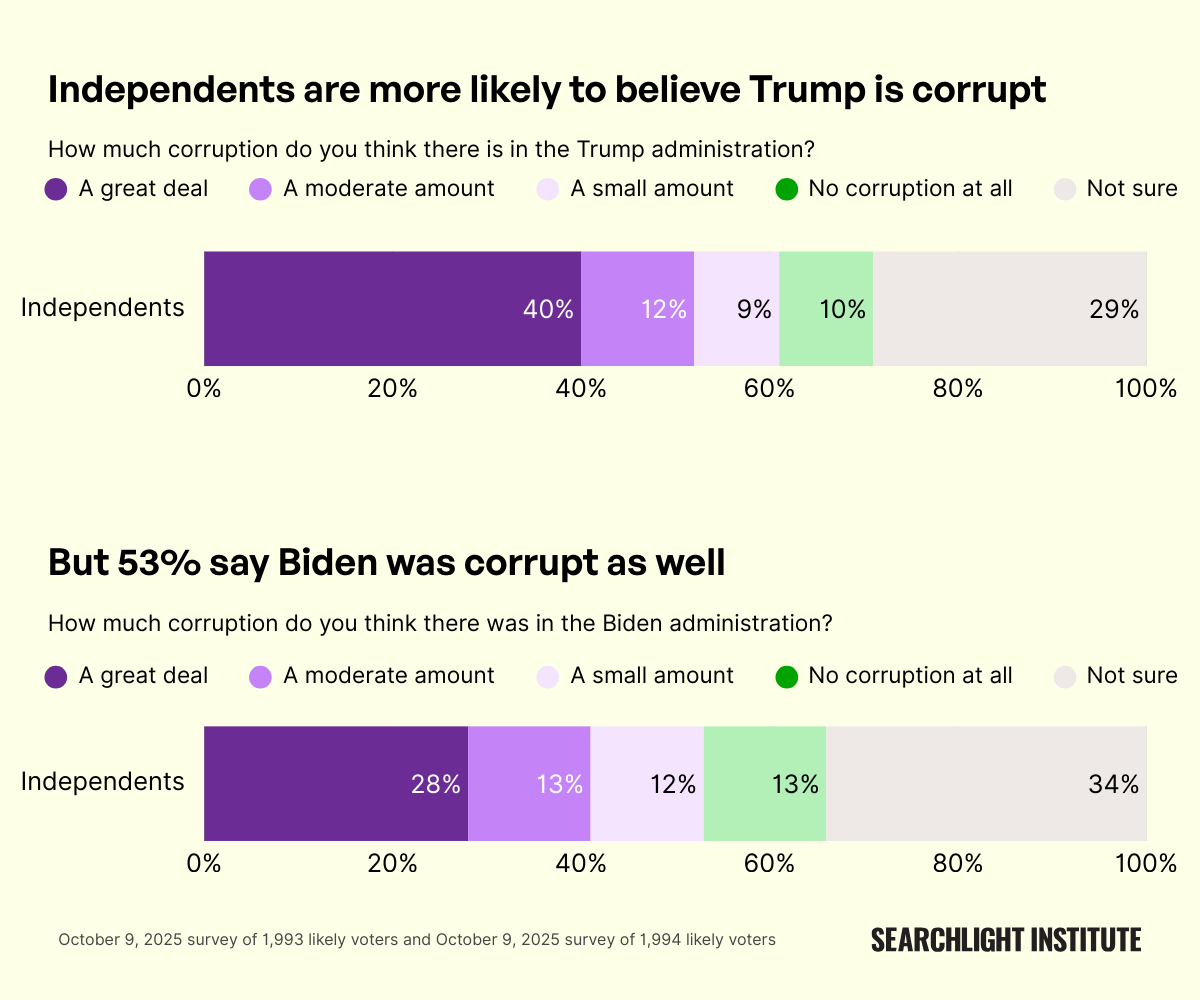
We explicitly asked about Biden’s corruption as compared with Trump’s. Trump is seen as more corrupt, though not by a large margin (48% vs 40%). Both are perceived as enriching their families first, followed by their donors and parties. Some Democrats are very sure Trump is seen as maximally corrupt by the American people and the electorate. This is not the case in our data: The gap between perceptions of Trump and Biden is notable, but not massive. Partisanship is a big factor here, but doesn’t explain everything. Less than a majority (47%) of Independents think Trump is more corrupt, and a narrow 9% of Republicans say the same. There is little agreement on Trump being highly, obviously corrupt — except among Democrats.

There are also signs that Democrats have lost faith in their own party: 39% of Democrats think the Biden administration was at least a little corrupt. This percentage matches the share of Republicans who think the Trump administration is at least a little corrupt. The cynicism is certainly worse when it comes to the opposing party, but not limited to it.
Conclusion
Voters seem to have a deep skepticism of the people who choose to run for and hold elected office. They want concrete reforms in place that ensure politicians do not abuse their power for personal financial gain — and measures that discourage politicians from clinging onto office despite concerns over age or physical and mental decline.
But trust in government remains at record lows for a reason. Elected officials are constantly identified in corruption probes. Older politicians, some with serious health concerns, remain in office despite an inability to fully serve constituents. Many members of Congress refuse to hold town halls in their districts, and the very idea of term limits continues to be hotly debated among politicians themselves.
The American public’s overall perception of corruption in government did not spring up overnight — it is the product of many decades wherein corruption has become rooted in the actions of many leading politicians in the country. To address voter concerns of corruption, elected officials have to take serious responsibility and adopt reforms that actually reduce corruption — not simply the perception of it. Only then will the trust deficit in government begin to close and more Americans will begin to have faith in the political system.
Methodology
Tavern Research conducted two surveys on behalf of Searchlight: One survey was conducted among 1,993 likely voters on October 9, 2025; another survey was conducted among 1,994 likely voters on October 9, 2025. At a 95% confidence level, the margin of error for the first survey is +/-3.6 percentage points and the margin of error for the second survey is +/-3.4 percentage points. The surveys were fielded over web panels and weighted by gender, race, education, 2024 presidential vote, and age. Respondents were also weighted by whether they passed attention checks.