
A Generational Pullback From World Affairs

In the first installment of “Reconsidering America’s Role in the World,” a multipart series analyzing the current state of how the American public views the country’s national security and foreign policy priorities, we established how the old axiom that politics stops at the water’s edge no longer applies. This piece, the second in that series, explores how public opinion on American involvement on the world stage may coalesce in the future.
Americans are divided across party lines on almost every aspect of national security and foreign policy. However, there is one point of agreement: Across the political spectrum, voters are signaling a clear desire for the United States to scale back its global footprint and turn inward. That sentiment is especially strong among voters under 35, which suggests that a new bipartisan consensus around anti-interventionism could develop — should generational trends hold.
Priorities
Foreign policy ranks at the bottom of voter priorities. When asked to rate how important various issues should be for the president and Congress, voters put the cost of living (76% calling it an extremely important priority), healthcare (63%), and national security (58%) at the top. Foreign relations (41%) and foreign trade and tariffs (37%) sit near the bottom of the list, ahead of only climate change (35%). The pattern is consistent across parties — neither Democrats, Independents, nor Republicans rank international issues among their top concerns. Importantly, when voters rank national security as a top issue, they are considering national security to include border security and other domestic matters, and not to be a broad international issue. In context, this poll was run during the early days of the Iran war, so it is particularly surprising that voters do not prioritize foreign policy, even during wartime.
Voters express again and again that they want the government to focus on the homefront. By a +24-point margin, voters prefer focusing on problems at home versus maintaining America’s leadership and engagement with the world. The preference is bipartisan: Democrats (+27), Independents (+32), and Republicans (+19) all want to focus on domestic issues. When voters are asked to choose between protecting America’s economic interests and promoting democracy and human rights abroad, only Democrats support promoting democracy (+3), and all other voters favor American interests (+28 among all voters, +59 among Republicans). Humanitarian aid has even sharper divisions, with Democrats favoring global health and aid programs (+27), and Republicans wanting to help Americans instead (+44). It’s notable that Democrats are most interested explicitly in nonmilitary interventions — the exact programs that Republicans are most likely to oppose.
Voters don’t want the U.S. to step off the world stage entirely, and only very small numbers think the U.S. should have no role (8% of Democrats, 11% of Independents, 5% of Republicans). They are, however, not very interested in the U.S. taking a leading role (only 17% prefer a leading role). The prevailing sentiment seems to be that voters want the U.S. to work with its partners but not take on greater responsibilities out of a sense of duty to the rest of the world.
Young People
Younger voters are more focused on domestic issues than older voters. The ideals of America as a world leader seem to be losing strength generationally. Voters aged 18-34 are 10 points more likely than voters 65+ to say that we should focus less on world affairs. They’re more anti-war as well, saying the focus should be on keeping America out of wars (net +40) compared to the 65+ group (net +21). Younger voters are also more concerned about the prospect of America being taken advantage of by allies (+23, compared to +13 among older voters). They seem to be skeptical of the function of the international order, and are worried that the U.S. is being asked to do too much.
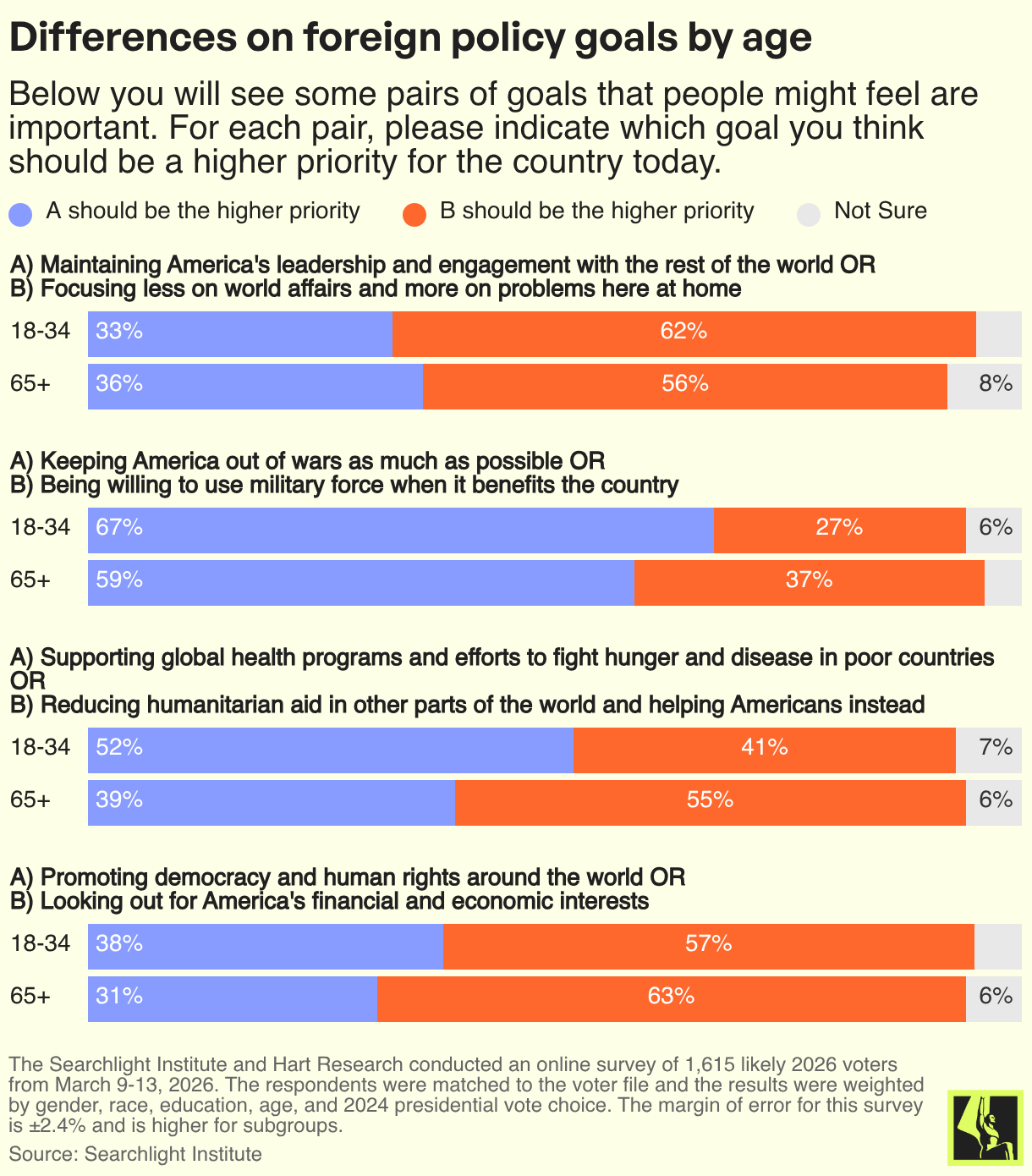
However, young people exhibit greater support for humanitarian aid and nonmilitary interventions. On global health and anti-hunger aid, voters under 35 favor maintaining humanitarian programs (+11), while seniors want to redirect that aid home (-15). The split on military spending is even sharper: 48% of young voters say the U.S. spends too much on the military, compared to just 24% of seniors, and seniors are roughly twice as likely to say the U.S. doesn’t spend enough (24% vs. 10%). On the trade-off between military spending and domestic priorities, young voters favor reducing military spending to increase domestic spending by an 11-point margin, while seniors favor military spending over domestic priorities by a 23-point margin. The fact that young people support more humanitarian aid while supporting reduced military spending presents a complicated picture of American opinions on foreign policy.
Young voters want a smaller, less military-focused American footprint, with less spending, less war, and less intervention, but more humanitarian engagement and a stronger focus on human rights. Meanwhile, older voters want a more antagonistic posture toward adversaries, particularly Russia, with national security and military strength as key values. Both groups want to focus on problems at home, but they’re motivated by different worldviews and perceptions of threats.
Russia and China
Both younger voters and seniors view Russia as the greatest threat to the United States, though older voters are more likely to rank it as a threat than younger voters (65% versus 55%, respectively). There is an even more significant divergence regarding perceptions of China: 61% of older voters rank the nation as one of the top two threats to the United States, just behind Russia, while only 44% of younger voters say the same.
Seniors are holding onto the experience of American dominance in the 20th century, but young voters are not as motivated by those ideals. Voters across the board agree that the United States is stronger than China militarily, but younger voters (net +8) are more skeptical of the United States’ economic dominance than older voters (net +21). As such, voters across the board think we should resolve conflicts with China via cooperation, rather than trying to limit China’s influence. This sentiment is particularly strong among young people, who favor cooperation 62% to 29%, compared to the overall baseline of 50% to 40%.
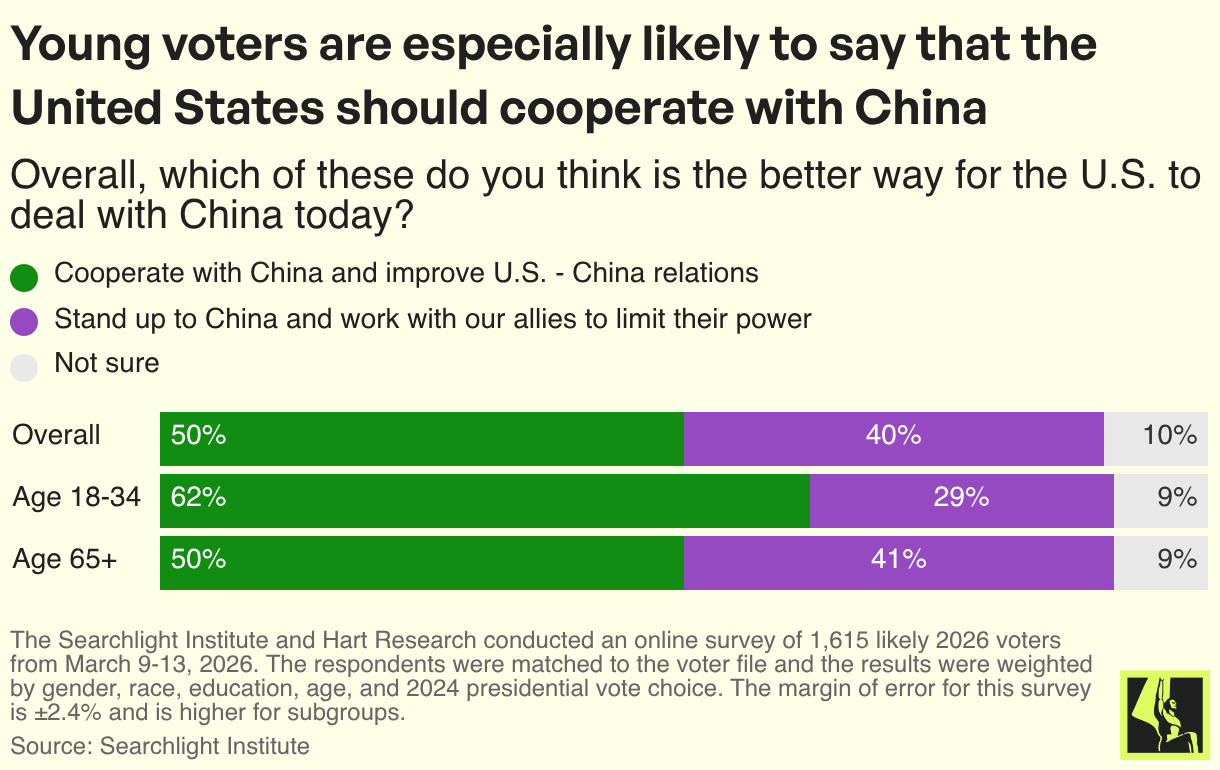
Russia is seen as the biggest threat by voters, and particularly by Democrats. There’s less of an appetite for cooperation with Russia, although 47% of young people still choose that option. Older voters are uninterested in cooperation: While a majority (50%) support cooperation with China, just 22% believe we should cooperate with Russia. Instead, the vast majority of seniors (70%) believe that the United States should stand up to Russia.
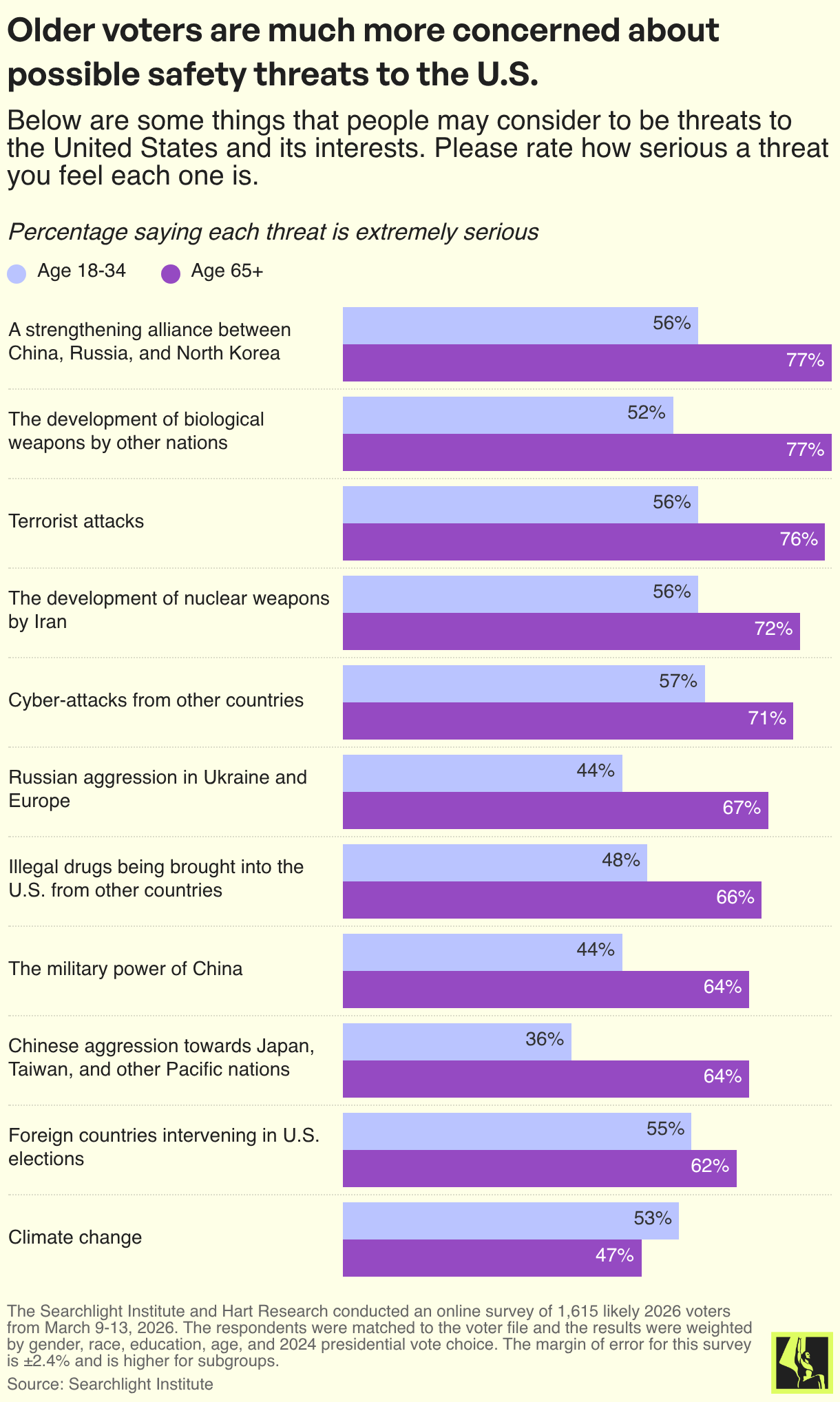
Older voters are generally more likely than younger voters to believe that threats to the United States, especially those involving Russia and China, are serious. Over three-quarters (77%) of older voters, compared to 56% of younger voters, say that a strengthening alliance between China, Russia, and North Korea is an extremely serious threat. Similarly, young voters are less concerned about the threat from America’s dependence on China for essential materials (53% younger / 62% older) and Russian aggression in Ukraine and Europe (44% younger / 67% older). In fact, when compared to older voters’ beliefs, the only issue that young voters believe poses a greater threat to the United States is climate change (53% younger / 47% older).
Conclusion
Americans are looking for a reduction in the role that the U.S. plays on the world stage. Majorities would prefer to keep the U.S. out of wars, and to focus on problems at home rather than maintaining America’s leadership in the world. Young people in particular feel less threatened by countries like China, and seek cooperation rather than aggression.
The age differences here imply that the push for more focus at home and less engagement abroad is likely to be an ongoing trend. However, this new generation wants to redefine isolationism. While younger voters oppose the use of military force, they also support humanitarian aid and international cooperation. How the U.S. engages abroad, and which countries it engages with, will be vital in shaping this new era of American foreign policy.
Methodology
The Searchlight Institute and Hart Research conducted an online survey of 1,615 likely 2026 voters from March 9-13, 2026. The respondents were matched to the voter file and the results were weighted by gender, race, education, age, and 2024 presidential vote choice. The margin of error for this survey is ±2.4% and is higher for subgroups.
This is the second of a series of posts, and the full toplines and crosstabs will be posted at the end.