
Reconsidering America’s Role in the World
Most polling on foreign policy and national security issues focuses on specific news of the day — particular countries, particular events, and so on. We wanted to avoid duplicating that work, and instead take a deeper look at how the American voter views the ways the U.S. interacts with the world. These fundamental beliefs drive how Americans react to new conflicts as they arise.
In addition, we were curious about the values that Americans are bringing to this policy area, and what they felt was most important. Voters are not always the most informed about the details of foreign policy and national security, but they have strong beliefs and preferences about their country’s behavior, which persist across events. This survey and series focus on those fundamentals.
America’s self-anointed post as the active — and occasionally interventionist — leader of the free world is in question. A ground war between Ukraine and Russia drags on while a political and moral reckoning on the homefront over the Israel-Palestine crisis only intensifies. President Donald Trump has plunged America into a war of choice with Iran after snatching the leader of Venezuela from a fort in Caracas. Trump has continuously lobbed threats against allies and neighboring states in a bid to manifest his own “Donroe Doctrine,” as he draws down the post-WWII troop presence in Europe.
The old bipartisan consensus on foreign policy is dead — and yet leaders today still struggle to meet the public where they are on the most central questions regarding foreign policy and national security.
Given the new, chaotic reality Americans watch on their screens and in the news each day, Searchlight surveyed the public on America’s role in the world. Almost every aspect of national security and foreign policy we tested showed dramatic partisan divisions. Politics no longer stops at the water’s edge.
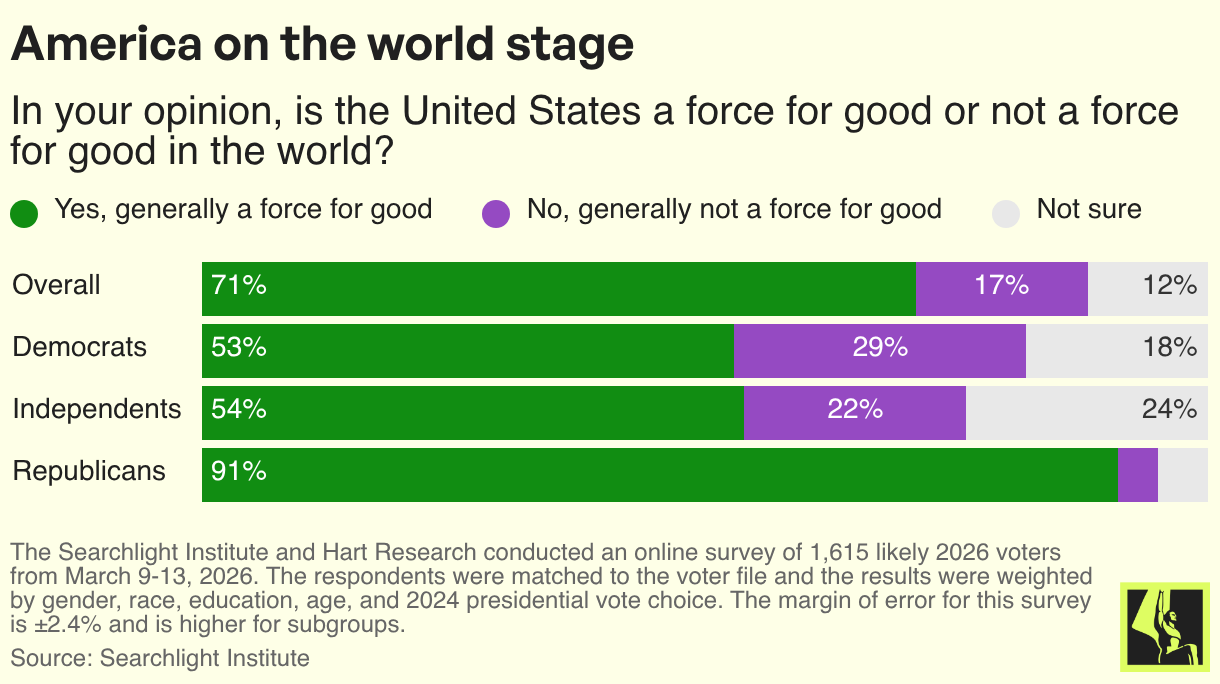
Nearly a third of Democrats (29%) say that the United States is not a force for good in the world. Republicans, likely due to their hold on the White House, are much more positive about the country: 91% say we are a force for good. At the same time, they also express some skepticism of America’s position in the world, with 23% saying they’re dissatisfied with it. Unsurprisingly, Democrats are overwhelmingly dissatisfied with America’s position in the world (85%).
Similarly, Republicans are far more likely to say that engaging with the world makes us more secure (albeit with a substantial 36% dissenting), while Democratic numbers are nearly the reverse (57% saying it makes us less secure). Much of this partisan division is likely a reaction to Trump’s specific policies and approach to foreign affairs. It is at the same time notable that there is little support for American foreign policy among those who dislike the current president, a deviation from generations past when attitudes reflected greater unity across party lines.
Republicans are also more likely than Democrats to say that the United States should play a major role on the world stage. Nearly twice as many Republicans (23%) as Democrats (12%) say that the United States should take the leading role in world affairs. While very few voters think we should take no role in solving international problems (8% of Democrats / 5% of Republicans), the majority land somewhere in the middle, saying the U.S. should take either a major or minor role (74% of Democrats / 67% of Republicans).
Policy Goals
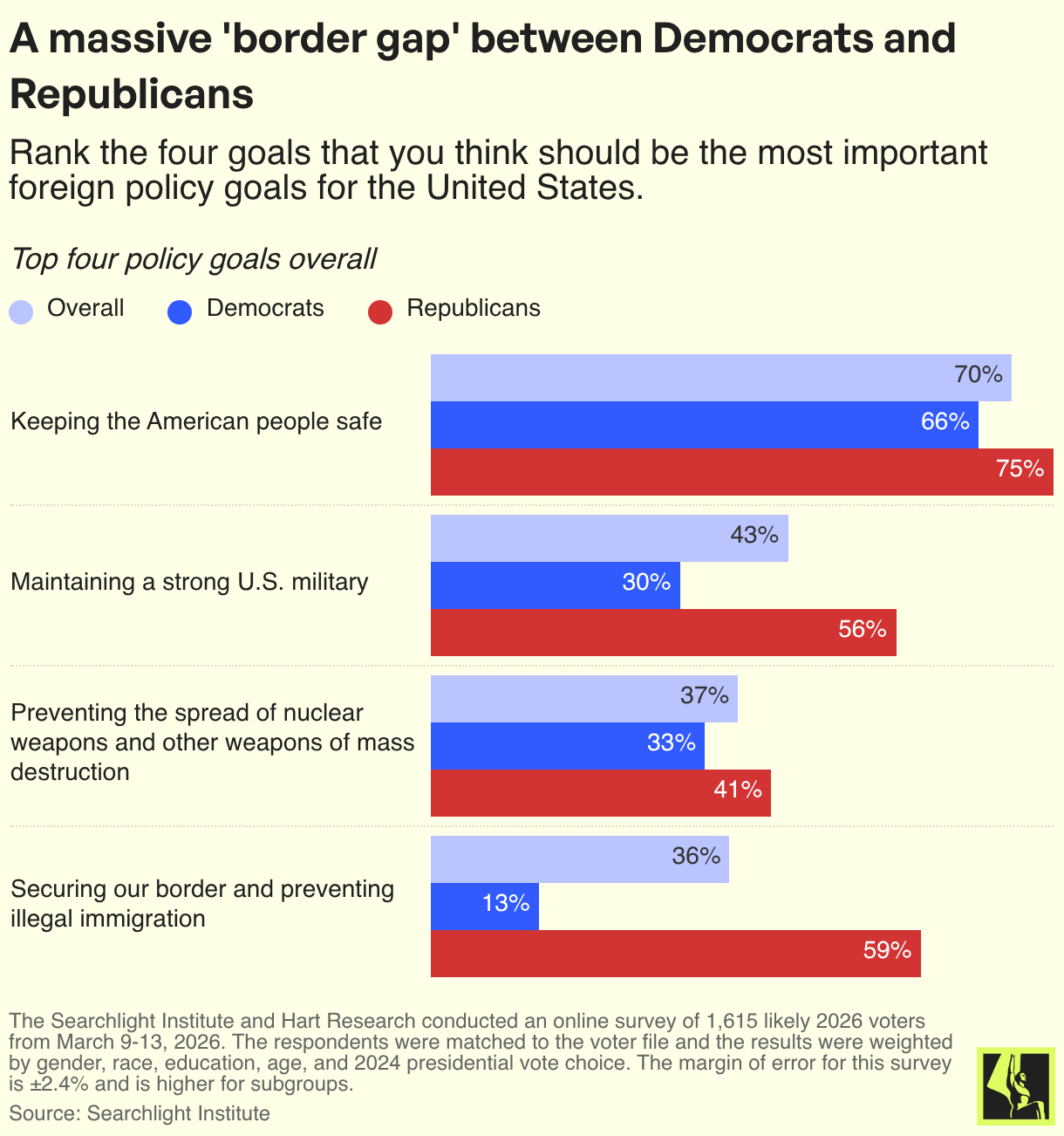
The most unifying policy goal is to keep Americans safe, with 66% of Democrats and 75% of Republicans putting it in the top four goals for foreign policy. However, the strategies to achieve this goal suffer from those same dramatic partisan divisions. Republicans prioritize securing the border and maintaining a strong military as the path to safety. Border security ranks second among 14 possible priorities for Republicans (and fourth among swing voters), but is ranked last by Democrats, who are more likely to prioritize keeping the nation out of military conflicts.
The electorate has several competing views of what safety and security means, directly tied to different perceptions of threats to the country, which we will explore further in a subsequent edition of this series. In a question about a wide variety of potential threats to the U.S., Republicans put illegal immigration on par with cyberattacks and biological terrorism, in distinct contrast with Democrats. On the whole, conservatives are much more likely to perceive any given threat as “extremely serious.” Some of the partisan division may be accounted for by the fact that conservatives view the world as far more dangerous than liberals do.
When voters are asked directly about how to promote security, we also see enormous partisan differences. Democrats strongly prefer diplomatic solutions, while Republicans are more torn between diplomacy, investing in domestic defense, and using the military to promote stability in other parts of the world. Neither group thinks economic policy like tariffs and sanctions are particularly effective.
Republicans are much more likely than Democrats to say that national security is an extremely important priority (71% of Republicans / 46% of Democrats). Importantly, some Republicans may be answering that national security is a priority because, to them, national security means immigration control and border security. There is a large gap in the percentage of Republicans who say that national security is a priority (71%) and the share who say that foreign policy and America’s international relations is a priority (45%). Democrats say that national security (46%) and foreign policy (40%) are both important priorities at similar levels.
Differing Approaches to Foreign Policy
We also see major differences when it comes to the specific actions and policies that Democrats and Republicans think the United States should prioritize in foreign policy. Republicans, in general, take positions that might risk military action, as long as those actions make the United States more secure. Democrats, on the other hand, are more willing to settle for a lower level of security for the United States to keep the country out of wars and allow for more diplomatic relations with other countries. Around 4 in 5 Democrats (81%) say that keeping America out of wars as much as possible should be the priority over being willing to use military force when it benefits the country (14%). Conversely, Republicans support the willingness to use military force (53%) over an explicitly anti-war policy (41%).
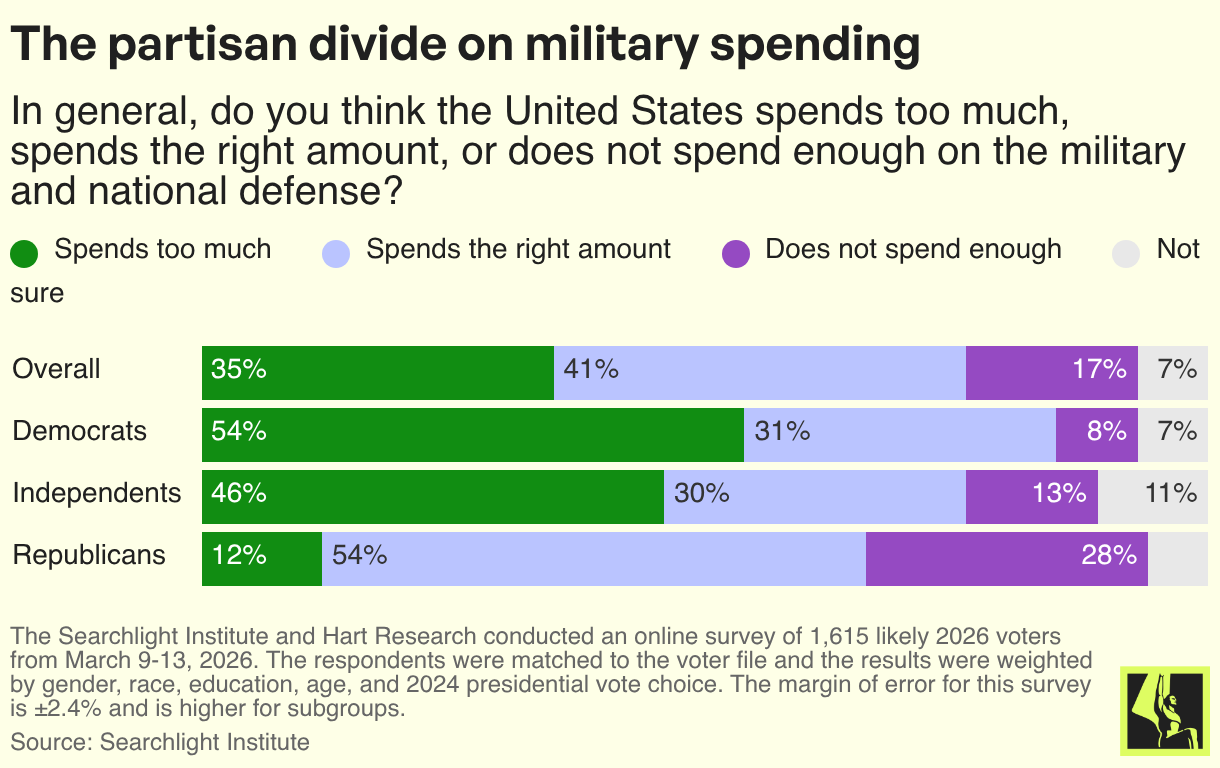
There is acute disagreement on military and national defense spending. The overall topline (35% say we spend too much, 41% say we spend the right amount, 17% say we don’t spend enough) obscures the difference by party: 54% of Democrats think we spend too much on the military and national defense vs. just 12% of Republicans. Meanwhile, 28% of Republicans think we don’t spend enough vs. 8% of Democrats. There is no Democratic coalition for increasing funding, and barely one for maintaining funding at the current levels. At the same time, there is no Republican appetite for cutting spending.
Democrats are also much more supportive of free trade policies, while Republicans want to prioritize American businesses — very likely a reaction to Trump’s policies. To that end, Republicans believe that stopping countries from taking advantage of the United States (65%) should be a higher priority than strengthening America’s ties to friends and allies (32%), while Democrats believe the opposite (18% stop countries from taking advantage / 78% strengthen ties to allies). Democrats are also more likely to say that promoting free trade with other nations (68%) should be a higher priority than protecting U.S. companies from foreign competition (21%) than Republicans are (31% promoting free trade / 61% protecting U.S. companies). Similarly, while Democrats are essentially split on whether lawmakers should prioritize promoting democracy and human rights around the world (48%) or looking out for America’s financial and economic interests (45%), Republicans show a clear preference for putting America’s interests first (19% promoting democracy and human rights / 78% looking out for America’s interests).
Where Are Partisans in Agreement?
As discussed, both parties think that American security is very important. They’re also on board with a general retreat from international affairs. A majority of Democrats and Republicans prefer “focusing less on world affairs and more on problems here at home” (60% Democrats / 57% Republicans) to “maintaining America’s leadership and engagement with the rest of the world” (33% Democrats / 38% Republicans). Neither party is interested in expanding military aid to other nations (14% of Democrats and 13% of Republicans say the U.S. should be more involved here).
There’s also approximate agreement about the “brands” of the two parties. Democrats are seen as less interested in conflict, more interested in diplomacy, and more likely to keep America out of wars, both by their own partisans and by Republicans. The division here is that Republicans view these traits as negatives. Unlike some other issues where there can be broad disagreement about what party positions actually are (i.e., Democrats think Democrats don’t focus on climate change very much; Republicans disagree), here the party positions are widely understood. The issue isn’t confusion — it is conflicting priorities.
Methodology
The Searchlight Institute and Hart Research conducted an online survey of 1,615 likely 2026 voters from March 9-13, 2026. The respondents were matched to the voter file and the results were weighted by gender, race, education, age, and 2024 presidential vote choice. The margin of error for this survey is ±2.4% and is higher for subgroups.
This is the first of a series of posts, and the full toplines and crosstabs will be posted at the end.