
When it Comes to Energy Policy, Voters are Most Worried About Costs
Cost of living is the dominant issue this midterm cycle. With gas prices, household utilities and the cost of transportation all skyrocketing, we wanted to understand voters’ opinion on energy policy. How did they balance low energy prices with fighting climate change? What policies did they think would make their personal energy costs decrease? What is motivating the opposition to the data center buildout?
We also asked voters about permitting reform. This polling was conducted prior to the announcement of the Senate’s recent bipartisan permitting reform deal, but it provides important information about the salience of the issue as the midterm election approaches.
Clean Energy Prices
A majority of voters (55%) say that fighting climate change and lowering energy costs can happen at the same time, compared to 26% who say that fighting climate change means that energy costs will go up. Importantly, opinion is divided on partisan lines. Seventy-seven percent of Democrats (net +65) say that addressing climate change and lowering energy costs are compatible, just 35% of Republicans (net -4) say the same.
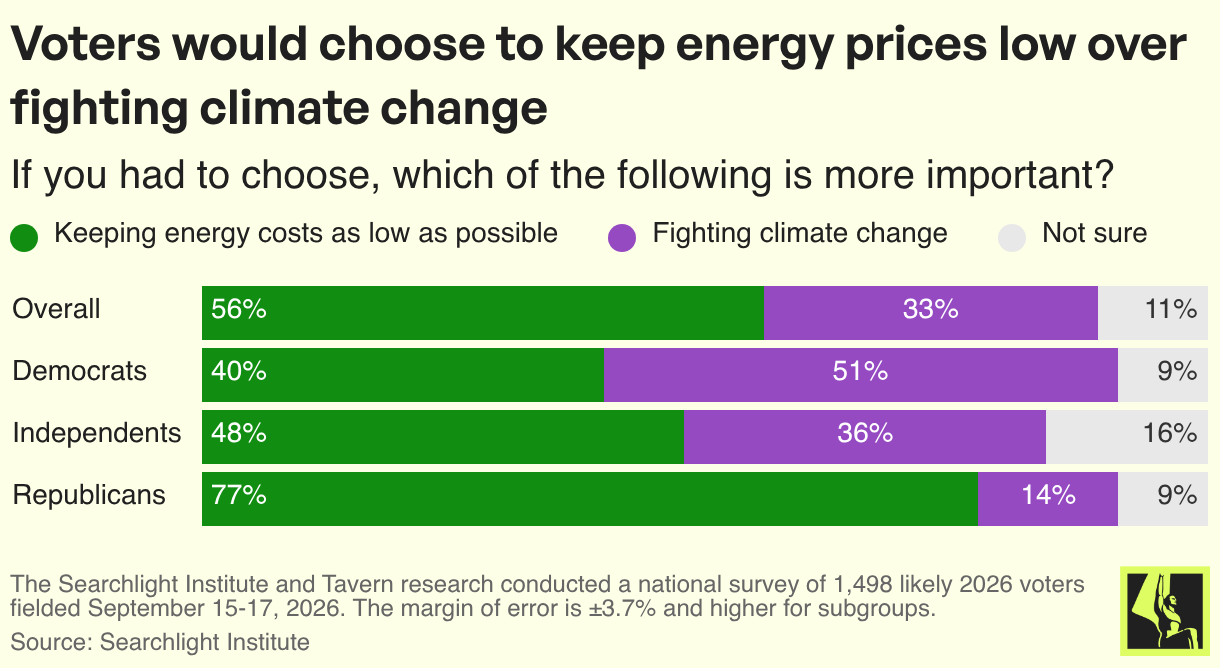
When forced to choose if it is more important to keep energy costs as low as possible or to fight climate change, 56% of voters chose the former. We see the same partisan divide with a slim majority (51%) of Democrats preferring to prioritize climate change while a large majority (78%) of Republicans are more concerned with energy prices, though 40% of Democrats prioritize keeping costs low.
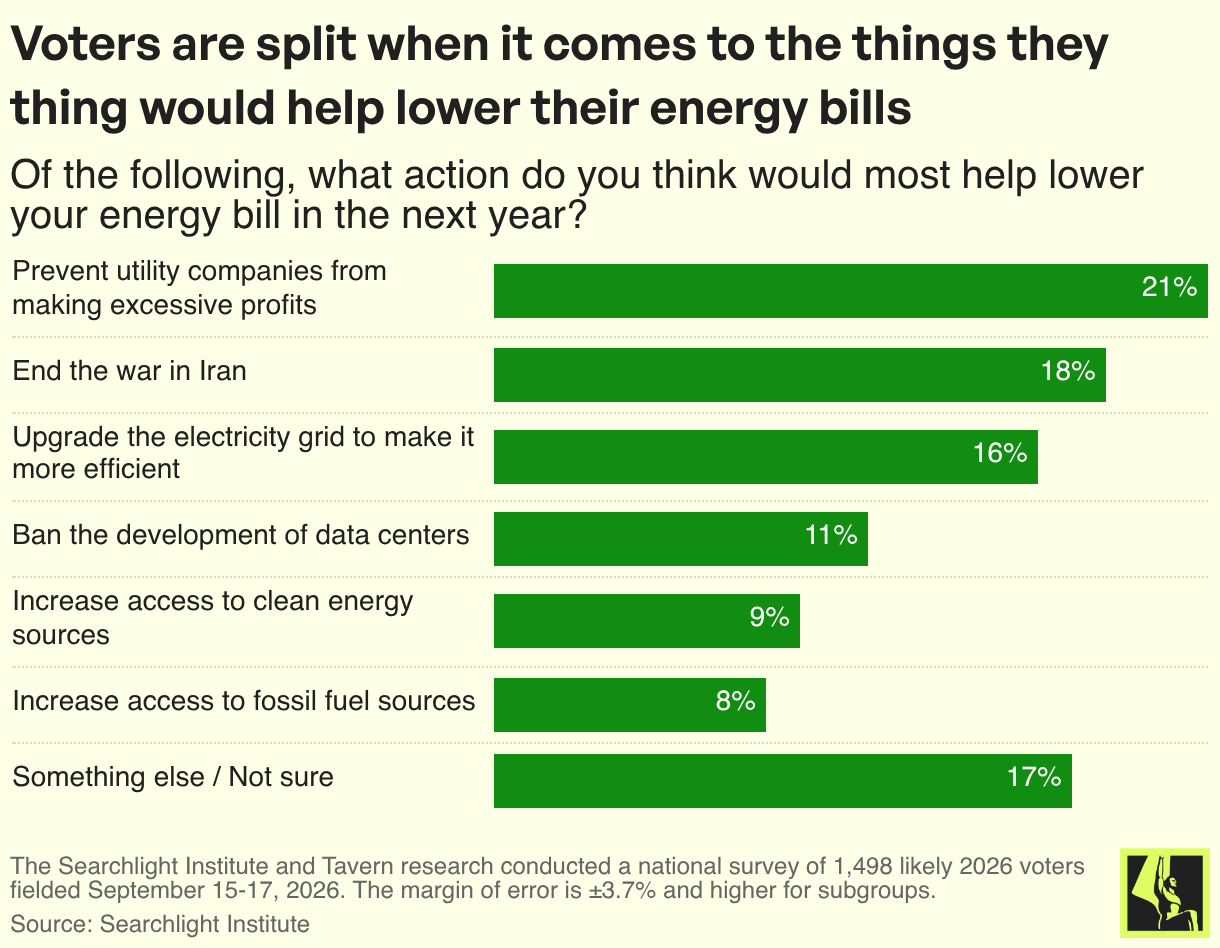
Nearly everyone (96%) says that their household’s electricity bill has either gone up or stayed the same over the past year. But voters do not agree on a single policy that will lower their energy bills. Voters are roughly split between curbing excessive utility profits (21%), ending the war in Iran (18%), and improving grid efficiency (16%). Meanwhile, only 11% say banning data centers.
Energy Independence
Voters support energy independence and nearly two-thirds (63%) say we currently rely on other countries for the materials needed to build clean energy technology. While they are especially concerned about dependence on China (net +53 concerning), they don’t like the idea of relying on any country — even friendly countries like Germany —for materials needed to build energy infrastructure (net +40 concerning).
Three-in-four (74%) voters, including majorities of Democrats (69%) and Republicans (82%), think that the United States is in competition with China to build data centers and AI. A plurality of voters overall (41%), and a majority of Republicans (58%), say that competing with China to lead in AI is a national security priority for the United States. Another 19% of voters agree that competing with China to lead in AI is an economic priority, but not a national security issue.
Data Centers
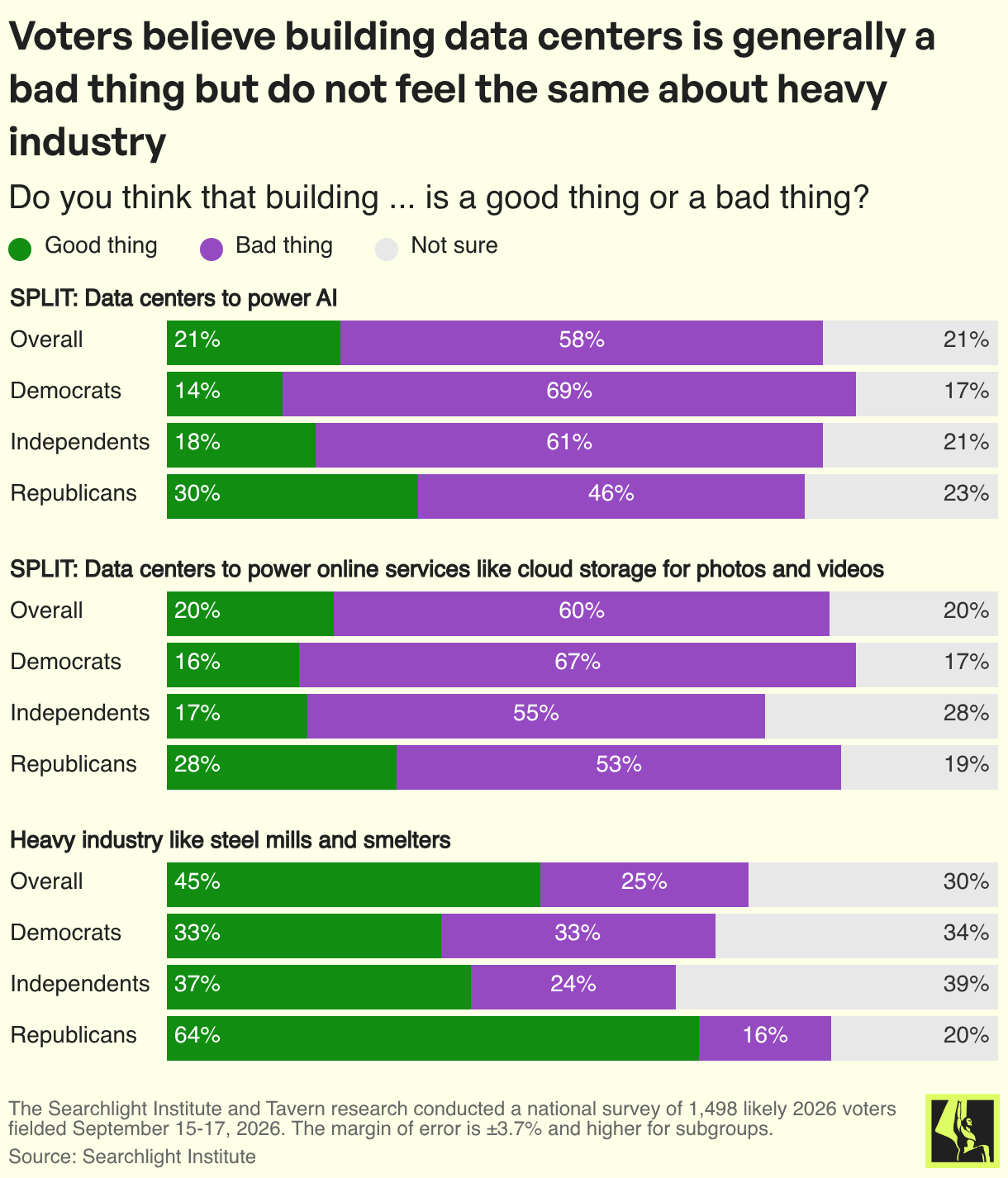
The data center backlash is real. A majority of voters say that building data centers to power AI (net -37) or to power online services like cloud storage (net -39) is overall bad. Importantly, this is not solely a NIMBY impulse, as voters are much more likely to say that building heavy industry like steel mills and smelters are a good thing (net +21). Voters overwhelmingly oppose building data centers to power AI in their area (17% support, 65% oppose). Democrats are more likely to disapprove (11% support, 74% oppose) than Republicans (27% support, 54% oppose). Voters overwhelmingly believe that the companies that own and operate data centers (71%) should be responsible for paying for the electricity that data centers use over the government (9%) or all electricity customers in the form of higher bills (7%).
Grid Reliability and Updates
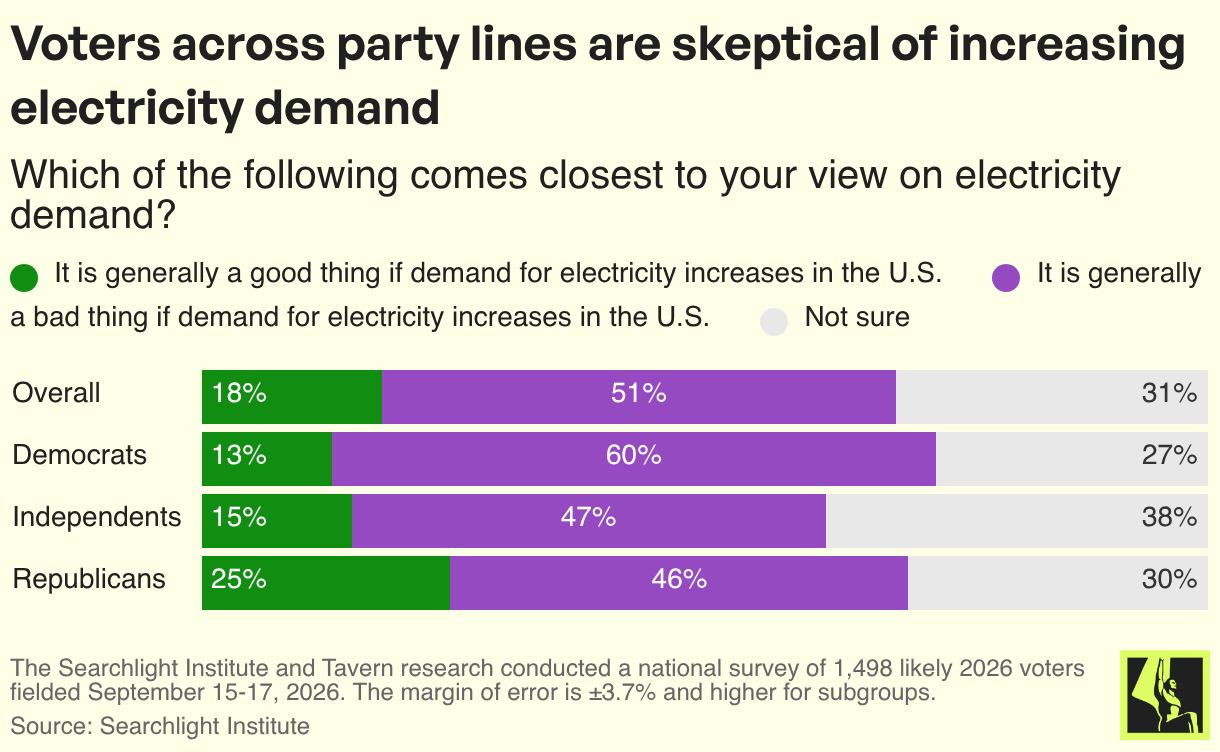
Voters say they currently have very reliable access to electricity, but also think increased electricity demand is bad. Seventy-nine percent of voters say that their electricity is at least somewhat reliable and a majority (52%) said that within the past year they have not experienced any of the electricity disruptions that we tested, like rolling blackouts or extended power outages. Despite the high levels of satisfaction with electricity performance, a majority of voters (51%) say that it is generally a bad thing if demand for electricity increases in the U.S. Fewer than one-in-five (18%) said that increasing demand for electricity is generally a good thing.
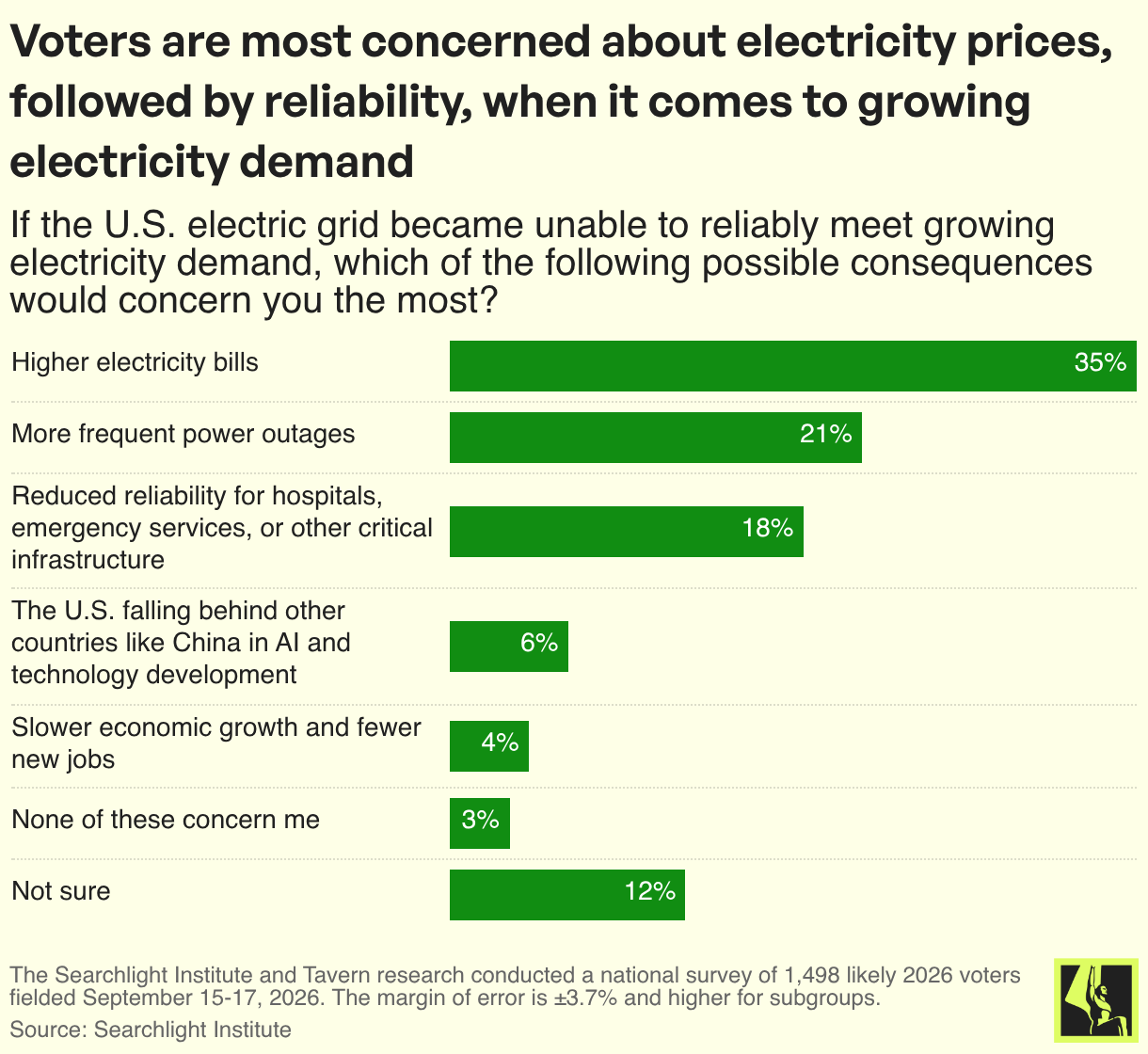
Voters from across the partisan spectrum do not have confidence that the U.S. electricity grid can reliably handle the added demand from AI and data centers (29% confident, 53% not confident). The consequence of added demand from the grid that concerns voters the most is higher electricity bills (35% overall, 39% Democrats, 36% Republicans) followed by more frequent power outages (21% overall) and reduced reliability for hospitals, emergency services, and other critical infrastructure (18% overall).
When forced to choose, a majority (57%) of voters say that a power grid that cannot keep up with demand is a bigger problem for America’s national security and economy than simply a personal inconvenience (21%).
Voters think the companies owning and operating the electric grid should be responsible for updates (39%), followed by the federal government (18%), and big tech companies (17%). Just 5% of voters think that the responsibility should fall on all electricity customers in the form of higher bills.
Growth and New Projects
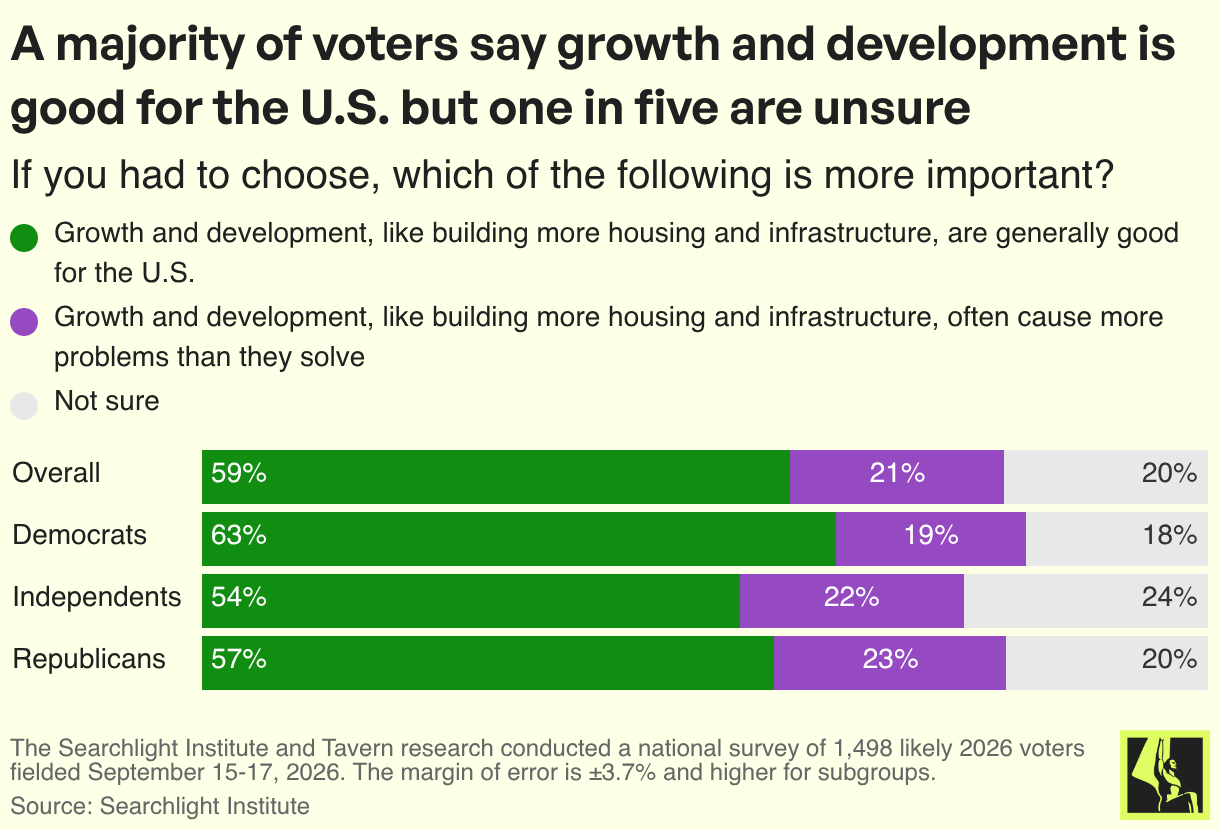
A majority of voters (58%) say that growth and development, like building more housing and infrastructure, are generally good for the U.S., but 21% of voters disagree and another 20% say that they aren’t sure. On permitting, just 28% say we should speed up the reviews to build new energy infrastructure even if it means less community input, while 48% say that the current review process should be kept as is to protect environmental and community concerns.
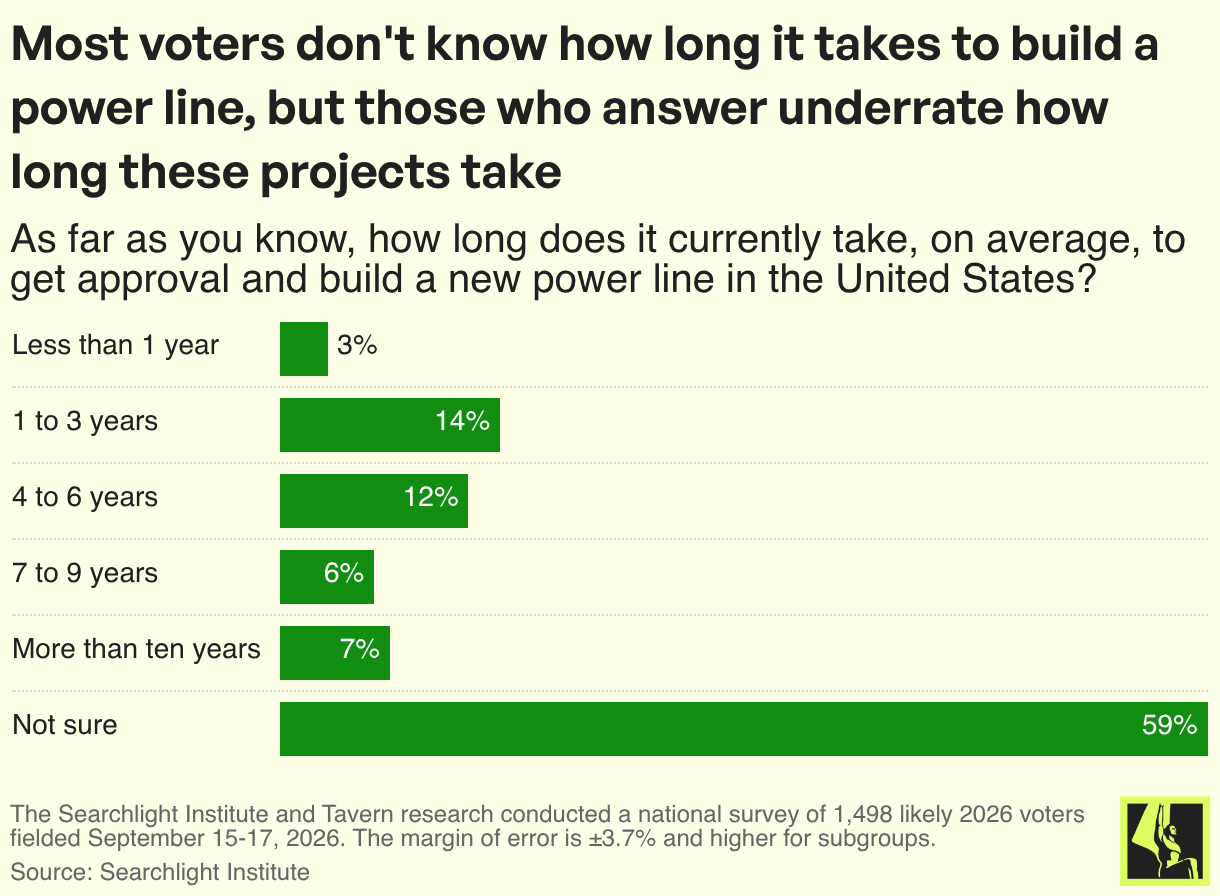
Most voters are not clued in to how long it takes to build major pieces of infrastructure. A majority (59%) of voters say they are not sure how long it takes for a power line to be approved and get built. Those who do answer the question generally significantly underestimate the length of time it takes (most frequently selected answers: 1 to 3 years or 4 to 6 years).
Responsibility
Voters do not trust the federal government to manage major long-term projects like modernizing the grid and would prefer state and local governments to manage these projects. Voters’ confidence in the federal government is underwater (net -25) and barely positive for their state government (net +5). Given these low scores, it is perhaps unsurprising that a plurality (27%) of voters say that private electricity and utility companies should lead the project of modernizing the grid.
Conclusion
Ultimately, the biggest energy issue for voters is cost. They know their electricity bills are increasing and they would prefer lowering costs over fighting climate change. They are split on the exact policies that would actually accomplish this, but would like the government to crack down on utility companies, end the war in Iran, and update the grid.
On permitting reform, voters do not support reducing community input to advance energy infrastructure, but they also do not understand the length of time it takes to build transmission lines. Additional research should look at how voters’ views change once they understand the problem in the permitting system.