
Weaving the Social Safety Net
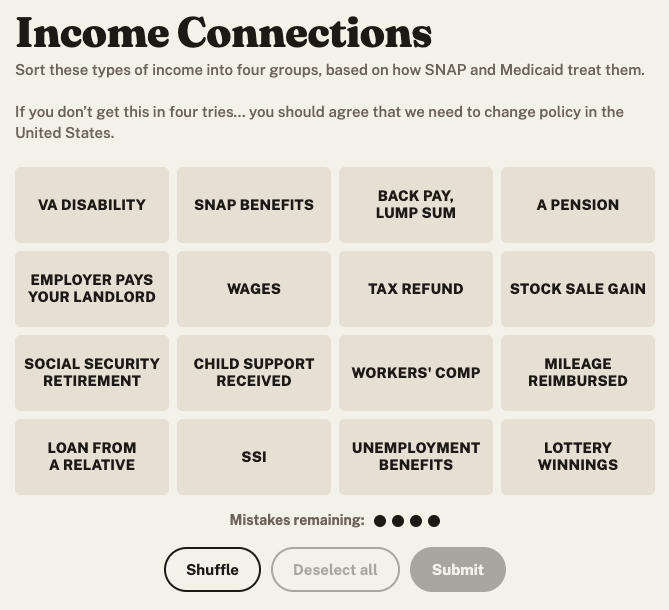
Try our “does this income count as…” version of Connections
Imagine this scenario:
Mirabel loses her job on Tuesday. By the end of the month, she needs to file for unemployment, get food assistance, find new health coverage, cover an unexpectedly high heating bill, and figure out how to sign her kids up for free school lunch. This means filling out at least five applications across five different agencies, all asking her approximately (but not exactly) the same questions.
Despite claims to the contrary, an evil guy on the 12th floor did not purposely design this byzantine maze to punish Mirabel. Rather, no one designed the safety net at all; every program only sees and cares about its own silo. This “safety net” was built up over more than 200 years by appropriations committees, agencies, federal budget accounts, programs, levels of government, and CIO dominions. In 2018, when our co-author Amira was the head of customer experience at the Office of Management and Budget (OMB), she interviewed a mother of a child with Down syndrome as part of one of the first “life experience” pilots. That mother described her reality: “In America, you have to weave your own safety net.”
When Marina became chief technology officer of the Department of Veterans Affairs in 2013, the VA had an enormous number of websites (over 1,500!), each built by individual offices with their own budgets, eligibility criteria, claims processors, claims processing software, databases, logins, forms, contracts, and contractors. Veterans could not reasonably be expected to navigate it all, and they demonstrably couldn’t. Marina set out to achieve the goal of creating a one-stop shop. And she did it! Today, veterans can find and manage most of their federal veterans’ benefits at VA.gov.
VA.gov is a good place to start an application for multiple programs — but what happens after someone presses submit remains largely unchanged. The underlying broken parts of the VA benefits systems are just harder to see because the site is functional and beautifully designed. For the applicant, this might actually be worse than the old mess. Back when they used to get stuck at the first step of what they knew to be a separate process, at least they knew they were stuck; now they get stuck six weeks later, deep inside a process they thought they’d already finished, with no idea which of four offices has their file.
Just last month, the current administration launched “America.gov,” the first AI front door to the federal government. It’s easy to use and intuitive, but it ultimately will do nothing to fix the fractured benefits system at the VA or help someone like Mirabel.
In our experience building consolidated websites, “one-stop shops,” portals, and front doors is the easiest part. When Mirabel asks the America.gov chatbot for assistance, she’ll still be battling multiple applications, processes to track, and benefits to manage and renew at different times. She’s still weaving her own safety net, even if she can search it more easily. Since 1993, every federal administration has promised Americans a one-stop shop for dealing with their government, and each built a website instead. “Integrated benefits” and “one-stop shop” and “portals” have long described the same hope: weaving the safety net together so people can easily access all the help for which they’re eligible, without having to fight five agencies, and with more efficient machinery behind the scenes.
Our report, published by the Searchlight Institute as part of the Tech Viaduct project, documents these efforts over the past three decades — and details what it would take to actually improve the way public benefits are delivered to the American people.
For years, civic technologists have been brought in to fix digital services in the hope that if we just clean up the front end, we can make government work better for people. We’ve tried it and have made important progress. Agencies have spent hundreds of millions of dollars in the process. Now, we’re calling an audible: we need to stop fiddling with websites and do the hard policy work of actually streamlining program administration.
What trips up most people navigating benefits is everything after the application: a certification interview you couldn’t get off work for, a recertification notice that went to your old address, an hour of overtime that makes you ineligible for a benefit without your realizing, and a caseworker demanding a calendar of how often you prepare food with your roommate. A better application form doesn’t touch any of that.
In contrast, a shared eligibility engine that can automate enrollment across programs, or proactive automatic enrollment, does improve things, because they meaningfully fix the underlying processes instead of tidying the front end. In Canada, for example, individual tax filing enables the federal government to automatically assess eligibility for several federal and provincial benefit and credit payments using reported net income.
Government shouldn’t keep pouring its money and best people into the interface layer, which private entities (and, yes, AI) can do increasingly well. On the other hand, government is the only entity that can determine eligibility criteria, reconcile them, authoritatively affirm facts, resolve the cases the rules don’t cover, and deliver benefits. That’s where lawmaker and agency time and investment belong.
The objective is speed and efficiency. An unemployed worker like Mirabel needs to receive benefits quickly, so she can recover quickly — and therefore have no more need for benefits.
To us, the goals are:
- People should only have to tell the government information once.
- Government shouldn’t do work twice (or more); if it is already adjudicating your eligibility for a certain benefit, it should determine everything for which you are eligible.
- When you are eligible, you should get it — automatically (unless you opt out).
There are numerous examples of the US government achieving those goals. For instance, there is the Express Lane Eligibility for children to remain connected to support, ex parte Medicaid renewals that keep eligible people automatically covered, and direct payments during the pandemic. But these efforts have been patchwork and siloed, not a top-down mandate or an empowered strategic effort across programs.
This mission could be a uniquely transpartisan effort because the status quo serves no political faction’s policy priorities. For conservatives concerned about waste and fraud, adjudicating the same facts separately in every program is maddeningly expensive for federal, state, and local budgets alike; scammers thrive in this chaos. Done well, streamlining will combat fraud by using more real-time data, reducing administrative errors, and enabling real fraud to stand out. It would also eliminate the overhead of running the same verification in a dozen places, and free caseworkers from low-value processing to focus on the critical human judgment work only they can do. For liberals who care about building a robust welfare state, this will get people what they need, fast enough to actually help.
This requires a commanding presidential directive that holds agency heads accountable for these goals and directs them to find every possible pathway within their power to achieve them. This will involve clearly articulating necessary statutory changes and collaborating with Congress along the way. We outline four concrete actions to begin this work:
- Documenting every program’s eligibility criteria in a common format, at every layer from federal statute down to state and county policy;
- Establishing and enforcing one authoritative source for every fact the government needs (like “income”) to make a determination;
- Reconciling criteria / definitions so they can be answered by the authoritative source;
- Validating that the systems administering these programs actually implement the law, by turning manual compliance reporting into automated testing.
Do those four things, and we fundamentally change the machinery behind America’s benefits system. More to the point, most eligibility determinations can be made without requiring Americans to submit an application at all. If every criterion a program uses — such as those involving income, residency, and other demographic factors — can be answered automatically by an authoritative government data source, then the program can proactively answer its own eligibility questions, the way the Social Security Administration enrolls everyone receiving retirement benefits in Medicare at 65. Criteria that can’t be answered that way should be moved up to a population level (free lunch for the whole school), rewritten to accept already adjudicated information, dropped, or (a much smaller set) handed explicitly to a human with the authority to adjudicate.
With objective published criteria, reliable automated authoritative sources, and a test suite every system must pass, the envisioned purpose of America.gov can be realized without much effort on the public interface. The lion’s share of effort instead needs to be dedicated to standardizing what only the government can affirm: the program rules, the verified facts, and processes for secure payment.
Before the United States House of Representatives, on June 20th, 1848, then-Representative Abraham Lincoln said: “Determine that the thing can and shall be done, and then we shall find the way.” After more than a decade trying to make services work better for people, we’re convinced it’s not about working harder, smarter, or with fancier technology. While important, that work has absolved our government from taking on the hard but crucial part. Political leaders must make a choice to make government work for people like Mirabel.