
Voters Want Predictability, Lower Costs, and Some Government Involvement in Health Care
Health care reform in the U.S. exists in a contested policy landscape. Voters have a very dim view of the health care system, mostly because of high costs. At the same time, voters have a positive opinion of their own health insurance and health care providers. This perception gap means that executing sweeping changes to the system will be particularly challenging. Even though voters do not trust the federal government, they still see it playing an important role in the health care system. While there is not an appetite for a full replacement of the current system with one that is completely run by the government, most voters think the government has a responsibility to ensure everyone has access to insurance and care.
The Current Health Care Landscape
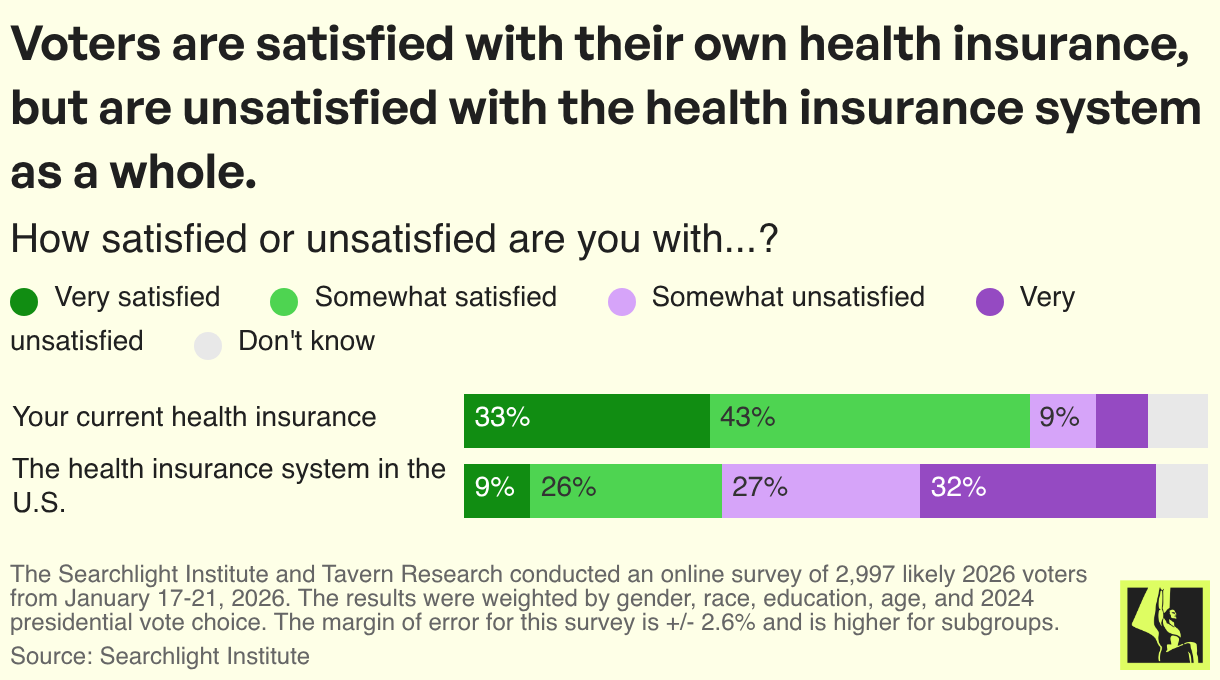
Voters view their own health care experiences very differently than they do the health care system at large. Over three-quarters (76%) of voters say that they are satisfied with their current health insurance, with one-third (33%) answering that they are very satisfied. However, when voters are asked about the health insurance system in the U.S., their opinions take a sharp turn. A majority (59%) answer that they are unsatisfied with the system, with nearly a third (32%) answering that they are very unsatisfied.
Voters, regardless of where they get their health insurance, generally say they understand their health insurance coverage and how it works. Even 73% of young people, who may be newer to dealing with insurance, say they understand it. At the same time, a majority of voters (51%) report that they feel like their health insurance coverage is constantly changing. Those who get insurance through Medicaid are most likely to see their insurance as stable (just 45% say it is constantly changing), while those who get insurance through the marketplace are most likely to say it is constantly changing (65%).
A majority of voters report that they have not skipped medical treatments due to cost. The most common action that voters take is skipping or delaying appointments (28%). Fewer voters say they have skipped filling a prescription (19%), taken less medication than prescribed (20%), or avoided the emergency room (22%) due to cost.
Notably, a larger share of voters do report needing to budget carefully in order to afford some of their medical expenses. Over a third (39%) say they need to budget carefully or go into debt to afford their monthly health insurance premiums, with 50% of voters who buy their health insurance on the marketplace answering this way. On top of their insurance premiums, voters report needing to budget or go into debt to afford out-of-pocket costs (34% budget, 16% into debt), and large or unexpected medical bills (27% budget, 46% go into debt).
Changes to the System and Tradeoffs
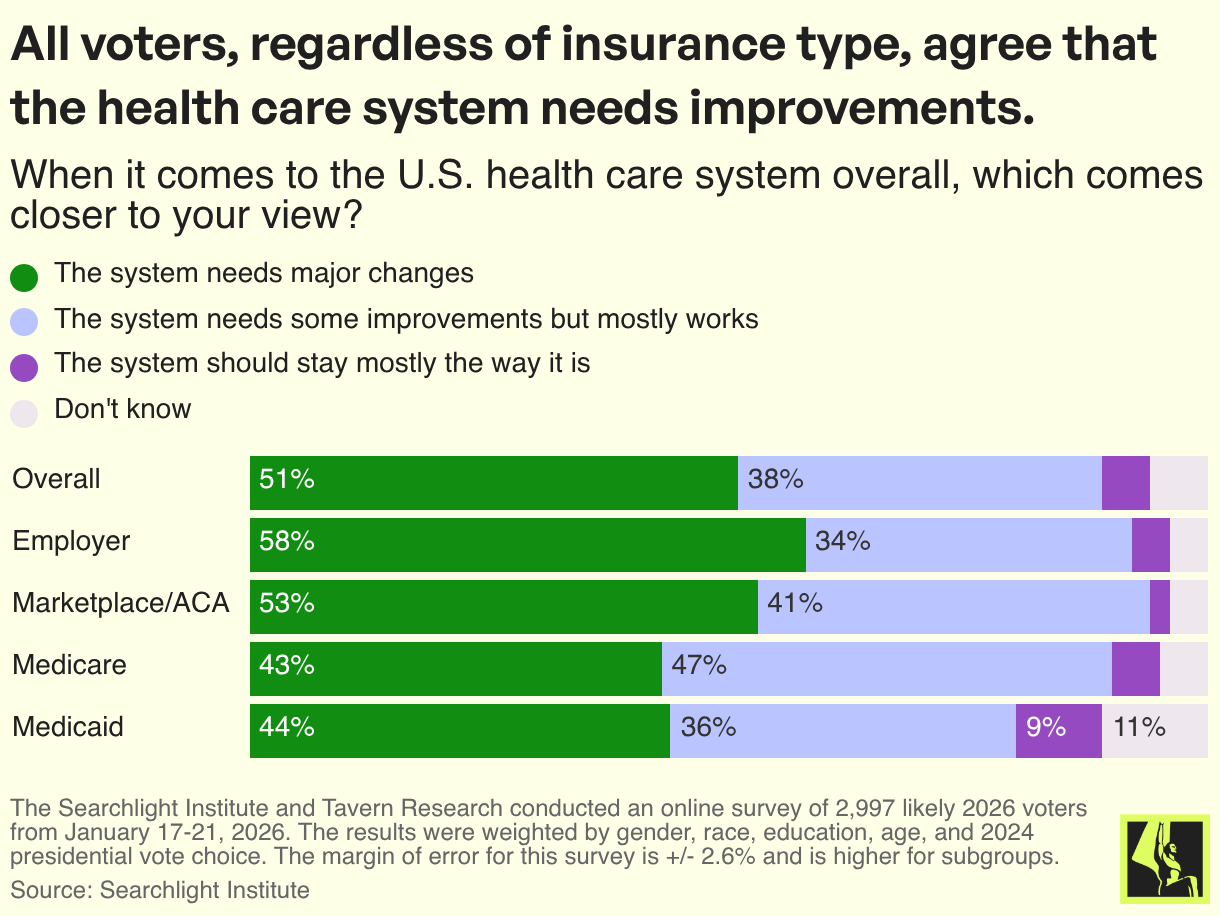
Democrats (57%) and Independents (56%) agree the U.S. health care system needs major changes, while Republicans are more split, with 45% saying the system mostly works. Just 5% of voters overall, and 6% of Republicans, answer that the system should stay mostly the way it is. There is nearly universal agreement that the system needs at least some improvements.
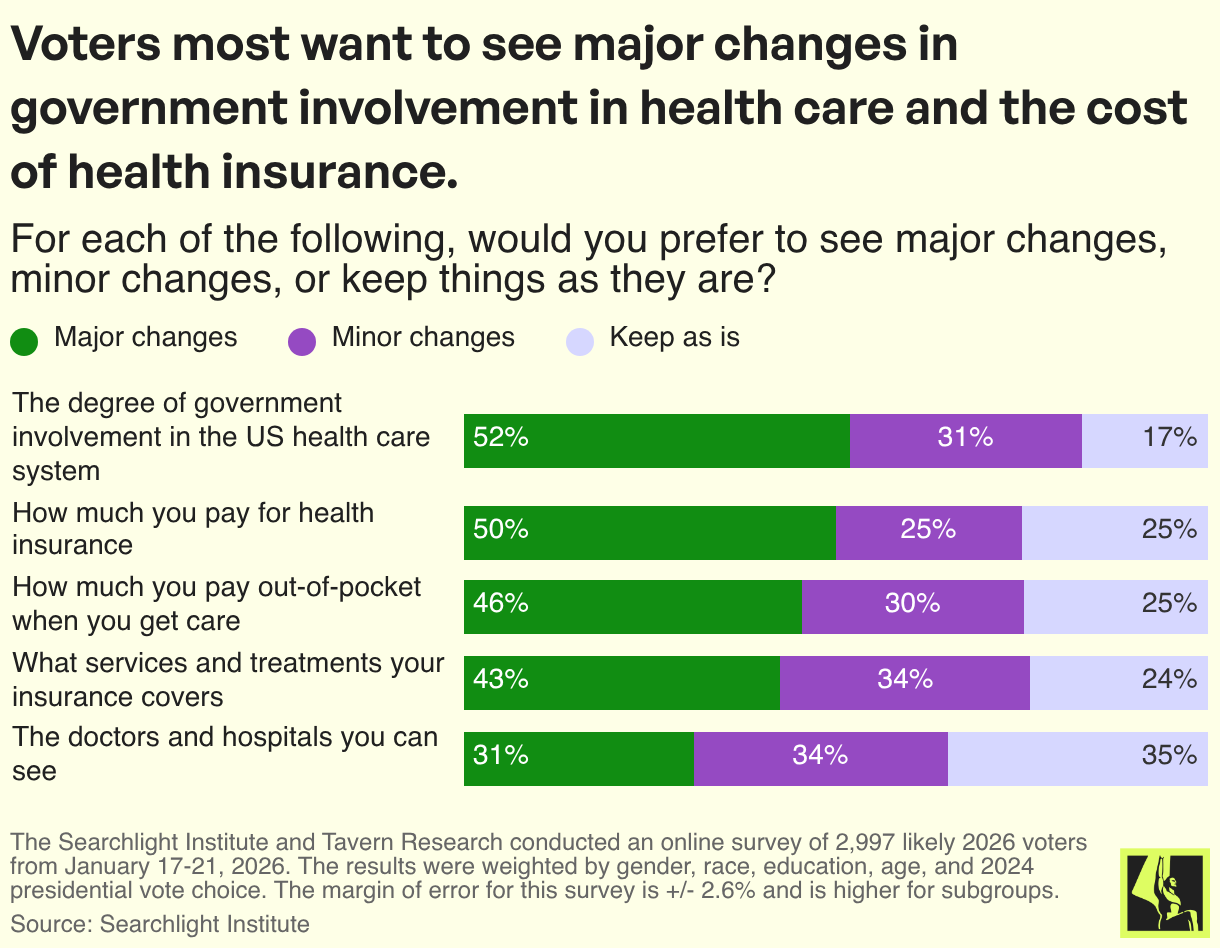
In a series of follow-up questions to understand which changes voters want to prioritize, government involvement in the health care system (52%) and the cost of health insurance (50%) are the top issues that voters say are due for major changes. A plurality of voters also want to see major changes to the amount they pay out of pocket when they get care (46%) and the services and treatments their insurance covers (43%). Importantly, we did not specify in this question whether a change in government involvement meant more or less government engagement in the health care system. While voters may have differing visions of governmental involvement in the system, nearly all (83%) agree it needs to change.
In terms of changes to the system, voters most want the government to be allowed to negotiate lower drug prices (40%), for health care costs to become more predictable (38%), and for coverage to be more expansive — both to cover those who have not previously been insured (36%) and to cover more treatments and procedures (36%). While Democrats’ priorities are to expand coverage for those who are currently uninsured (44%), Republicans are more focused on allowing the government to negotiate drug prices (40%). Voters’ main concerns about health care reform are that taxes would increase (28%), that wait times could increase (28%), and that some procedures might not be covered under a government health care plan at all (31%). Importantly, these are the top concerns across partisan identification.
Voters are generally unwilling to entertain tradeoffs about access, coverage, and wait times in order to have cheaper health care. Regardless of where they get their health insurance, voters answer that they would rather have to wait to see a better doctor than compromise on quality to have quick access to health care (72% versus 14%). By a smaller margin, voters say they would rather have access to the best health care available — even if it comes at a high price — than have more affordable health care with fewer treatments available (44% versus 35%). Support for high-quality but expensive health care comes mostly from people who get their health insurance from their employer (50% versus 35%) and those on Medicare (52% versus 30%). People who get their insurance from the marketplace (37% versus 40%) and Medicaid (34% versus 37%) are split, but lean toward prioritizing affordability.
However, even those who don’t prioritize affordability want to know how much they are going to pay for their health care plans. A majority of voters (51%) say that they would rather have a health care plan where they will always know what they’ll pay, even if they have less of a choice in their doctors. Additionally, a majority of voters (54%), including majorities of voters on all insurance plans, say that they would rather pay more in taxes but have no bills when they need health care, compared with paying less in taxes but paying out of pocket when they need health care (54% versus 28%). The higher taxes option is especially popular among voters on Medicare (57%) and those who get their insurance on the marketplace (56%).
The Government’s (and Other Actors’) Role in Health Care
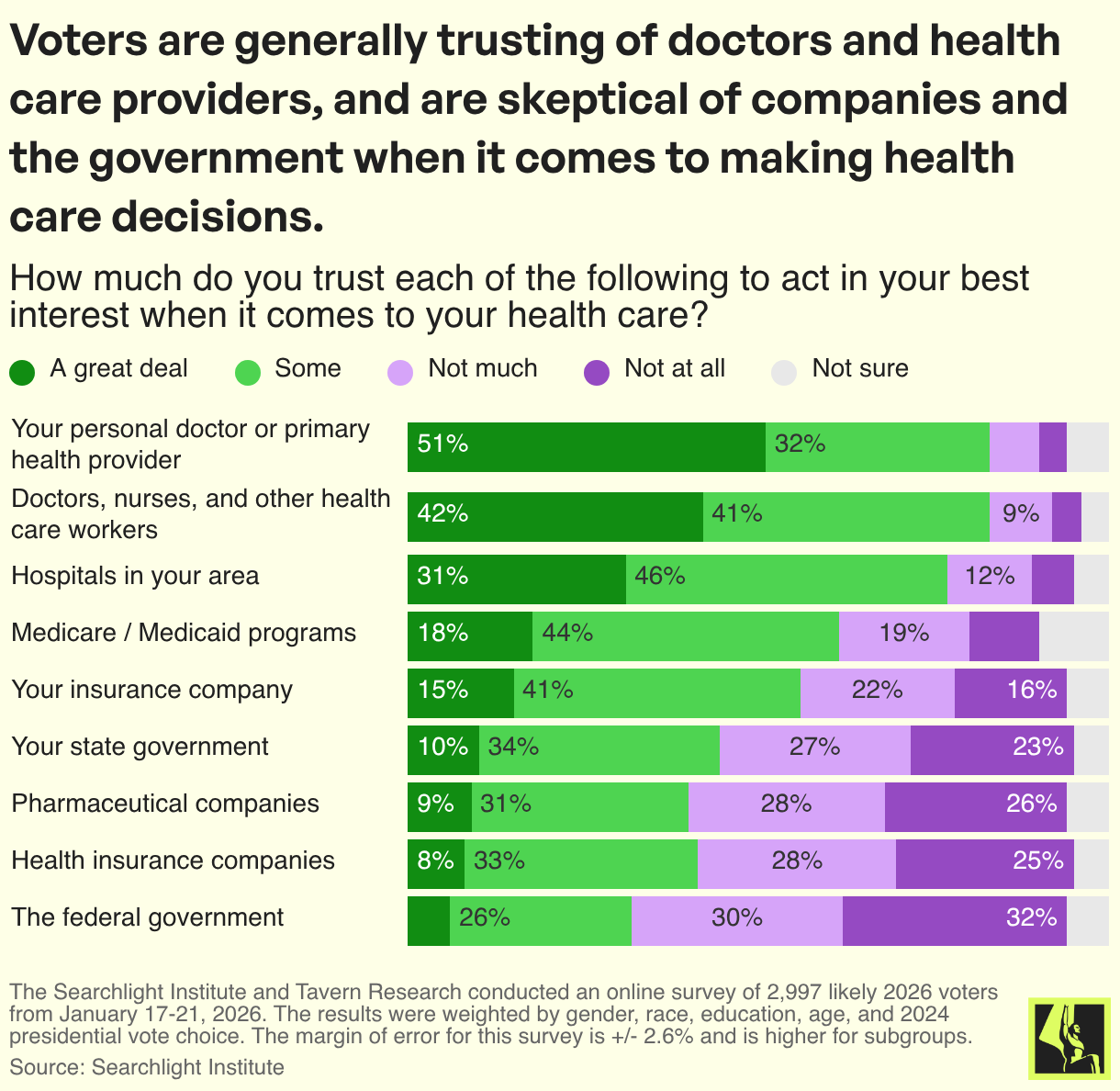
Voters place the greatest amount of trust in people and places they know — and health care professionals in general — to act in their best interest when it comes to health care. Just over half (51%) of voters say they trust their personal doctor or primary care provider a great deal when it comes to making decisions about their health, while 31% say the same of hospitals in their area. A meager 8% say the same of health insurance companies.
Voters do not trust the government to act in their best interest when it comes to their health care decisions. Just 6% say they have a great deal of trust in the federal government (32% trust at least some), and 10% of voters have a great deal of trust in their state government (44% trust at least some).
Given voters’ low levels of trust in government regarding health care, it should come as no surprise that few voters answer that they trust the government over private companies to provide services like health insurance coverage. A plurality (47%) say they are not sure which of the two actors they trust more, while 34% say they trust private companies and just 19% say they trust the government. Importantly, there is not a large difference in opinion among Democrats and Republicans: 37% of both groups trust private companies, while 22% of Democrats and 19% of Republicans trust the government.
Voters do not trust the federal government to act in their best interest when it comes to making health care decisions, though they generally agree that some kind of government intervention is better than having no health care or insurance. A majority of voters (57%) believe that the government has a responsibility to make sure that everyone has access to health care. There’s a partisan split here: Democrats (net +68) and Independents (net +26) agree that the federal government has a responsibility to ensure health insurance coverage, while Republicans (net -10) disagree. A similar share of voters overall (60%) say the federal government has a responsibility to make sure all Americans receive basic health care treatments. Similarly, responses vary across party lines, with Democrats (net +79) and Independents (net +44) in agreement, while Republicans (net -12) disagree.
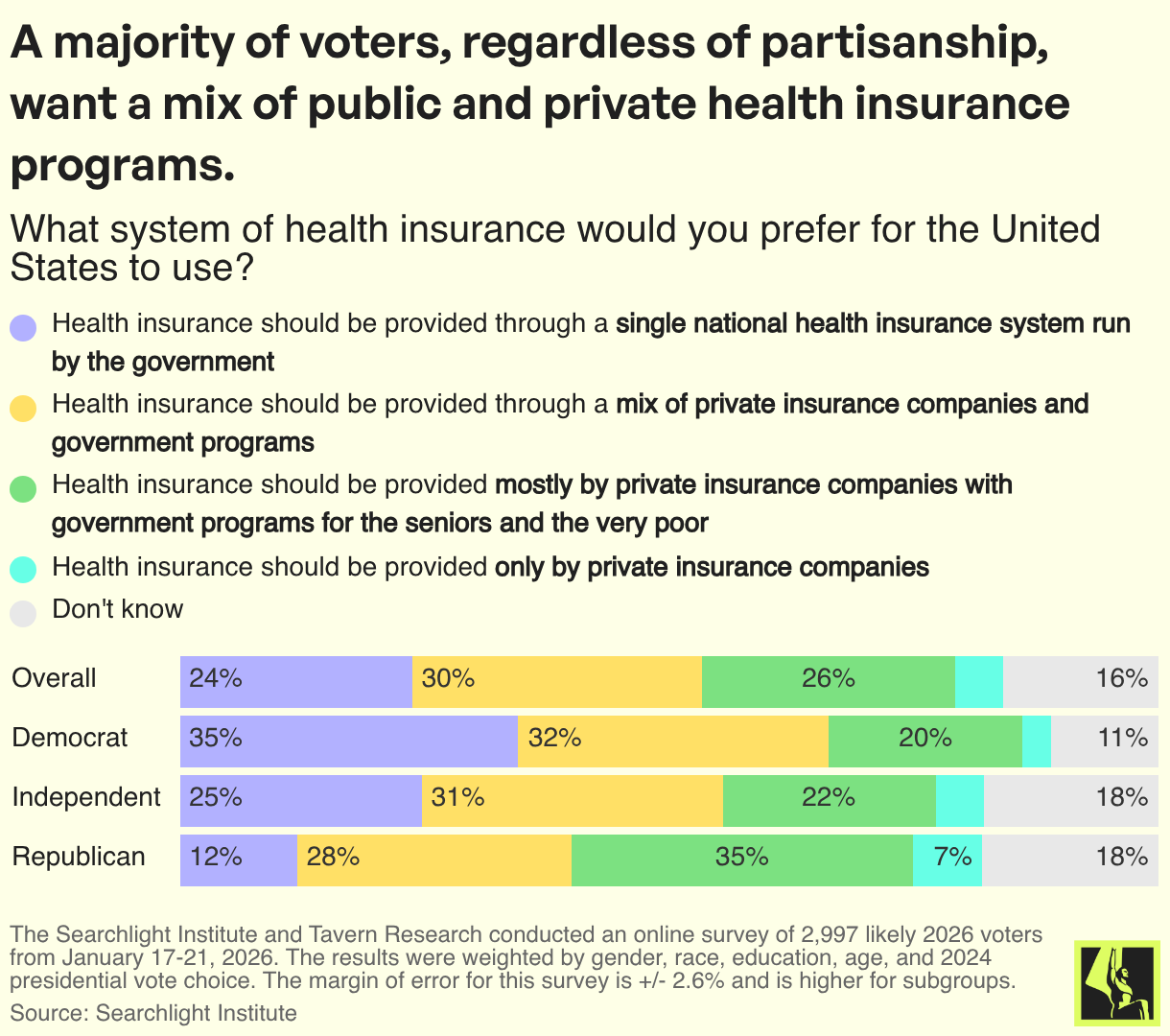
Voters are split on what the health care system in the United States should look like. A majority (56%) answer that they want a mix of private and public health insurance systems. Around one-quarter (26%) prefer the current system of private insurance with public programs for seniors and the very poor, while 30% would like a mix of private and public insurance available to all. Just 5% want only private insurance, while less than a quarter (24%) answer that they want a single national public insurance system. Importantly, a mix of private and public health insurance systems is the most popular proposal across partisan lines and among all people, regardless of their current health insurance. Voters’ preference for more options in their health care by having both private and public insurance programs is consistent with both their concerns about cost and their general distrust of the government to provide health care.
Conclusion
Voters believe that the government has a role to play in reforming a health care system they see as broken. They’re uncomfortable with total governmental control, due to low trust levels, but support regulatory intervention and government health care options. However, voters still like their specific insurance more than the health care system in general. These findings reflect a desire for change but a discomfort with instability or the potential to lose access to the health care voters currently have.
Methodology
The Searchlight Institute and Tavern Research conducted an online survey of 2,997 likely voters from January 17 to 21, 2026. Results are weighted by gender, race, 2024 presidential vote, education, and age. The margin of error is 2.6% and is higher for subgroups.