
Voters Want a Fairer Deal for Workers
Key Findings
- Voters see massive pay gaps between CEOs and average workers as a major contributor to inequality and believe that CEOs are generally overpaid.
- A strong majority of voters, including majorities of Republicans and Democrats, believe that businesses owe their employees a share of their profits beyond their regular salary.
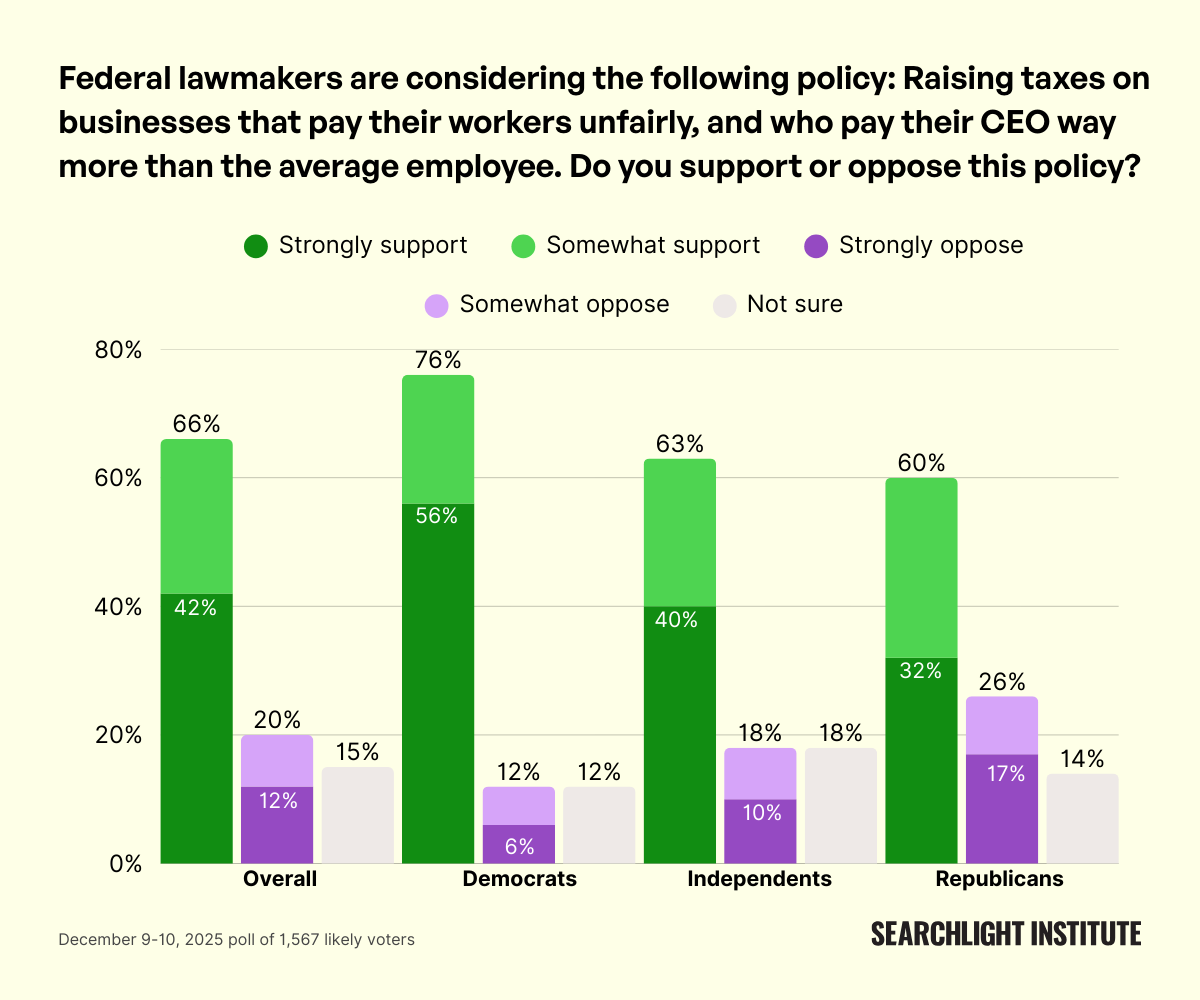
- Changes to the tax code that enforce fairness are highly popular, especially raising taxes on businesses with excessive CEO-to-worker pay gaps (net +46 support).
- Despite feelings that many billionaires got that rich via exploitation or luck, voters still think that people should be allowed to amass that much wealth if they do it fairly and by following the rules.
Wealth and Inequality
Voters are deeply unhappy with how wealth and income are distributed in the US, and are especially unhappy with how corporate profits flow to a small group of executives rather than workers. Sixty-seven percent think that CEOs are generally overpaid for the work that they do, and 59% think that pay gaps between CEOs and regular employees are a major contributor to economic inequality.
There’s also evidence of dissatisfaction with how the monetary gains from business productivity are shared with workers. Sixty percent of voters think that “businesses who make profits owe a share of that money to their employees,” rather than just owing employees their regular salary. This is a majority opinion among both Republicans and Democrats, across ages and education levels. Giving workers a share of the profits generated by their companies is highly popular.
The distaste for the very wealthy isn’t just coming from personal feelings, but from a concern for the country as a whole. A plurality of voters – 46%- say that the presence of the very wealthy generally hurts the U.S. and makes it weaker. These same voters don’t believe that someone should be prevented from becoming a billionaire — in fact, 53% say you should be allowed to accumulate that much money. There is, of course, an ideological gap in support for these measures, with Republicans being far more likely to say billionaires have a positive impact on the country (44% vs 13% of Democrats) and that you should be allowed to become a billionaire (69% vs 38% of Democrats).
Even as they say that people should be able to accumulate billions of dollars, voters are generally skeptical that billionaires amass their money through moral avenues. A plurality of voters, including a fifth of Republicans, answer that most billionaires got their wealth by exploiting and hurting other people. Republicans still demonstrate decent support for raising corporate tax rates, with a third saying those rates are too low.

Promoting fairer worker pay via the tax code
We tested a variety of potential alterations to the tax code that would incentivize fairer pay — more proportional pay between CEOs and workers, more salary transparency, etc. Most were popular, which makes sense given the general feeling from voters that corporate tax rates were too low.
Raising taxes on businesses that do not pay fairly, and that maintain overly large gaps between CEO pay and regular employee pay, was very popular (net +46) with a total of 66% support and 42% saying that they strongly support the proposal. Once again, we see a partisan gap, but still quite strong support overall (76% among Democrats; 60% among Republicans). The idea of giving a tax cut to businesses who make their pay scales public, in an effort to promote transparency, did less well but was still broadly popular (+30).
We were also interested in the idea of promoting hiring practices that allow workers to secure decent jobs. Giving tax cuts to businesses that meet targets for hiring and training young and early-career employees did very well across the board, at +43 support. A similar proposal to encourage hiring of single parents and moms returning to the workforce did even better, at +52, with enormous support across age, gender, and partisan lines. We did test the conservative counter-proposal that companies be incentivized to hire married men with families, and it performed far worse, despite achieving narrow majority support among Republican voters. Republicans seem to be more likely to support corporate tax cuts for good behavior overall, so framing any otherwise progressive proposal this way may help increase their support for the measure.
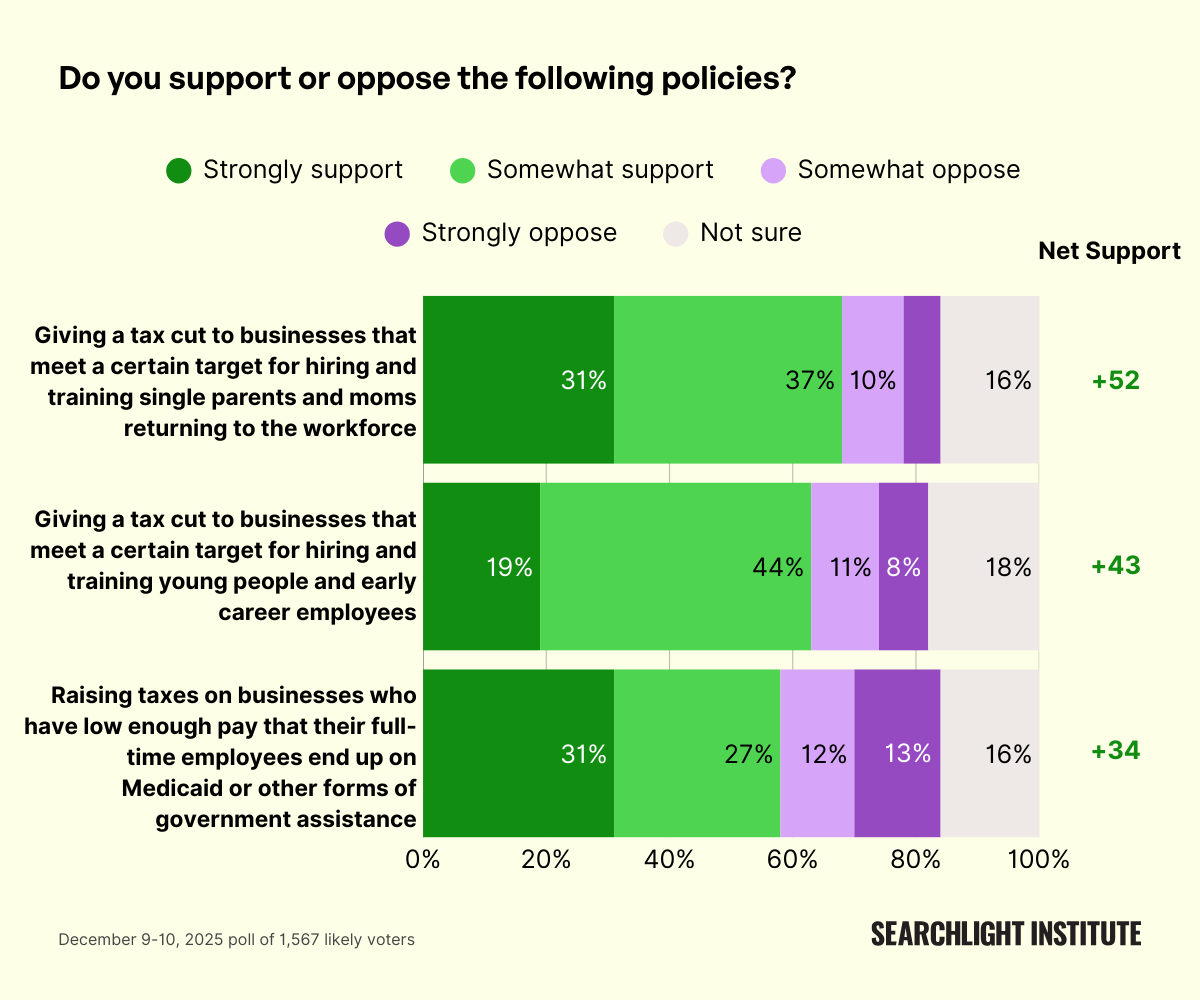
Another popular proposal was the idea of raising taxes on businesses who pay so poorly that their full time employees qualify for programs like Medicaid (+34). Voters believe that full time work ought to grant you enough income to support yourself at a comfortable level and not require support from government programs, and seem to be happy to penalize businesses not living up to that standard. Also, on the theme of safety net programs, voters strongly supported eliminating the income cap on Social Security so that high earners would pay based on their whole salary (net +39).
Conclusion
Voters generally support using the tax code to incentivize good behavior or punish unfair behavior by corporations. The idea of penalizing highly unequal pay, where CEOs earn dramatically more than normal employees, does well across partisan lines. Since voters feel that CEOs are overpaid, and that the very wealthy are contributing to problems in the U.S., there’s an appetite to use the tax code to enforce fairness and ensure that workers get a larger slice of the pie.
Whether it is incentivizing transparent pay scales, or the hiring of more early-career employees, there’s potential to craft very popular policy using alterations to the tax code for corporations. Across party lines, voters think that corporations and the wealthy owe their success to the efforts of ordinary workers — and that they should share their profits with those workers.
Methodology
Tavern research ran an online sample of 1,567 likely voters fielded over web panels from December 09, 2025 to December 10, 2025 and weighted by gender, race, 2024 Presidential Vote, education and age. Respondents were also weighted by whether they passed attention checks. The margin of error is 4.0%.
Dustbin
We tried a specific formulation of the “tax changes for companies whose CEOs make too much” question, capping acceptable CEO pay at 60x the average employee salary. It seems like the wording here was just too confusing to get a clear read on opinion. The wording we landed on was “Giving a tax cut to businesses where the CEO is paid less than 60 times what the average employee at the company earns. Businesses where the CEO makes more than that would have their tax rates stay the same.” While the 60x multiplier rule may work in practice, when explaining it to voters, describing it as simply “earning too much” is probably cleaner.