
Unlocking Affordable Child Care in America
The Problem
-
Child care is unaffordable for too many families, and most solutions involve increasing government funding without long term solutions that actually drive down costs. Government subsidies cannot be our only answer to this problem. We need to rethink rules that needlessly drive up costs.
-
In more than half of U.S. states, the average cost of center-based care for an infant is higher than annual in-state college tuition, and nationally, half of families with young children spend more than 20% of their income on child care. The shortage of available slots in child care centers makes the problem even worse.
-
Occupancy costs are typically the second-largest expense for providers after labor. While options to lower real estate expenses are limited, revisiting outdated rules that restrict centers from operating above ground level could help lower tuition costs, increase worker wages, and expand viable sites for child care, including for new child care businesses, particularly in dense and high-cost markets.
The Terrain
-
Even for families that can afford child care, access is scarce. In many communities the number of children under age five vastly exceeds the available licensed slots–with waitlists often 6 months or more–and providers struggle to open new centers due to high operating costs.
-
At the same time, the sector relies on chronically underpaid workers—most child care teachers earn less than $30,000 a year—contributing to high turnover and persistent shortages.
-
More than nine in ten Americans think child care affordability is a problem, including 91% of Republicans and 97% of Democrats. While most of the policy debate on childcare affordability has centered on the design and scale of public subsidies, there has been only limited exploration of the impact of regulation, and none on the specific issue of upper floor restrictions.
The Searchlight Approach
We propose that policymakers allow child care centers to operate on upper floors of multistory buildings as-of-right. Doing so would unlock more affordable, viable sites for providers, especially in dense or high-cost markets where ground-floor space is scarce and expensive. By eliminating an outdated barrier that has no bearing on classroom quality or children’s safety, states and cities can expand access, ease family budgets, and help stabilize a sector essential to both child development and workforce participation.
Most attempts to address child care have come in the form of increasing federal subsidy through the Child Care & Development Block Grant (CCDBG) without attendant changes to policy that actually drive down costs.
A modest increase in the CCDBG budget could finance this incentivization program for a select number of years in the highest-cost markets as determined by the Administration for Children and Families. To be eligible, states and localities would need to demonstrate as-of-right zoning flexibility for child care providers —or at a minimum, add clear guidance on who can approve exceptions and under what circumstances.
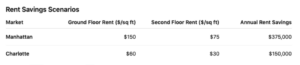
In some localities, this policy change could lead to savings of $375,000 in annual rent costs.
Analysis
Safety and Quality Considerations
Some cities and states explicitly prohibit child care centers above or below the ground floor. In North Carolina, for example, the State Building Code §1007.6 asserts that any center serving children up to second grade must be located on the ground level:
Rooms used for first grade children and younger shall be located on the level of exit discharge. Rooms used for second grade children shall not be located more than one story above the level of exit discharge.
Elsewhere, upper-floor sites may be permitted only after obtaining approvals from one or more of multiple agencies. Responsibility is often diffuse: the fire department refers applicants to the Department of Buildings, which refers them to the Department of Health, and so on. See, for example, § 47.41 of the New York City Health Code:
No infant/toddler child care program, or family shelter-based drop-off child supervision program that supervises infants or toddlers, receiving a first permit on or after September 1, 2008, shall provide services in any room, area or other space above the first floor or below the ground level floor of a building, except that the Department may allow such programs to occupy spaces above the first floor or one level below the ground level floor of a building, where DOB and FDNY or other appropriate government entities have approved such use and the Department has approved the applicant or permittee’s evacuation plan.
The result is a complex, opaque process that favors operators who are patient and well-capitalized. Some providers report not even considering upper-floor spaces due to the uncertainty associated with gaining approval.
The North Carolina Department of Administration explains its restrictions by pointing to the difficulty of evacuating very young children up and down stairs in emergencies. Other cities and states, however, recognize that advances in building and fire safety technology have obviated these concerns in modern buildings. These states and localities allow non–ground-level centers as long as protections such as sprinklers, multiple exits, alarms, evacuation plans, and trained staff are in place.
The State of Colorado and City of Boston recently revised their regulations to permit centers above or below ground under established safeguards. In New York State, which oversees home-based child care in New York City, providers are permitted to operate on any level—meaning that a home-based provider can educate and care for children out of an upper-floor walk-up provided other safety requirements are met, including requiring low staff-to-child ratios that enable safe evacuation if needed. Data show that safety incidents are exceedingly rare. Further, it is now common for hospitals across the country to place NICUs on upper floors, where highly vulnerable and largely non-ambulatory patients are cared for under strict safety requirements—illustrating how modern codes and building systems have made upper-floor care very safe.
Strong regulation in childcare is essential to protect children’s safety and ensure quality. Rules on staffing, training, and environments create the basic conditions for healthy development and guard against the risks of cost-cutting. Unlike proposals to loosen core standards such as teacher qualifications, staff-child ratios, or group sizes—which directly shape the care children receive and for which evidence is mixed—removing blanket prohibitions on second-floor centers does not affect quality of care, classroom interactions, caregiver credentials, or safety protocols inside the facility.
Note: Nothing in this proposal would support reducing the recommended number of exit stairwells or means of egress in multifamily multistory buildings as prescribed by the International Association of Fire Fighters. We strongly urge policymakers to factor this and the perspectives of local emergency rescue services into their considerations when determining locality eligibility, awarding grants, and promulgating any necessary rules for implementing this proposal.
Projected Impact
Potential Savings for Providers
Reducing occupancy costs, which typically account for 10% to 20% of child care provider expenses, could yield meaningful savings for providers, particularly in high-cost cities. In a study of tall commercial buildings in New York and Chicago, Liu, Rosenthal, and Strange analyzed detailed rent data floor-by-floor and found that rents drop sharply—by as much as 50 percent—when moving from the ground floor to the second floor. One provider operating in New York City suggested that the difference in rent between the ground floor and the second floor is even more pronounced: as much as 80% or 90% cheaper.
Consider a 5,000 sq ft childcare center with 50 children and 10 teachers. The table shows annual rent savings in Manhattan and Charlotte, NC, assuming second-floor space is 50 percent cheaper than ground floor space:
Broader Impact for Families, Workers, and Communities
The broader literature on child care regulation finds that some rules reduce supply and drive up costs. Hotz & Xiao (AER, 2011) found that state regulations on child care tend to reduce the number of center-based providers, especially in low-income areas, while increasing quality in higher-income markets. Currie & Hotz (2003) found that requiring child care center directors to have more education reduces both fatal and non-fatal childhood injuries, but also raises costs and pushes some children out of regulated care into potentially riskier settings.
Though we lack empirical research that specifically predicts the impact of loosened floor level restrictions, it is likely that the cost savings would result in greater supply in many communities, and that providers would use at least some of the savings to lower tuition for families (or slow the pace of increases) and support higher wages and benefits for workers.
First, we expect that new savings would very likely drive greater competition in the childcare market. For-profit child care operates on narrow margins—often under 1%. As the U.S. Department of Treasury noted in a 2021 report, the sector’s “diffuse and unconcentrated” structure reflects low margins and few economies of scale, which dull incentives to grow. Allowing second-floor centers would roughly double the pool of eligible sites in many places and expand options for centers to open or grow. Full ground-floor rent can be prohibitive for child care centers in their early years as they build out their enrollment and grow their business — especially for small, mom-and-pop operators without deep reserves. Since rent doesn’t scale with enrollment, and upper floors tend to rent for less, providers can cut a major fixed expense. New entrants to the market could put downward pressure on tuition and upward pressure on wages as providers compete for families and staff, though the overall effect would depend on how crowded and profitable the local market is to start.
Data also suggest the child care workforce would likely benefit from loosened restrictions. With savings on occupancy, providers may make long-overdue investments in recruiting and retaining its workforce. Providers have a business imperative to do so: The Bureau of Labor Statistics projects about 160,000 childcare openings per year over the next decade, mostly to replace departing staff rather than add positions. Research consistently finds low compensation is the top reason workers leave, and replacing each staff member costs an estimated $20,000–$25,000.
While not all savings would flow directly to families or staff, the below table illustrates the potential per-child tuition reduction and per-teacher pay increase if the entire amount were devoted to either outcome (again using the 50 children to 10 teachers assumption):
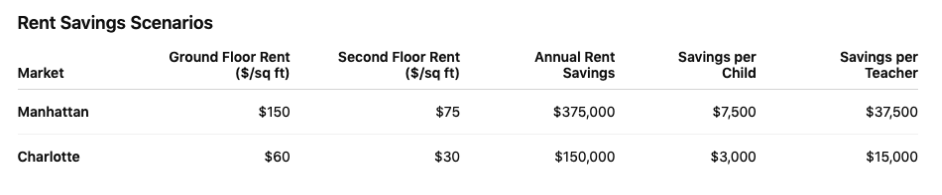
Again, the above example may represent a conservative estimate, since some buildings may offer even steeper discounts for second-floor space. Further, these numbers do not consider the potentially significant impacts of increased supply on tuition and wages.
Conclusion
Child care costs are high and only expected to keep climbing over the next decade. Policymakers are right to pursue solutions that bring down the costs for consumers, but without parallel changes in policy that get to the heart of the costs of providing child care, the cost trajectory will not improve.