
The Searchlight Approach to the Housing Crisis

The Problem
- Housing policy is stuck in an unproductive dynamic: Decades of underbuilding have created a housing affordability crisis, but the policies that will spur housing development at scale tend to be politically unpopular. Bridging this gap is the key to solving our housing crisis.
- Over the last decade, the U.S. has built about 1.2 million units per year, far short of the 1.5 million to 2 million units needed to keep up with demand.
- As the enduring strength of NIMBYism demonstrates, residents of a given neighborhood have little incentive to support pro-growth policies, and strong reasons to oppose them — even as research demonstrates that building more housing lowers costs.
The Terrain
- Searchlight polling highlights the conundrum facing policymakers: 79% of Americans say that housing costs are “too high” or “way too high,” and 62% say it’s become harder to find housing they can afford over the past three years. Yet when asked about building more homes in their community, 44% think it will raise prices at least slightly, compared with just 24% who think it will lower prices, and another 32% aren’t sure either way. Voters have other concerns about building more housing, as well: A big concern is crime, with 41% expecting it to go up.
- Despite this ambivalence about building more housing, voters strongly support proposals around streamlining permitting processes. The most popular proposal is requiring local governments to approve housing that meets their standards, at +51 support. Making permitting for new housing faster and easier also performs well, with +48 support.
- Overall, our polling paints a picture of an electorate with deeply mixed feelings and high levels of uncertainty about housing policy — one that does not currently have a strong incentive to support policies that will spur more housing development, and is likely to need one.
- As a way of giving voters an incentive to support pro-housing policies, we tested the idea of a $1,000 per-household rebate that would go to residents of localities “that build enough new housing to keep up with their population growth.” This idea registers at +14 support with high levels of “not sure.” Given that it was billed as having the explicit goal of building more housing, and given voters’ wariness of that goal, a framing that emphasizes the more popular aspects of pro-housing policies — such as streamlining permitting processes — holds promise.
The Searchlight Approach
To create a dynamic where residents have a stake in the policies that are most likely to increase growth and lower costs, we propose a novel, market-based federal incentive program that lowers housing costs by encouraging local governments to build more, and giving residents a financial incentive to support pro-housing policies.
Under our proposal, every household in communities that hit ambitious housing production targets would receive a cash rebate. If states and cities rapidly increase the pace and amount of housing development, their residents will benefit — not only through lower housing costs in the long run, but also through direct rebates to relieve housing cost burdens in the short run.
The size of the rebate would be equal to the change in rent for the typical home in that community over the previous year. For example, in Nashville, where HUD-calculated average rents increased by $213/month (or $2,556/year) between 2023 and 2024, if the city increased its housing production and met the production target, every household, including both renters and homeowners, would receive a check equal to $2,556.
Because the rebate would be pegged to a localized rent measure, the rebate would allow city leaders to effectively keep rent flat for the median renter for each year they hit the target. For homeowners, the rebate would offset some or all of their property taxes. The rebate could be delivered directly to individuals, similar to the 2020 and 2021 stimulus payments, or funds could be allocated to municipalities to issue to households.
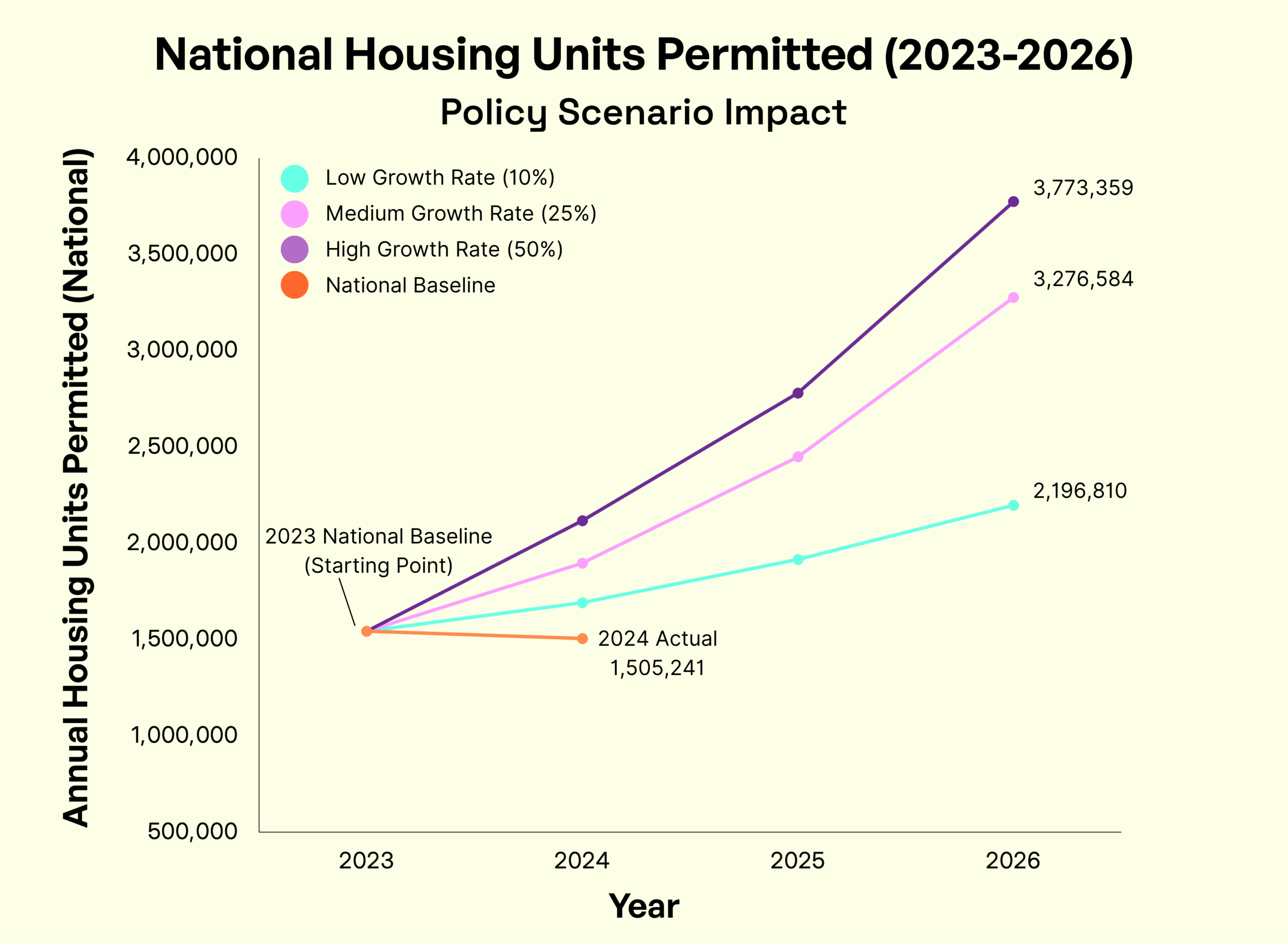
Even if the policy were only able to induce relatively modest boosts, with sustained, year-over-year 10% increases for three years, the United States would cross the 2 million permits per year threshold, a level last seen before the Great Recession. And if jurisdictions were to hit and maintain higher permitting levels, then the additional housing units induced by this program would be sufficient to close most estimates of the housing supply gap.
N.B.: There’s been much discussion of “rent freezes” in housing policy. If enacted, this proposal could allow leaders to frame the projected housing cost stability as a sort of “freeze” without the downsides of such a policy. Renters’ rebates would be roughly equivalent to recent rates of rent increases. The Searchlight proposal would incentivize growth instead of disincentivizing it — as traditional rent freezes do.
How Would It Work
Jurisdictions could qualify for the program and unlock federally funded housing dividends for their residents by meeting one of two production thresholds:
- High production growth. Cities that permit at least 75% more homes than the preceding three-year average would qualify. For example, Newark, N.J., which permitted an average of 1,614 units annually between 2022 and 2024, would have needed to permit 2,825 units in 2025 to qualify. As context, if every community hit the threshold for three straight years, the U.S. would fully close one of the larger estimates of its housing supply gap (3.7 million units).
- High per capita production. Cities could qualify if they permit at least 10 units per 1,000 residents, roughly the 90th percentile nationwide. This ensures that cities already producing at high levels are not penalized for more modest year-to-year fluctuations. For instance, Austin, Texas, permitted 9.5 units per 1,000 residents in 2024 — a very high per capita rate relative to other comparable cities. Austin would trigger rebates for its residents by modestly increasing from its 2024 rate and meeting the 10 units per 1,000 threshold.
Communities could meet the production thresholds in whatever ways they see fit. Some jurisdictions might make overdue changes to their zoning or building codes, or implement measures to decrease the time it takes for developers to receive permits, while others might provide gap financing to enable more deals to pencil out. In addition to local action, state governments and housing finance agencies could adopt complementary policies and funding strategies to further boost housing supply across all its jurisdictions. We contemplate some of these state-level executive actions here.
Residents of communities that meet one of the two thresholds in a given year would receive a housing dividend. The size of the rebate would be equal to the change in rent for the typical home in that community over the previous year.
We propose that the program be put in place for four years. The first year would provide time for jurisdictions to plan, implement new policies, and accelerate new and expanded financing tools. Rebates would be awarded annually at the end of Years 2, 3, and 4. Communities would be eligible every year as long as they met their targets.
Analysis
Recent years have seen a number of proposals to incentivize housing production at the state and local levels. The Biden-Harris administration provided small grants to communities to identify and reduce barriers to construction, and also rewarded communities with “pro-housing” policies in places with higher scores on a range of infrastructure grant programs. Proposals to go beyond this include the bipartisan YIMBY Act, which would require Community Development Block Grant recipients to report on and make plans to track exclusionary land-use policies, and a bill by Senator Elizabeth Warren that was recently passed by the Senate alongside other pro-housing bills that would provide $1 billion over five years to reward local governments that build more housing with more money for supportive infrastructure, parks, roads, or schools. Similarly, the Economic Innovation Group has proposed a “density dividend” that would reward jurisdictions that enact a model zoning code and meet construction targets with funds that they could spend on infrastructure, education, public transit, or affordable housing. This proposal differs from these federal incentive ideas because the monetary reward for achieving results would flow directly to local residents and not to units of government, and would incentivize actual progress toward new housing production, and not simply process and policy reforms.
Our proposal would apply incentives directly to each of the key players who may impact local decision-making on housing: current homeowners, current renters, and policymakers. Local debates over housing policy are typically dominated by a small segment of homeowners opposing more development, warning of changes to community character, stress on local infrastructure, and increased traffic. Policymakers are largely responsive to these voices, who are typically more affluent and politically connected. The policy would give more residents a direct and short-term financial stake in boosting housing supply. While the prospect of a cash rebate may not bring all previously opposed residents to support new policies to build more, it may be attractive for some, especially lower-income homeowners. Other homeowners’ opposition to new development may be softened by the understanding that their friends and neighbors would lose out on rebate checks.
Our polling underscores the potential for a rebate to change community attitudes toward housing production. The survey finds that 46% of residents think building housing in their community would be bad. Of the 46% who express that view, 24% (or 11% of overall respondents) would support more housing being built in their neighborhood if it meant they would receive a $1,000 annual rebate. As more residents have a vested interest in boosting supply, it follows that the local elected officials who represent them would be more likely to support aligned reforms. Since the housing dividend depends on meeting a numerical goal and not enacting a prescriptive list of new, one-size-fits-all policies, it leaves room for policymakers and their constituents to tailor solutions to their local contexts, as long as the result is more housing.
Projected Impact
The total impact and cost of the proposal would depend on the extent to which the policy is effective in incentivizing cities to build more housing. Some cities will act boldly to build needed housing and relieve housing cost burdens for their residents, while other motivated cities may make modest changes but be otherwise limited by macroeconomic or fiscal constraints. Another subset of cities will not meaningfully change their housing production at all, either because there is insufficient demand or because NIMBY and other political dynamics make new housing unpalatable no matter the circumstances.
Analyzing the nation’s largest cities’ housing production between 2023 and 2024, were the policy in place, only Fort Worth, Texas, would have hit the high per capita production threshold to qualify for housing cost rebates, with Austin and Nashville just below the threshold. However, significant increases in housing production are possible through actions directly within cities’ control. For example:
- According to a recent paper by the UC Berkeley Terner Center for Housing Innovation, San Diego approximately doubled its housing permits between 2022 and 2024, and did so by limiting ministerial review for individual projects, creating local density bonuses, and increasing its planning department staff and improving coordination.
- In a forthcoming Terner analysis focused on Denver and leveraging Terner Labs’ Housing Policy Simulator, a combination of policy reforms — including increasing height limits and density near transit stops, reducing parking requirements, and reducing various development fees — is estimated to increase the rate of expected multifamily homes constructed each year by 35% to 55% beyond status quo policy conditions, depending on economic variables.
- In a similar analysis of hypothetical policy changes in San Diego, Terner Labs estimates that rezoning and relaxing building envelope constraints on most low-density residential parcels to allow for “missing-middle” homes up to 10 units would increase annual multifamily housing construction by 70% to 110%, compared to the baseline zoning.
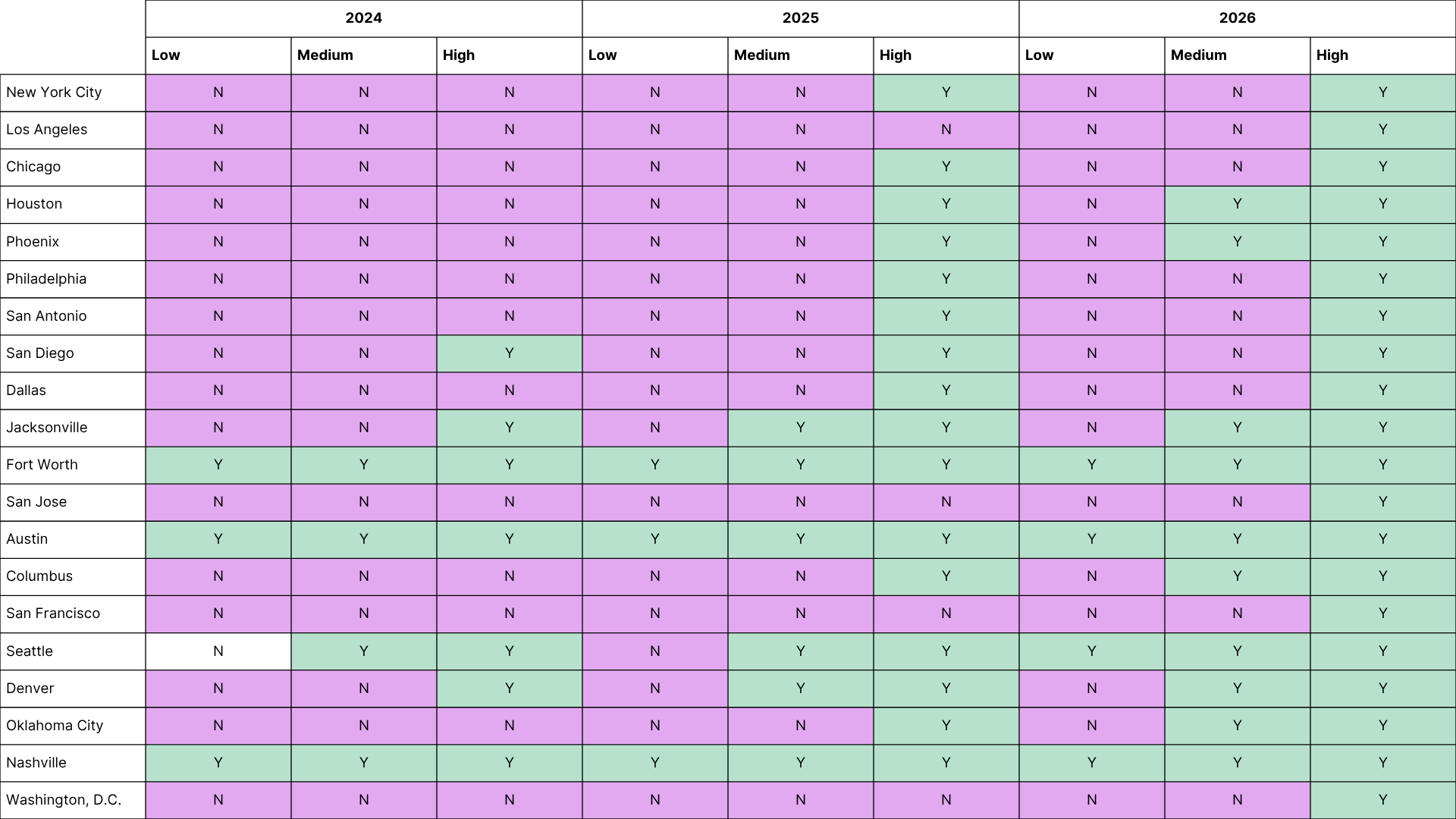
Table 1 below shows local and national housing production under three scenarios: increases in year-over-year permitting of 10%, 25%, and 50% for three years. Under various scenarios, seven of the 20 largest cities could reach one or both of the qualifying targets in the first year, and a majority of the largest cities could qualify for rebates in the out-years if they took reasonable steps to increase year-over-year housing production.
TABLE 1: Potential Housing Growth in the 20 Largest Cities Under Various Scenarios
The graph below shows the national impact of this increase in housing production relative to recent permitting levels. Even if the policy were only able to induce relatively modest boosts, with sustained, year-over-year 10% increases for three years, the United States would cross the 2 million permits per year threshold, a level last seen before the Great Recession. And if jurisdictions were to hit and maintain higher permitting levels, then the additional housing units induced by this program would be sufficient to close most estimates of the housing supply gap.
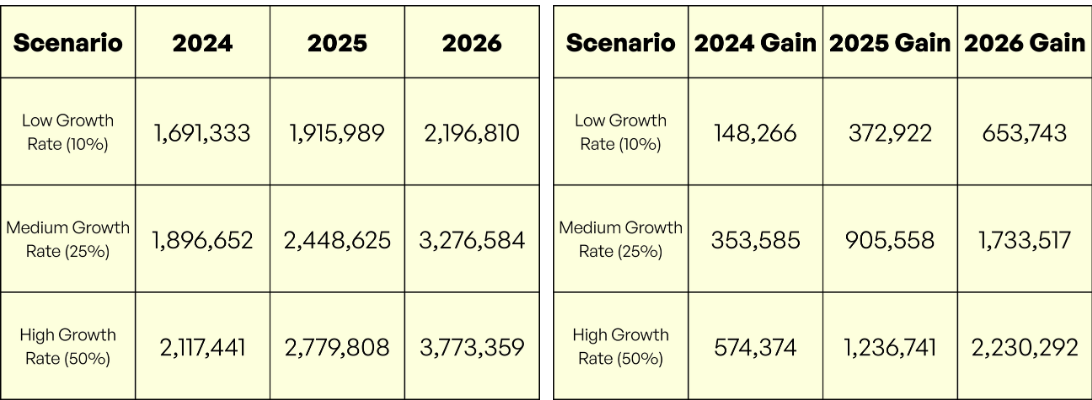
In terms of potential cost, if every city increased permitting by 10% for each of the three years (“low growth” in the above chart), the total three-year cost would be $71 billion. If every city grew at the “high growth rate” of 75%, the total three-year cost would be $272 billion. These would be major federal investments, but would reflect the approval (and subsequent construction) of millions of new housing permits. Further, while rebates would only be issued for three years, the impact of the incentive in additional units induced would extend beyond the duration of the program, as the new zoning and other pro-housing reforms that jurisdictions adopted in an attempt to meet the threshold would endure even as rebates ceased. For example, if a city adopted a new policy to legalize accessory dwelling units (ADUs) as an initial step toward boosting permits and hitting the threshold, the benefits of that policy would continue over decades, as households continued to build ADUs.
According to our simulation, the median household in qualifying cities would receive annual rebate checks of approximately $2,220. This rebate would be a significant boost to household income, the prospect of which could lead to more support for pro-housing policies. Some may argue that landlords may seek higher rents in places where rebates are awarded. Because the rebate would be temporary, tied to annual housing permitting levels, and relatively short in duration, landlords could not confidently anticipate or capture it when setting lease terms. Importantly, the rebate would serve as a “bridge” for new units coming online, which would result in greater market competition and more limited landlord pricing power.
Conclusion
Solving America’s housing affordability crisis requires bold federal action that catalyzes local change. This proposal offers a novel, market-based approach: tying real financial benefits for residents to local governments’ success in boosting housing supply. By directly connecting new housing production to immediate cost-of-living relief, the program not only accelerates the pace of development but also reshapes the political incentives that have long stymied progress.
Authors
Aaron Shroyer is a former fellow who focused on federal and state strategies to boost housing supply.
Chad Maisel is a former fellow who focused on affordability and economic opportunity.