
Strong Enforcement, Fair Pathways: What Americans Want for Our Immigration System
When it comes to immigration, Americans want two things: strong enforcement of our laws, including in the interior of the country, and fair treatment of immigrants, including a pathway to citizenship and humane treatment of deportees.
As our polling shows, this is not a false choice, and liberals would do well to embrace both. Americans don’t currently trust Democrats to fix our broken immigration system — but they also don’t necessarily like what they’re seeing from the Trump Administration when it comes to interior enforcement.
There’s a path forward for liberals to reclaim the public trust on immigration. Searchlight has released a set of comprehensive recommendations on how liberal policymakers can do exactly that. Americans see the immigration system as chaotic and broken, and are looking to reform the system. They support increasing border security, particularly in ways that safeguard human rights. While voters tend to feel positively about immigrants who contribute to the country, paying taxes and behaving as good citizens, they support deportations for those who break the rules.
These findings build upon our previously released polling detailing Americans’ perceptions of ICE, which you can read more about here.
Voters think the system is broken
A full two-thirds (66%) of voters say that the current immigration system is broken. Yet their reasons for this belief vary — Democrats are more likely to say it is broken because of the chaotic nature of enforcement while Republicans point to high rates of illegal immigration. Most voters (59%) think that immigrants strengthen our country, but again, opinions diverge by party. Notably, of those who think the immigration system is working well, a plurality (47%) cite the fact that illegal immigrants are being deported as a sign of the system’s function.
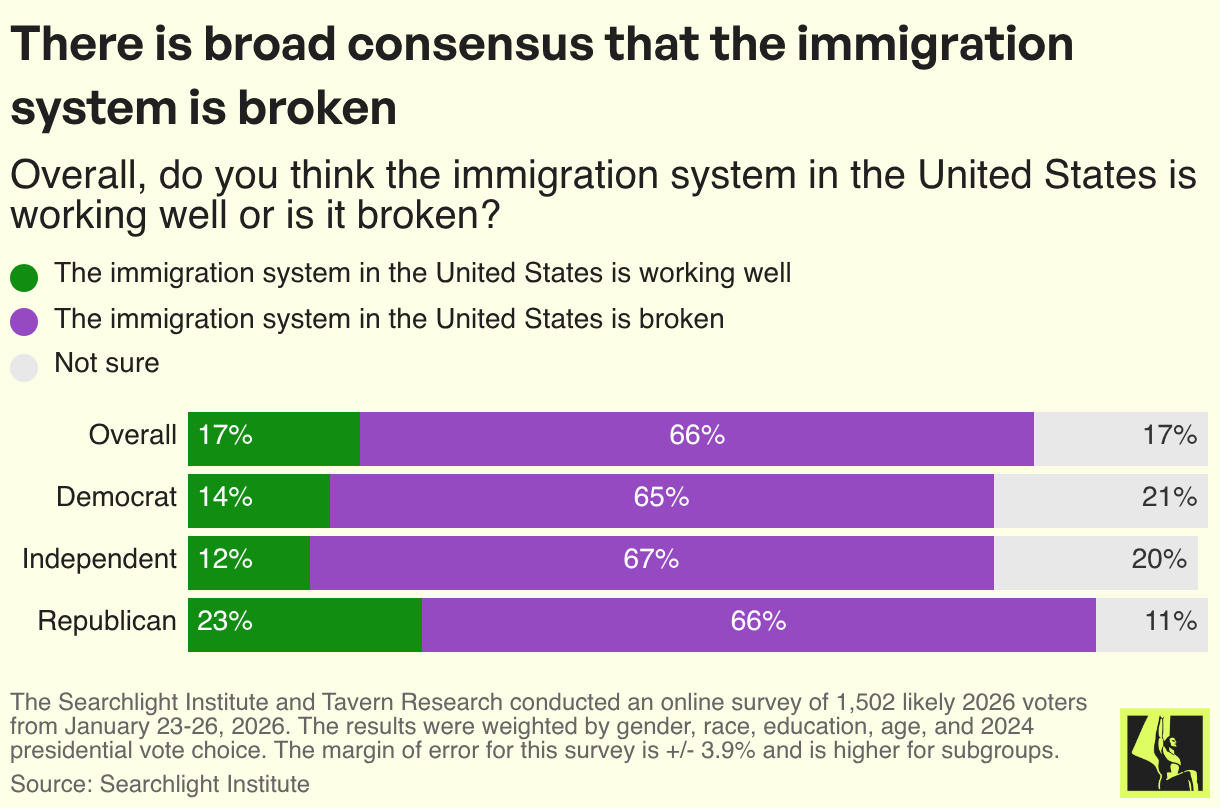
For voters, the challenge is balancing what they see as a valid need to control illegal immigration with concerns about cruelty or increasing chaos.
Voters’ concerns about the presence of illegal immigrants primarily focus on the risk of crime and — among Republicans — the potential for them voting in U.S. elections. Among Republicans, 76% say they are very concerned about non-citizens voting, while 65% say they are very concerned about crimes being committed against them or someone they know. While these concerns are much more common among Republicans, they are present among Democrats as well: over a third of Democrats say they are concerned about immigrants committing crimes, and a similar share say they are concerned about immigrants not learning to speak English. Meanwhile, only 28% of voters overall are very concerned about losing out on jobs, and only 30% say they are very concerned about immigrants making housing more expensive and scarce.
Strong support for enforcement at the border
When asked about the Trump Administration specifically, voters were more likely to say they were doing “too much” in terms of deporting illegal immigrants already living here (43%), while only 30% say they are doing “too much” to secure the border.
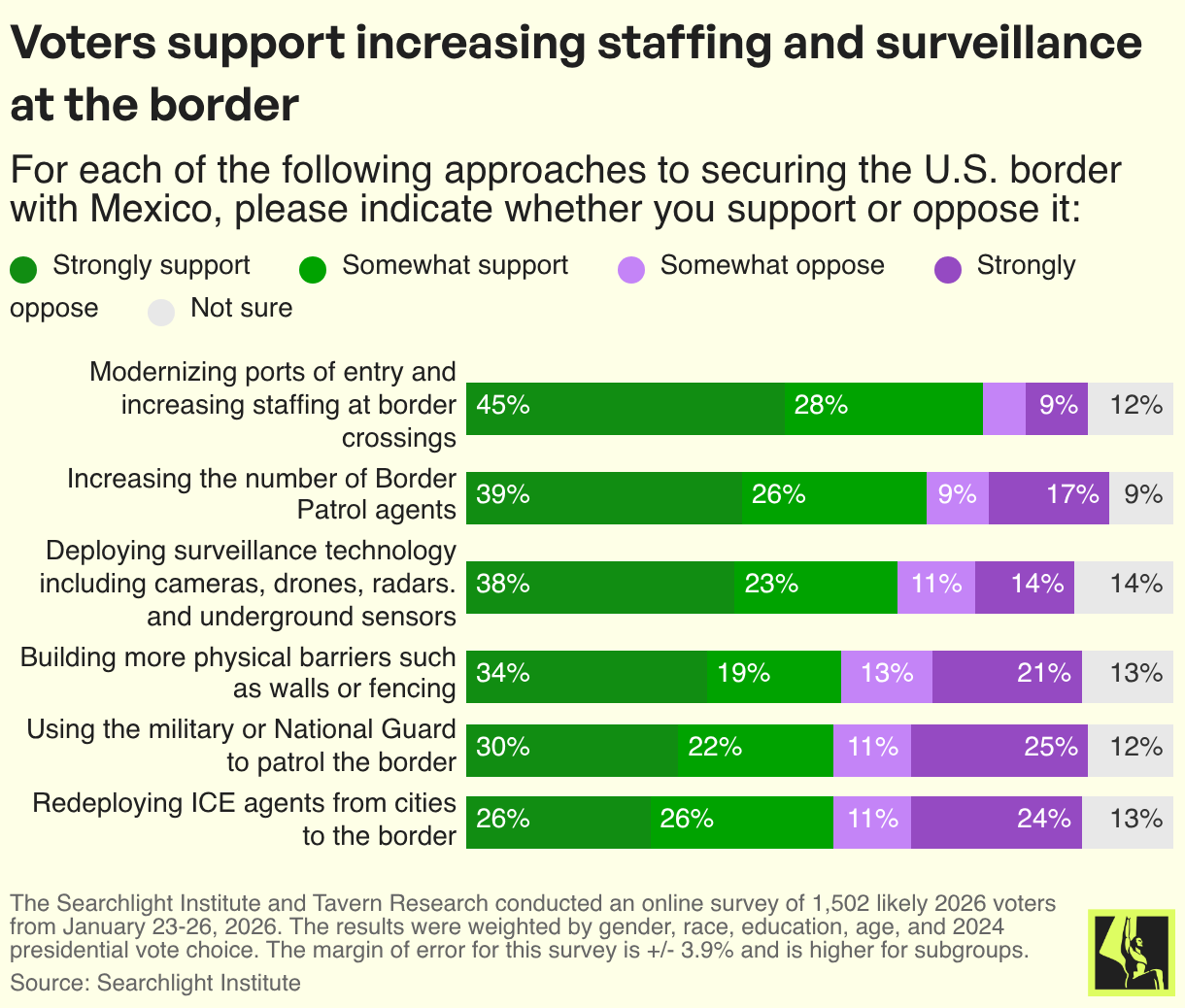
Most measures to increase border security are popular. Building more physical barriers suffers a penalty among Democrats, likely because of its association with Trump, but other forms of security like drones, radar, and sensors, have more bipartisan appeal. Modernizing ports of entry was also particularly popular, with support from 59% of Democrats and 90% of Republicans. Redeploying ICE agents to the border has strong support among Republicans (69%), but much less among Democrats (only 39% support, while 50% oppose).
The Interior
Most voters, including many Democrats, believe that at least some immigrants living in the U.S. illegally should be deported. Just 17% of voters say that no immigrants living in the U.S. illegally should be deported (including just 30% of Democrats).
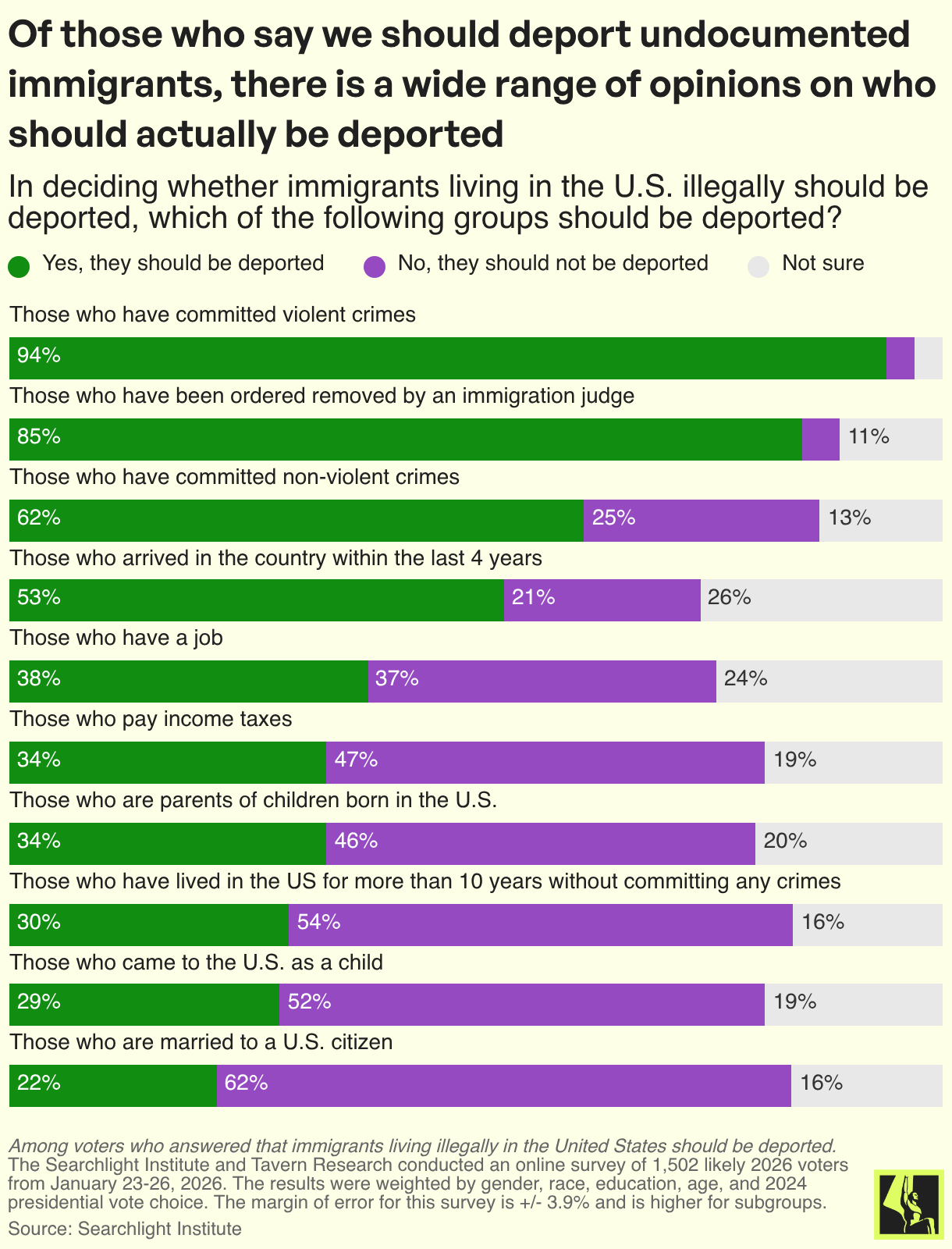
Voters strongly prioritize the deportation of criminals, particularly violent criminals, with 72% selecting this group as their top priority. We asked a series of follow-up questions of those who think that all or some illegal immigrants should be deported to determine their position on specific groups. Just 38% say immigrants who have a job should be deported, compared to 61% who say those who had committed nonviolent crimes, and 94% who say those who had committed violent crimes should be deported. Democrats who supported at least some deportations, unsurprisingly, were the most mixed on the deportation of nonviolent criminals, with 50% saying those people should not be deported. Illegal immigrants who pay income taxes or arrived in the U.S. as children are also less likely to be prioritized for deportation. Voters also strongly believe that those who have been ordered for removal by an immigration judge should be deported — 85% of voters who support at least some deportations also support this.
Among those who oppose all deportations, 49% say that their view would change if that person was convicted of a felony like identity theft or drug possession, while 76% say their view would change if that person was a violent criminal.
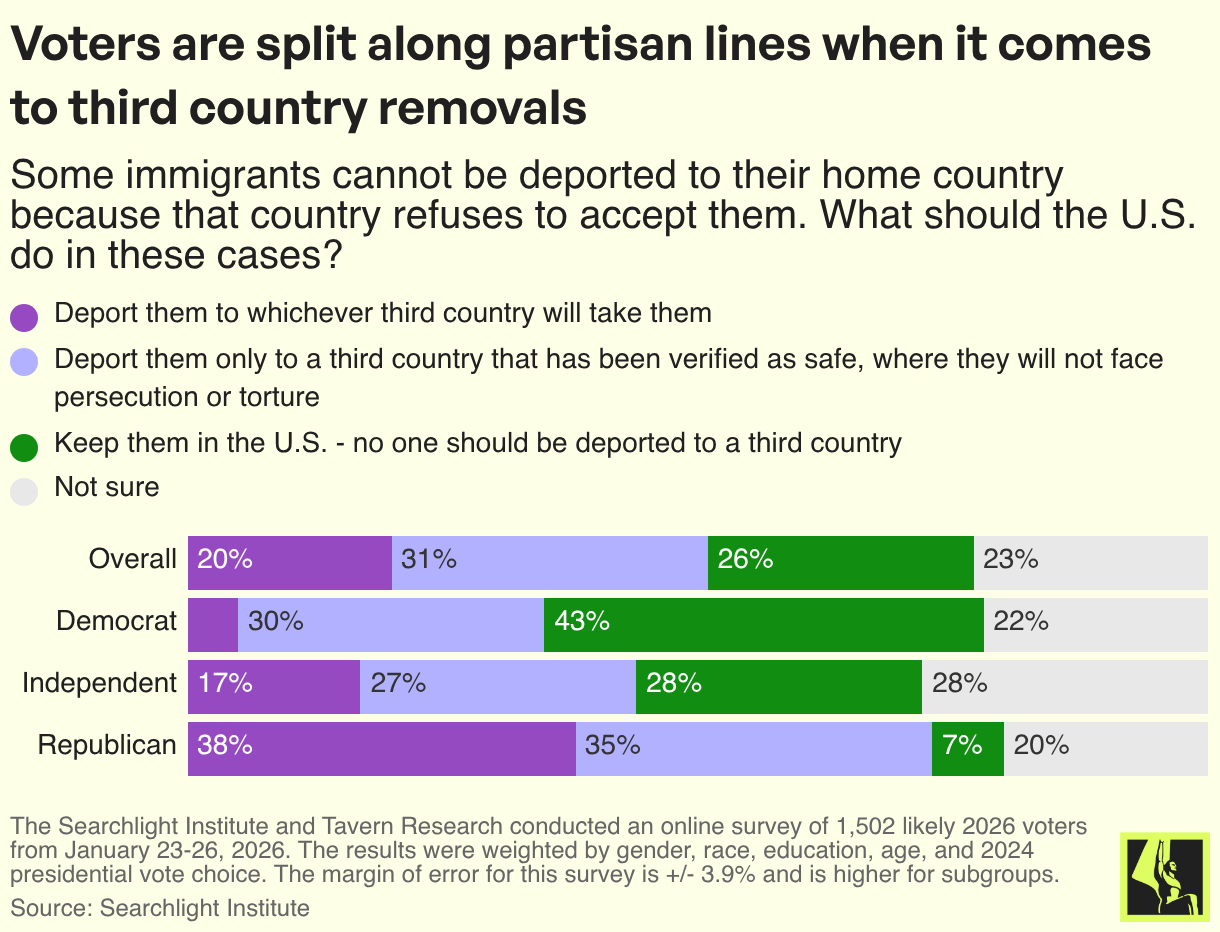
There’s somewhat of a split on the prospect of third country removals (i.e., when someone is set to be removed from the U.S., but cannot be sent back to their country of origin). Only 20% of voters (primarily Republicans) are comfortable deporting someone to any third country that will take them, while 31% think this is acceptable only if the country has been verified as safe. Meanwhile, about a quarter of voters (26%) think that no one should be deported to a third country (mostly Democrats).
When asked about the fundamental principle of the matter, 54% of voters say that people who have entered the U.S. illegally but lived here productively for years should be allowed to stay in some capacity. This is very split by partisanship — just 29% of Republicans think these people should be allowed to stay, compared to 76% of Democrats and 56% of Independents.
Voters overall believe that the most important qualifiers illegal immigrants must meet to be able to apply for citizenship are passing a background check (64%) and not having been ordered removed by an immigration judge (44%). These are closely followed by learning English (43%). Republicans see paying back taxes (42%) as another high priority.
Legal Immigration and Asylum
There’s middling support — just 37% — for granting existing illegal immigrants a status that allows them to work and stay in the U.S. but does not include a pathway to citizenship. Unsurprisingly, Republicans tend to oppose this. Across the board, Republicans oppose measures that might increase the number of foreign workers, unless they are narrowly targeted to high skilled technology workers or international college students. There’s particular opposition among Republicans to allowing employer petitions for more foreign workers to lower costs.
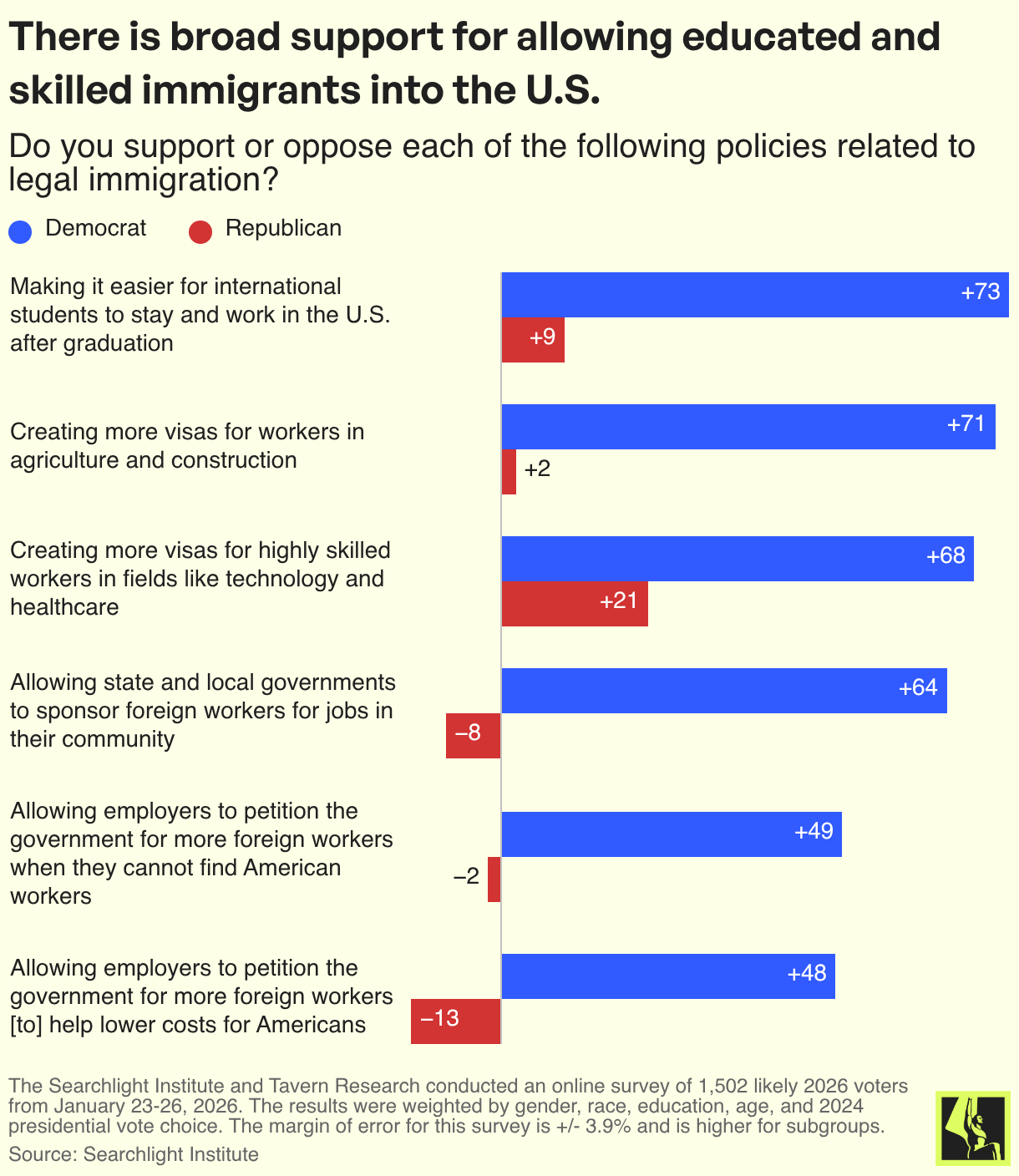
A majority of voters (52%) believe that an increase in legal pathways to come to the U.S. would decrease illegal immigration. While Republicans are more likely to believe that legal pathways would encourage more people to try to enter the country, they are still evenly split on the issue.
Voters generally support the asylum program. A majority (55%) think that people who apply from their home country should be eligible, and 48% think that those who present themselves at the border should be eligible. Nearly as many (44%) think that anyone fleeing persecution or torture, regardless of how they arrive, should be considered for asylum. Simultaneously, just 12% think that someone who crosses the border illegally should be eligible. Voters are torn about where people should wait while their claims are processed. 39% of voters think people should wait in the U.S., while 41% think they should wait somewhere else — their home country (18%), any third country (12%), or somewhere near the border (11%).
Conclusions
Even as voters are horrified by ICE overreach and cruelty, they still strongly support immigration enforcement. Voters think the current immigration system is broken and simultaneously too harsh and too ineffective at controlling entry to the country. They strongly support enforcement at the border — including technological improvements and additional staffing — but also see interior enforcement as necessary. The primary concern about uncontrolled illegal immigration is crime, and economic concerns are real but secondary. Voters believe that interior enforcement should focus on violent criminals, and are open to the idea of legal pathways for long term residents who have not committed crimes and meet other criteria. Expansion of legal pathways for new workers is controversial, likely reflecting concern about job displacement.
Methods
The Searchlight Institute and Tavern Research conducted an online survey of 1,502 likely voters from January 23 to 26, 2026. Results are weighted by gender, race, 2024 presidential vote, education, and age. The margin of error is 3.9%.
Dustbin
We asked respondents how they thought deportations would affect specific categories of prices in their area, with the thinking that people might have a sense of what industries are more or less dependent on immigrant labor. Instead, a majority of respondents answered that prices would stay the same or they weren’t sure — to every question. A plausible conclusion is that voters just haven’t really thought enough about the downstream price impacts to have strong thoughts.