
Kids Eat Free: The Case for Universal School Meals
Introduction
School lunch is more than a meal. The lunch period is time spent with friends, discussing pop culture, trading gossip, and yes, eating what is on the daily menu. If you are one of the hundreds of millions who attended K-12 in this country, you have likely eaten a school meal. School lunch is a quintessential American experience — and one of the larger investments the United States has made in our children. But this cafeteria commitment still comes with cumbersome strings attached. Millions of families are charged a daily fee for their children to receive a school meal.
The lunch payment process is different from other key school services like bus routes. Children do not need to present payment each time they hop on the yellow bus taking them to school, and they shouldn’t have to for lunch either. It is time to make school meals free for all children.
Born as part of an agricultural surplus program during the Great Depression, the United States school lunch system has become something far greater than a means for farmers to sell excess food. The program is capable of supplying every child in the country a guaranteed meal at school. For decades, though, states and the federal government have failed to convert that capability into reality. This changed during the COVID-19 pandemic. Temporary program waivers guaranteed meals to every student, no matter their income or ability to pay. With sufficient political will, bureaucratic barriers keeping kids from eating lunch were eliminated. Although those waivers expired, Congress can accomplish the same feat again in the aggregate.
This paper details a path forward, building off permanent components of the school lunch system, namely the Community Eligibility Provision (CEP). Established through the Healthy, Hunger-Free Kids Act of 2010, the CEP has allowed schools in high-poverty districts to serve all students free meals without requiring parents to submit individual applications. The CEP has eliminated cumbersome paperwork, reduced the stigma of receiving free meals, and reached millions of children who would have fallen through the cracks of the old system. Today, more than 54,000 schools participate, serving over 27 million children. But the CEP was designed as a targeted intervention. The reimbursement formula, certification process, and scope of eligibility all limit how many schools participate.
Reforming and expanding the CEP — as has already been done in recent years — will allow Congress to establish a permanent, universal free school meals program with distinct flexibility in the overall cost to the federal government. Every school would be extended CEP eligibility alongside more generous meal reimbursement rates to make the policy possible.
Food for thought: the effect of school meals
Government programs focused on children tend to have a high return on investment. School meal investments, in particular, can return more than $2 in economic and health benefits for every dollar spent.
In addition to the benefit of keeping students from going hungry during the day, there are downstream effects associated with school meals. For example, students with access to school breakfast score higher on cognitive achievement tests, with effects concentrated among low-income students. Kindergartners with access to universal meals have higher attendance and less chronic absenteeism than those who do not. A reduction in suspensions has also been found at elementary and middle schools that adopted universal free meals, with the largest effects in areas with higher food insecurity.
Universal free school meals could extend these effects. A national analysis has shown that the localized adoption of free meals for all students increased breakfast and lunch participation, with math scores improving in districts that previously had low free meal eligibility. Studies have also found benefits at the state and local levels. A study in South Carolina demonstrated greater improvements in scores among young students in particular. Meanwhile, an analysis of New York City middle schools found test improvements across a wide range of income levels.
The benefits of universal school meals go beyond the academic setting: These reforms can lead to improved food prices for entire communities. Local implementation of a free school meals program allowed households with school-age children to reduce their purchases at the grocery store. This decline in sales at large retail grocery stores then led to retailers lowering their prices in the local area. In short, free school meals for all children can benefit the entire community.
Historical background
School meal programs in the United States trace back to the late 1800s, when charitable organizations and women’s civic groups began providing meals to malnourished children in urban schools. These patchwork programs were locally funded and were almost entirely concentrated in urban centers.
Early in the 20th century, malnourishment and hunger became a severe national security problem. One-third of Americans drafted were rejected due to being underweight or having poor nutrition. These issues were exacerbated due to mass unemployment and low wages during the Great Depression. Hunger was particularly apparent in American schools, with significant portions of the school-age population facing malnutrition-related health complications. Before the 1930s, states had mostly stayed out of directly feeding children in schools; state funding for meals in schools was typically only for the operational costs, and lunch programs often depended on donated goods.
The situation started to shift because of the New Deal. In 1935, federally run school lunch began under the Works Progress Administration. These new operations helped solve a critical problem plaguing a large sector of the U.S. economy at the time: agricultural surplus. The Great Depression brought a collapse in the agricultural market, leading to low prices and large surpluses. The Roosevelt administration and Congress, in an effort to stabilize commodity prices, authorized the United States Department of Agriculture (USDA) to purchase surplus commodities and donate them to, among other places, school lunch programs. By 1940, almost every state supplemented federal funds for school lunches.
Child welfare and the agricultural economy became intimately tied when Congress passed the National School Lunch Act in 1946, supporting the health of children, protecting national security, and encouraging domestic crop consumption. The resulting National School Lunch Program was built on a political coalition united by overlapping interests rather than shared values. Farmers and their Southern Democrat allies sought a federal mechanism to absorb agricultural surpluses and stabilize commodity prices. Military officials and public health advocates, alarmed by malnutrition rates documented among children and draftees, saw school meals as an investment in national fitness.
In the decades after the NSLP’s creation, though, access remained deeply uneven. Steps were taken to guarantee school meals for all low-income children. Congress expanded eligibility by guaranteeing free meals for all students under the federal poverty line (FPL) in the 1970s, and then subsequently raising the eligibility threshold to receive free school meals to 130% of the FPL in the 1980s. But not all of the reforms improved access. First, eligibility for reduced-price lunches was tightened. Second, Congress cut per-meal reimbursement rates to schools, resulting in around 2,000 schools ending program participation altogether and 3 million students subsequently losing out. Lastly, income verification requirements — while intended to be a spot check on income eligibility — presented an administrative burden that limited program adoption and resulted in eligible children losing free or reduced-price school meals.
To alleviate the paperwork burden for eligible families, Congress established a certification method in the early 1980s where households on SNAP (formerly known as “food stamps”) could be approved for free school meals by submitting their SNAP enrollment documents to their respective school food authorities. Reforms in 1989 further reduced the paperwork burden for families on SNAP by allowing schools — in conjunction with state benefit agencies — to “directly certify” students for free meals with program enrollment data. Over time, direct certification was automated and expanded to include families enrolled in Temporary Assistance for Needy Families (TANF) and, later, Food Distribution Program on Indian Reservations (FDPIR).
Direct certification helped ensure that low-income children receive free meals at school, although states use this mechanism at a varying rate. Nearly two decades after direct certification was established, the best-performing states certified nearly all eligible children directly, while the worst states certified roughly 35%. Two-thirds of SNAP households in states with the worst direct certification rates were unnecessarily forced to navigate the paper application process for their children. According to a 2010 analysis by the Center on Budget and Policy Priorities, there were significant gaps in certification. An estimated 2.5 million SNAP-eligible children went uncertified. When factoring in the children who could have been certified through TANF or FDPIR, this number expands to 3.5 million. About 40% of this population did not end up receiving free meals. The remainder who did were eventually enrolled, but had to submit duplicative paper applications.
The chronic inability to supply free school meals to all eligible children came to a head in the late 2000s. Policymakers remained interested in growing the number of students guaranteed meals at school, but the status quo approach was not cutting it. In response, Congress passed the Healthy, Hunger-Free Kids Act of 2010, which created the CEP. It established universal free meals in schools and districts with a sizable proportion of students from low-income households, thereby eliminating the need to certify individual children in low-income school districts.
In each of these districts, all students receive free school meals; paperwork is no longer necessary. Families are relieved of completing school meal applications and worrying about meal fees. But schools are not necessarily reimbursed for all meals at the highest federal rate, known as the “free” rate. Instead, school districts are reimbursed on a sliding scale based on the share of students who are directly certified, a proxy for the extent of poverty within the student body. Other factors are at play, but implementation of the CEP has corresponded with a higher rate of increase in the provision of free and reduced-price meals. Critically, the CEP can be expanded to establish universal free school meals.
How the federal government supports free school meals today
To be considered for the CEP, schools must be enrolled in the School Breakfast Program and National School Lunch Program. There are then two prominent components of the CEP that impact eligibility and the recipiency rate of free school meals. First, CEP eligibility depends on the percentage of students who are already on means-tested assistance programs — known as the Identified Student Percentage (ISP). Second, the meal reimbursement rates that schools, local education agencies, and districts receive depend on the proportion of students on means-tested assistance, the ISP metric that CEP eligibility depends on.
Both of these policy levers play a critical role in just how many students benefit from free school meals, and can be adjusted to expand eligibility and meal consumption. Reforms will be suggested on ways to deliver free school meals to all children — and at a manageable cost to schools — after detailing how these CEP provisions function.
Qualifying for the Community Eligibility Provision
The CEP allows for high-poverty schools, groups of schools, and entire local education agencies or districts to serve free breakfast and lunch to all enrolled students without collecting household income applications. In place of the individual eligibility determinations that come with traditional free or reduced-cost lunch programs, participating schools and districts qualify for the CEP based on a set percentage of enrolled students already receiving means-tested assistance: the ISP.
Specifically, the ISP represents the share of enrolled students who are determined to be eligible for free meals due to participation in programs like SNAP, TANF, FDPIR, and in most states Medicaid. This certification is largely done by matching state benefit records to school enrollment. To be eligible for the CEP presently, a school must have a minimum ISP of 25%.
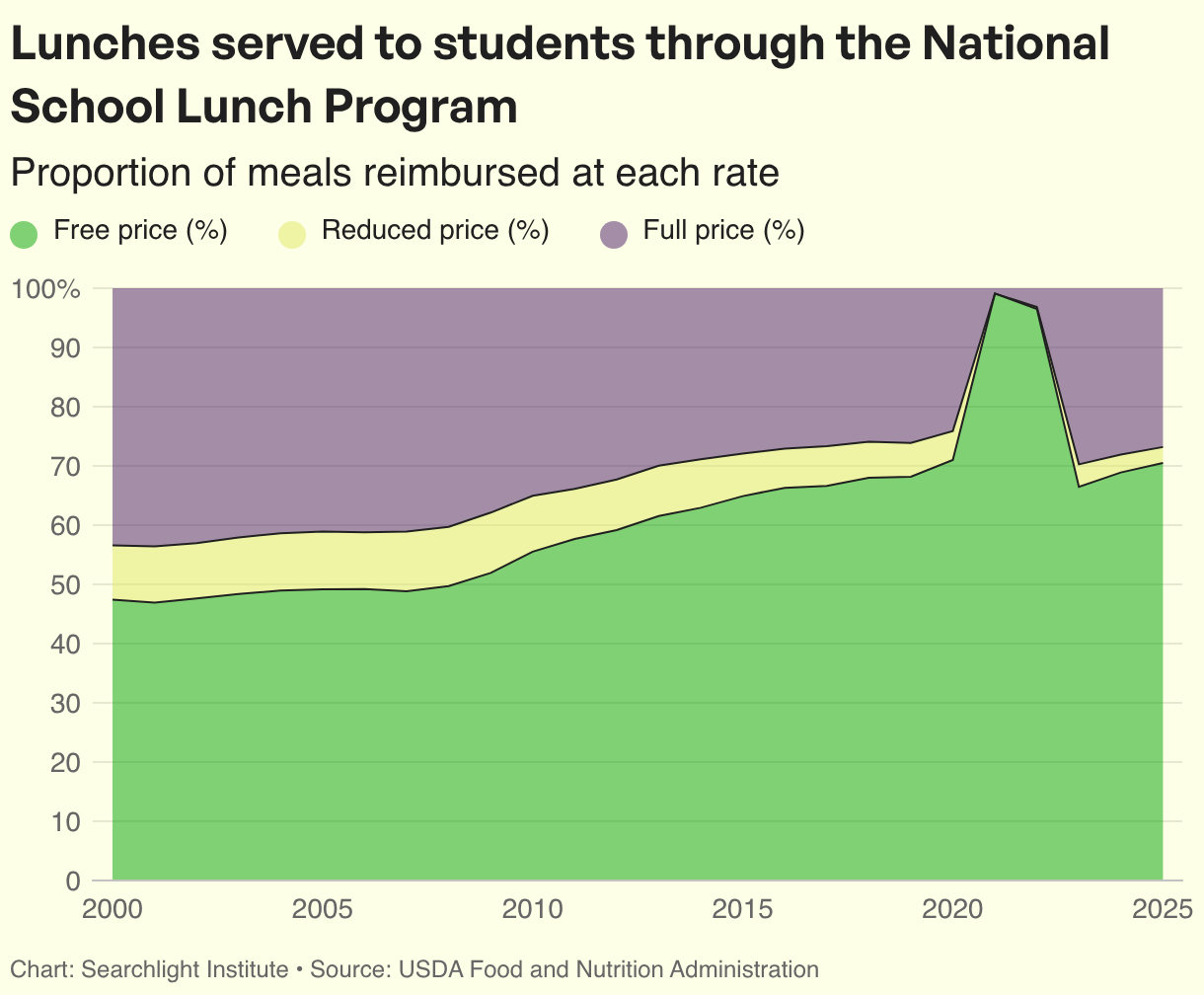
Since the passage of the Healthy, Hunger-Free Kids Act in 2010, school enrollment in the CEP and free meal uptake have grown immensely. The share of average daily lunches that are reimbursed at the “free” rate has risen almost 16% since 2010, from 55.3% to 71% in 2025 (Figure 1). Greater use of the CEP has also contributed to the decline of reduced-price meals, which have gone from 9.4% to 2.7% of meals provided during that span. Critically, the percentage of students receiving free lunches was nearly 100% during the COVID-19 pandemic — but just for that limited period — and will be discussed later.
CEP enrollment has played a major role in increasing meal consumption at participating schools. According to USDA analysis, the CEP increased average daily lunch participation by 6.8% and breakfast participation by 12.1% among adopting schools and districts, compared to non-adopting schools with similar characteristics. These gains persisted and modestly grew in the second year of implementation. Likewise, state-level studies in Texas, Pennsylvania, and Maryland found that opting into the CEP could increase meal participation between 4%-8%.
However, adoption has not been uniform across or even within states. CEP adoption is voluntary and the decision to do so is made at the district or school level. Whether a school adopts the CEP, as demonstrated in the following section, is largely a financial decision. Reimbursement rates and revenue streams are important to consider when schools adopt the CEP. Schools may participate individually, as a subgroup of schools within a district, or altogether across a district or region. Schools may strategically form a collective applicant group to maximize the collective reimbursement amount received. Meanwhile, other schools and districts may opt not to participate altogether.
Nationally, just 74% of eligible schools decided to utilize the CEP. The three states closest to 100% CEP-eligible participation are New Mexico, Vermont, and West Virginia — all between 99.2% and 99.8%. Fifteen states currently have less than 50% of their CEP-eligible schools participating, with New Hampshire being the lowest at 2.8% (Figure 2). Uptake in the program is influenced by a variety of factors: outreach by state and advocacy groups, direct certification systems, state laws, when the program was adopted in the state, and the meal reimbursement rates provided by the federal government.
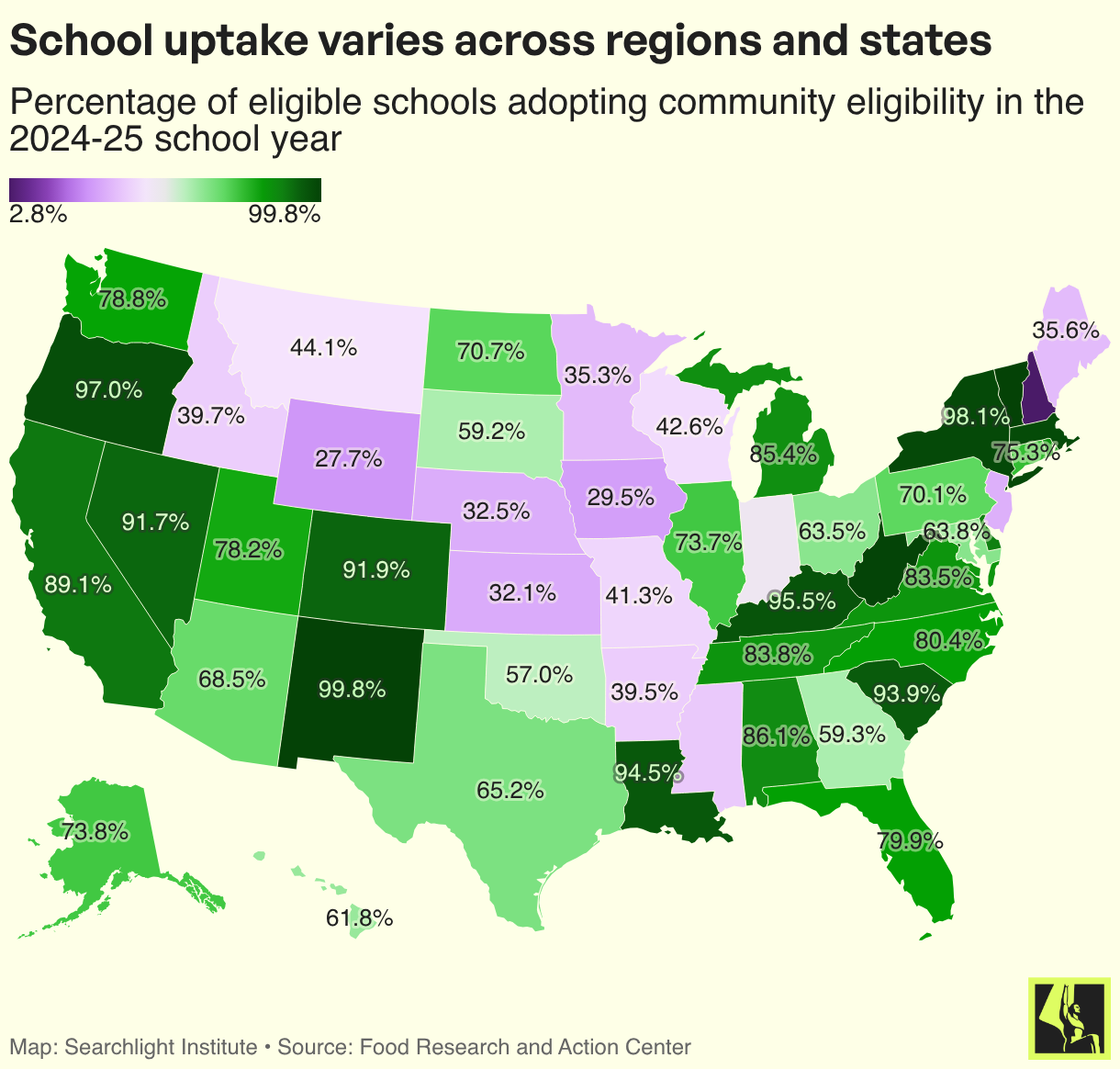
Because the CEP operates downstream of means-tested benefits like SNAP, Medicaid, and TANF, schools can be significantly impacted by changes made to eligibility to those programs. For example, six states (Alaska, Hawaii, Mississippi, Missouri, New Hampshire, and South Dakota) and the District of Columbia do not participate in direct certification through Medicaid. While Medicaid and SNAP participation is the most common benefit combination, almost 30% of Medicaid participants do not participate in any other benefit program. In these states, dependents of Medicaid-only recipients would not be counted as part of their school’s ISP figure.
Recent reforms to SNAP and Medicaid, enacted as part of the One Big Beautiful Bill Act (OBBBA), pose the most urgent threat to schools’ CEP eligibility and the financial viability of CEP in schools that continue to qualify. The new cost-sharing effort mandates that most states will need to cover a portion of SNAP costs — for the first time ever — and states with higher error rates will shoulder a greater percentage of their program costs. States could be on the hook for hundreds of millions of dollars in SNAP expenses, forcing state lawmakers either to cut overall state spending, levy higher taxes, or tighten eligibility for SNAP — with direct implications for the CEP. Already between July 2025 and March 2026, 4 million people have fallen off the rolls of SNAP, including over 800,000 children. Shifts in the ISP should be expected and could be the difference between a school or district qualifying for the CEP or not.
How reimbursement rates are determined
In addition to whether a school or district qualifies for the CEP, the ISP metric is used to calculate the meal reimbursement rate(s) received. A minimum ISP of 25% determines whether a school qualifies for CEP. When determining the share of meals that are reimbursed at the highest rate by the federal government (the “free” rate), CEP applies a multiplier of 1.6 to the ISP number to account for students in poverty who may fall through the cracks in the direct certification process. For example, if 30% of students have been explicitly identified as receiving assistance, that figure is multiplied by 1.6 to determine the percentage of meals reimbursed at the free rate.
Schools with an ISP of 62.5% or higher are fully reimbursed for every meal served because the multiplier brings the fully reimbursed share to 100% (62.5% x 1.6 = 100%). If a school or district has an ISP below 62.5%, their multiplier-adjusted ISP figure is the percentage of served meals that are reimbursed at the free rate — the remaining percentage receive a smaller “paid meal” rate. All students eat at no charge regardless of which reimbursement category their meal falls into for schools enrolled in the CEP.
Reimbursement rate amounts are adjusted annually using the Consumer Price Index for All Urban Consumers (CPI-U) focused on food away from home. For SY 2026-27, the lunch reimbursement rates are around $4.78 for free meals, $4.38 for reduced-price meals, and $0.47 for paid meals (Figure 3). The breakfast reimbursement rates are around $3.05, $2.75 and $0.42 for free, reduced-price, and paid meals, respectively. Reimbursement rates are crucial to school cafeteria operations because the food services rely heavily on federal program revenue. When reimbursement revenue fails to keep pace with operating costs, school cafeterias must reduce costs, which can reduce meal quality, or generate additional revenue to break even.
Reimbursement amounts often do not cover the materials, labor, and operating costs necessary to produce a meal. In fact, around one-third of total program revenue for school meals typically comes from charging students for meals (paid or reduced-price) and is critical to operations. While most school food authorities are able to break even, nearly one-third have been unable to cover the costs of running their programs. This share dropped significantly during the pandemic when federal funding levels increased — albeit only for a short period of time.
For this reason, federal reimbursement rates can dictate whether it is financially feasible for eligible schools to participate in the CEP. Schools with the highest poverty concentrations find the CEP financially beneficial — by offsetting costs they would otherwise need to cover — while eligible schools with lower ISPs may face a fiscal dilemma. For them, opting into the CEP can bring additional cost burden. Many of those lower-ISP schools do not participate in the CEP because they would need to shoulder much of the cost of forgoing meal fees from families. Among LEA-wide eligible districts with ISPs between 40% and 45%, only 33.4% participated at all, compared to 78% of districts with ISPs above 62.5%. Each 10-percentage-point increase in ISP was associated with a 17-percentage-point increase in the likelihood of adoption when other factors were held constant.
Schools do have ways to limit their cost exposure at the margins. The CEP allows for schools to enter the program in a group and have their ISP calculated together. This enables schools to maximize their ISP count and provide more meals that receive the highest possible reimbursement rate. For example, a large school with an ISP of 80% could form a group with two small schools with ISP rates of 60% to ensure that they receive the free meal reimbursement rate for every meal provided to students. Certification for the CEP also allows schools to lock in their reimbursement rate for a four-year period. Schools may update their ISP at the start of each four-year period or within the four-year cycle under certain conditions, if doing so would increase their reimbursement. More than half of participating LEAs reported recalculating their ISP before the cycle’s end.
With that said, the most effective way to make the CEP financially viable for more schools is to improve the federal reimbursements provided. The paid-meal rate, in particular, can make the CEP enrollment prohibitive for eligible schools with modest ISPs.
Building off progress made under recent administrations
As we enter the 2026-27 academic year, universal free school meals remain a low-hanging and feasible policy priority. The biggest reason: Virtually all children received free meals during the pandemic, an unambiguous success of the Trump and Biden administrations. What was in place for a brief period of time could be implemented again, permanently.
When Congress passed the Families First Coronavirus Response Act (FFCRA) in 2020, the USDA received a host of temporary waiver authorities around school meals. In addition to helping schools stay compliant with COVID-19 precautions, the USDA leveraged these new waivers to allow all schools and districts to serve free meals. This was technically done through the summer meal program, although the waivers were applied during the regular school year as well. Starting in July 2021, the provision of free school meals was paired with another waiver letting schools receive the higher summer meal reimbursement rate for each meal provided to students. In total, 98% of state agencies used waivers to allow school meal operations to claim the more generous reimbursement rate for meals served. This expansion expired by the start of the 2022-23 school year, but it provides a clear demonstration of how expanded eligibility and larger reimbursement rates can be paired to achieve universality.
Progress has been made in meaningful increments since then. Rather than allowing the policy to lapse, a number of state legislatures passed bills to fund universal free school meals. Entering the 2026-27 school year, nine states have taken this step on their own. Meanwhile, executive branch adjustments were made to the CEP in 2023 as congressional action stalled.
In particular, the Biden administration expanded the provision of free meals by reducing the ISP eligibility threshold for the CEP. In October 2023, the USDA finalized a rule lowering the minimum ISP from 40% to 25%. This expansion of CEP eligibility has played a role in additional school districts qualifying, although newly eligible districts may face financial constraints that prohibit participation. As discussed earlier, lower ISP levels can result in districts covering the cost of a significant number of meals that would have largely been paid by families otherwise. But the reimbursement multiplier cannot exceed 1.6 according to statute. Without improved reimbursement rates, the cost of covering those meals could be difficult for districts. And only Congress can make that a reality.
Securing universal free meals, permanently
USDA and individual state efforts are worthwhile investments, but legislative action at the federal level is necessary to enact a permanent expansion to all children and reimburse schools enough to cover the costs. Only then will free school meals become universal. Fortunately, a durable solution can be delivered through reforms to the CEP that are more budget-friendly than the $11 billion annual cost of extending the pandemic meal waivers. This approach involves statutory adjustments to the CEP’s eligibility threshold and the reimbursement rates provided to schools and districts.
Bring the CEP eligibility threshold all the way down
The CEP should be reformed to maximize eligibility. While the Biden administration did move the ISP eligibility level from 40% to the current 25%, this was done via agency regulation and concerns were relayed that going further may have risked the legal viability of the adjustment. Congress should take the next step and bring the threshold down to 0% in statute, opening up CEP eligibility to all schools and districts on a permanent basis.
Raise the multiplier used for determining reimbursement rates
Even if CEP eligibility becomes universal, schools with lower ISP levels may still be reluctant to enroll for financial reasons. The cost of a sizable number of meals paid by families would shift to the schools. For this reason, expanding CEP eligibility is necessary yet likely insufficient to achieve universality — so it should be paired with more generous reimbursements.
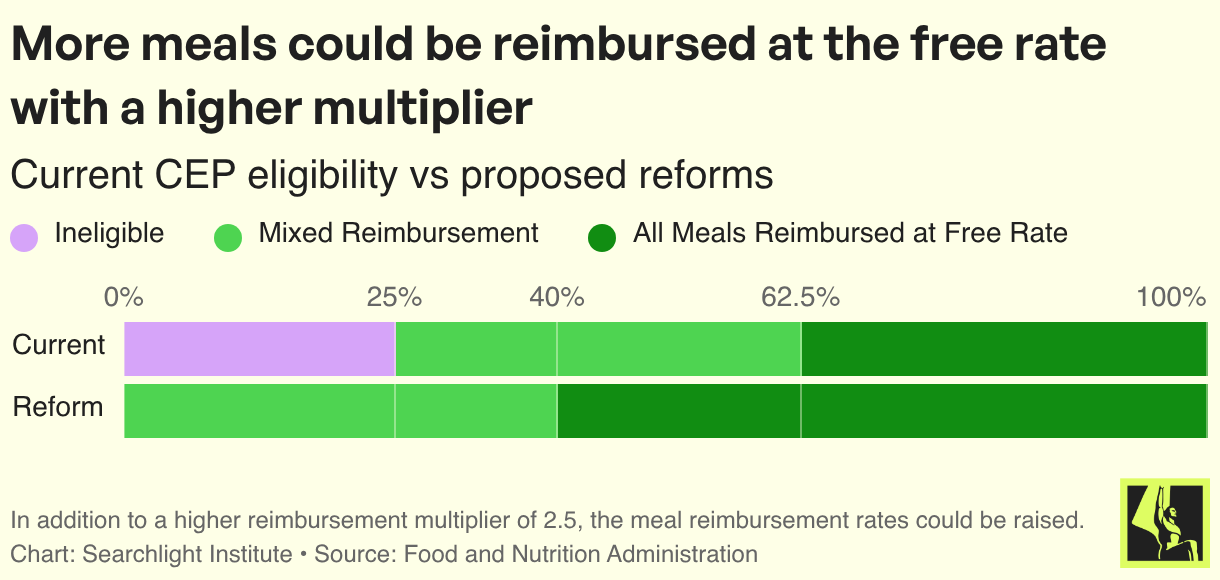
One way to offset schools’ cost burden is for Congress to increase the multiplier applied to determine schools’ reimbursement rates. For instance, the multiplier could be raised from 1.6 to 2.5, allowing schools with a 40% ISP to be fully reimbursed. Schools with ISP levels below 40% would have a larger share of their meals reimbursed at the free rate as well. There are existing House and Senate bills that would implement this higher multiplier. Higher multipliers will make it easier for schools to participate in the CEP, albeit at a higher price to the federal government.
Directly raising the reimbursement rates offered
Congress can further support schools by increasing the actual reimbursement rates offered for each type of meal. Higher reimbursement rates for each free meal could help incentivize CEP participation among schools with lower ISPs. The same could be true if the federal government offset more of the cost of paid meals that schools would otherwise need to shoulder if enrolling in the CEP. Alternatively, a larger free-meal reimbursement rate could be applied to all meals, as is done in the proposed Universal School Meals Program Act of 2026, although this would be more expensive for the federal government.
Another route could be for Congress to set a reimbursement floor for schools using the CEP. If a school’s ISP is too low, the school may not administer universal school meals under the existing reimbursement rates despite being made eligible. A reimbursement floor could guarantee that 40% of meals at each school would be reimbursed at the free-meal rate. The reimbursement multiplier would still be applied — meaning schools in wealthier districts would still have some meals reimbursed at the paid rate — but would pertain to fewer meals overall.
Undoing OBBBA’s worst provisions to support CEP enrollment & reimbursements
While the CEP should remain the focal point for reform, there are other reforms that could improve CEP enrollment and the reimbursement rates for schools. At the federal level, recent changes made to Medicaid and SNAP under OBBBA are set to reduce — or already have lowered — the number of program participants in states. This could consequently lower the number of children who can be directly certified and incorporated in each school’s ISP figure. Lawmakers should look to undo those reforms.
Conclusion
Over the last two decades, significant progress has been made to alleviate administrative burdens for American families and deliver free meals to their children while at school. But the job is not done. Congress should statutorily expand CEP eligibility to all schools and improve the reimbursement levels provided so every school can cover the cost.
In doing so, Congress can (re-)establish universal free school meals and make the lunch room process as straightforward for children as getting on the bus: no direct payment required.