
Is Medicare for All a Vibe?
For years, the debate around universal health care has polarized the Democratic Party, with some insisting that it requires a single-payer Medicare for All system. However, as Medicare for All has risen in prominence, American voters have come to a different conclusion. They see Medicare for All more as a symbol of the broad goal of achieving universal health care — a goal which all Democrats support — than as a specific policy.
Encouragingly, progressives are starting to move away from their long-held insistence that Medicare for All has to mean single-payer. Senator-elect Abdul El-Sayed campaigned on a plan to allow private health insurance to remain alongside Medicare for All, and recently said the essence of his plan “is guaranteed public health insurance.” Senator Adam Schiff called for Medicare for All, which, in his words, meant “If you want to participate in Medicare, you can do that. If you want to stay on private insurance, you can stay on private insurance.”
This newfound flexibility from progressives has begun to materialize alongside a more dynamic posture toward health care from Democratic leadership. Speaker-designate Hakeem Jeffries pledged to use the upcoming Congress to pass universal health care for children (Medikids) and lower the age of Medicare eligibility — two massive expansions of public health insurance.
Democrats should seize on this moment to align themselves with voters’ understanding that Medicare for All is shorthand for universal health care, and shift their intraparty debate to focus on how to achieve it without diehard adherence to a specific policy. In doing so, they can move beyond an unproductive circular argument and embrace a brand that is very popular with American voters.
A survey from the Searchlight Institute finds that the Democratic Party’s burgeoning health care consensus is in-line with public opinion. This is because most voters are more likely to describe Medicare for All as shorthand for “universal coverage” rather than as a specific policy. It is important to understand Medicare for All as a brand — one that has gained near-ubiquitous recognition, but which voters mostly understand to mean universal coverage.
Searchlight asked likely voters two open-ended questions:
- What does Medicare for All mean?
- What is the difference between Medicare for All, single payer, and a public option?
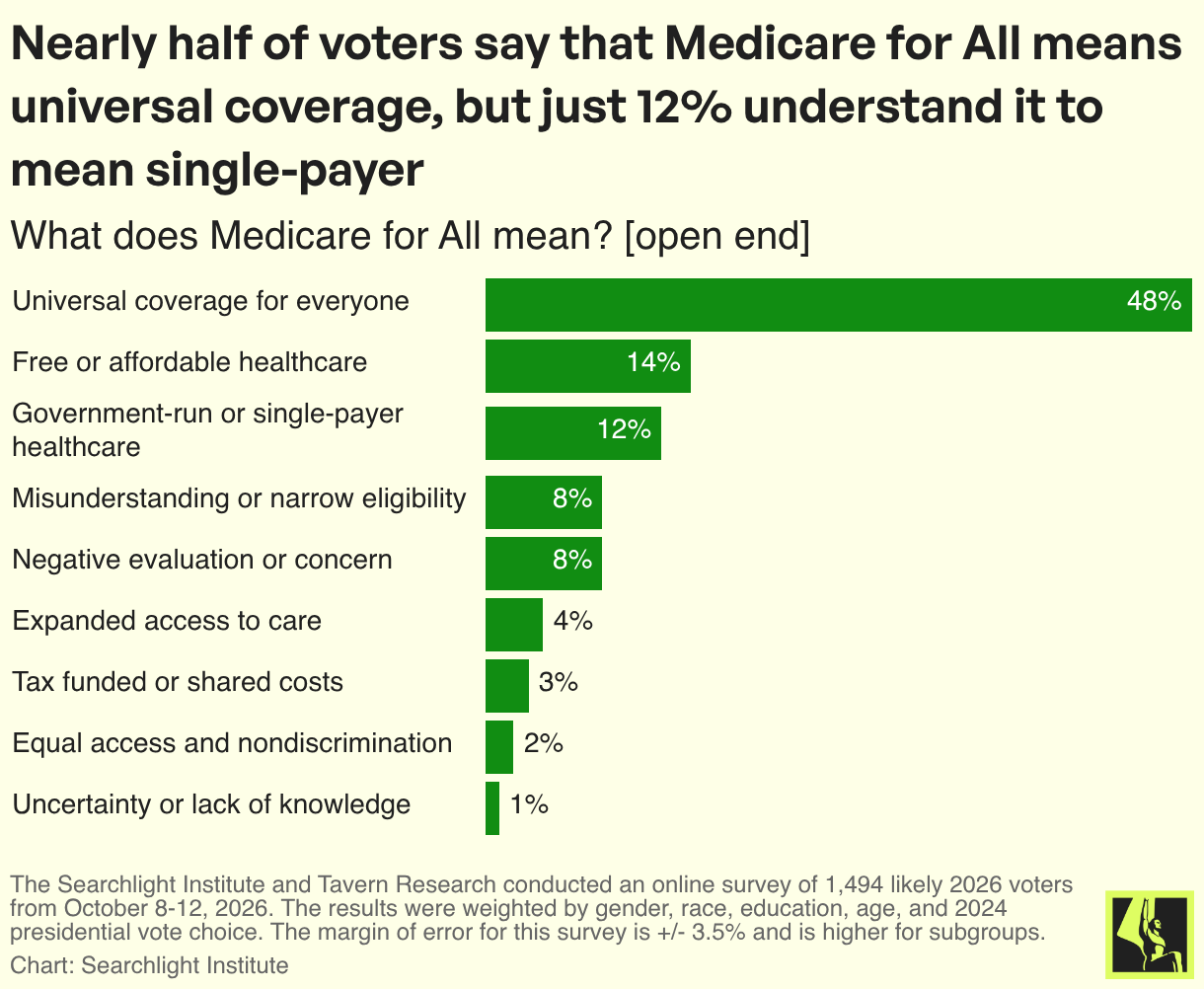
Just 14% of respondents say Medicare for All means free or affordable health care, while only 12% describe the slogan as meaning government-run or single-payer health care. Nearly half of voters say that Medicare for All means “universal coverage” for everyone. At the same time, a plurality of voters (37%) misunderstand “single-payer insurance” to mean that each person would pay for their own plan. Positive responses to polling questions about “Medicare for All” that give no other details of the plan should be interpreted as positive responses to the general idea of universal coverage, that could be provided by several different plans.
The results are in line with a clear pattern Searchlight has noted over the past year of our health care public opinion research, including our polling collaboration with the progressive media company Zeteo. Support for Medicare for All is strong and durable in the abstract, mainly as a slogan meaning universal coverage, but that support decreases when voters are given the specifics of the current Medicare for All legislation introduced by Senator Bernie Sanders (I-Vt.) and Congresswoman Pramila Jayapal (WA-07) — new taxes, ending private insurance, or tasking the government with successfully administering a national health care plan.
What Voters Really Think About Medicare for All
- Voters mostly understand Medicare for All to mean universal coverage. Nearly half of voters (48%) say that Medicare for All is universal coverage for everyone, 34-points higher than the second most popular response. Importantly, only 1% of voters said that they did not know what Medicare for All means. There might be some confusion about the details of the program, but voters are familiar with the policy name.
- When asked what Medicare for All means, voters do not immediately think about how to pay for the program. Only 3% of voters mentioned taxes or the costs of the program, and ending private insurance did not register at all. Importantly, aspects of Medicare for All that have reduced support for the program in our previous polling did not come up in responses to this open-ended question.
The Difference Between Health Care Proposals
- Few voters could tell the difference between these three health care proposals: Medicare for All, single payer, and a public option. Just 12% of voters overall were able to explain the differences between them, while 17% of voters said that there were no differences, and another 12% were unsure. Another 10% of voters responded with unprompted support or opposition to the policies rather than a definition, suggesting that some voters believe these names to be partisan signals rather than unique policies.
- Importantly, single payer is not a widely understood term among voters. 37% of voters gave the opposite definition of single payer, saying it meant individuals pay for their own care. Nearly three-quarters (74%) of respondents gave confused or incorrect responses.
Consistency with Past Results
These findings deepen our previous polling in January, March, and June, which found that Medicare for All is very popular in the abstract, but that popularity falls when voters hear more about the program details.
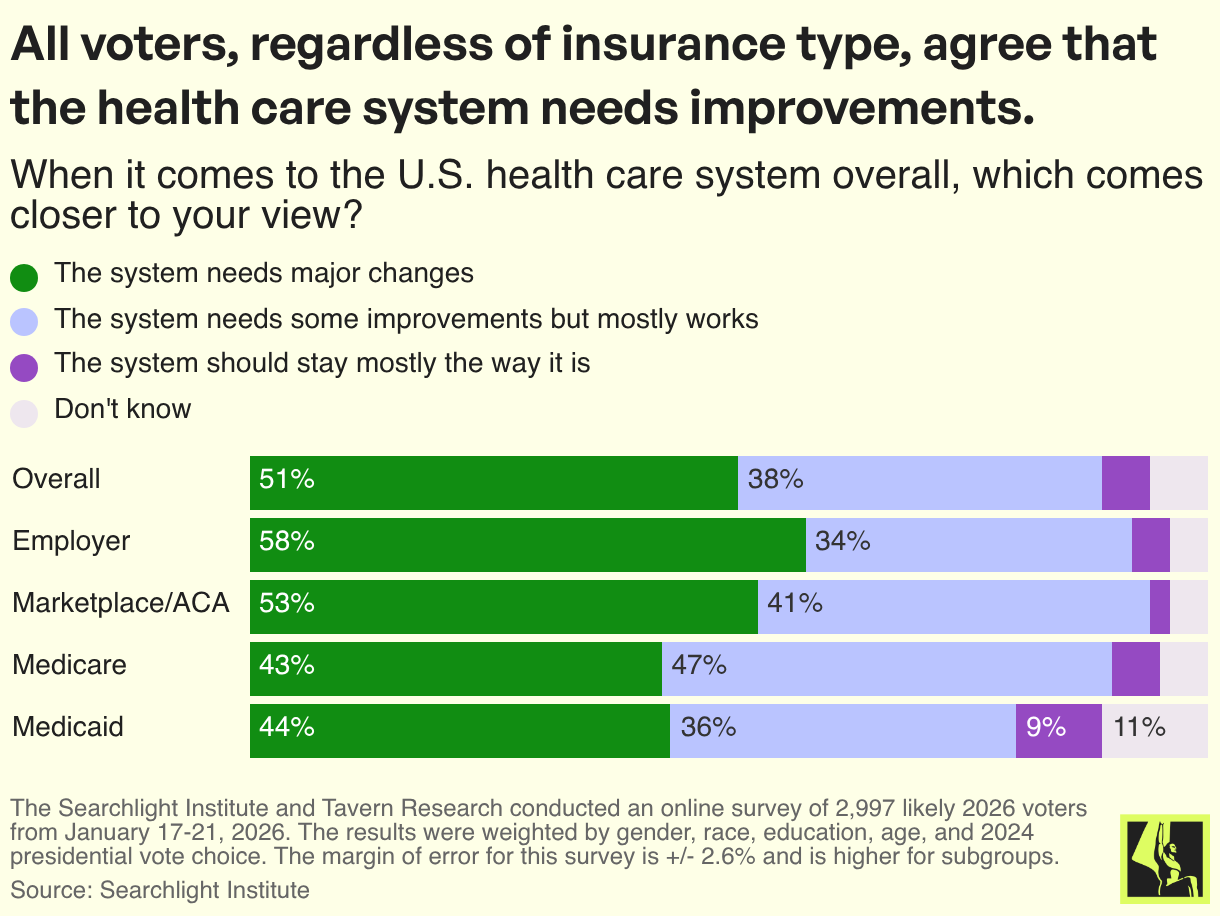
- Voters have an appetite for changes to the health care system. In our January polling, we found that Democrats (57%) and Independents (56%) agreed the U.S. health care system needs major changes, while Republicans were more split, with 45% saying the system mostly works. Just 5% of voters overall, and 6% of Republicans, answered that the system should stay mostly the way it is. There is nearly universal agreement that the system needs at least some improvements.
- But voters don’t want the changes to mean eliminating all private health insurance. Our January polling also found that voters were split on what our health care system should look like. A majority (56%) answered that they want a mix of private and public health insurance systems. Around one-quarter (26%) preferred the current system of private insurance with public programs for seniors and the very poor, while 30% would like a mix of private and public insurance available to all. Just 5% wanted only private insurance, while less than a quarter (24%) answered that they want a single national public insurance system. Importantly, a mix of private and public health insurance was the most popular proposal across partisan lines and among all people, regardless of how they currently receive health insurance.
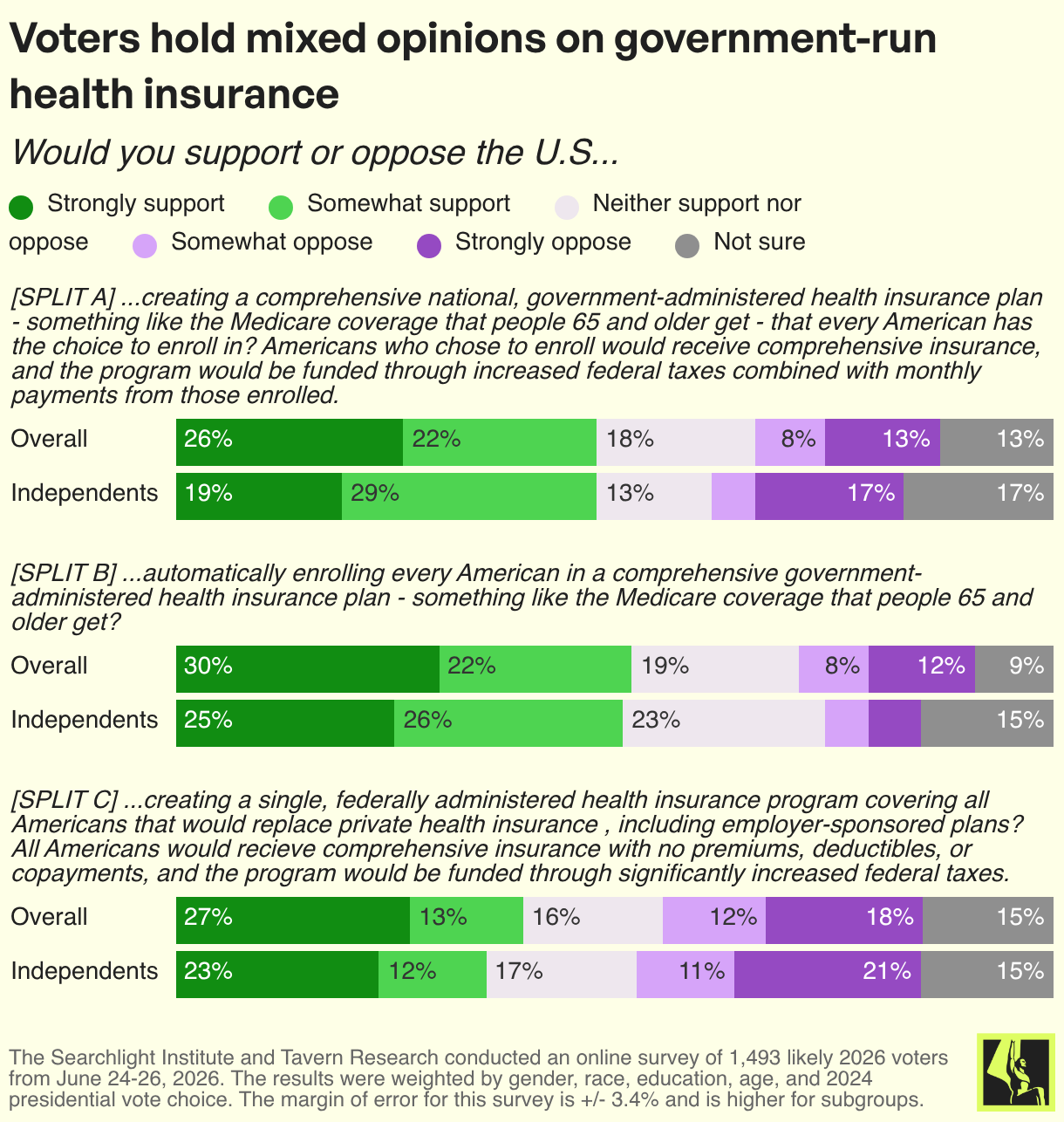
- In a split test, voters are least supportive of Medicare for All when they are told about the trade-offs of the policy. The results of a June split test found that a government-run health insurance program was attractive to voters when they were provided an honest description of the program’s benefits and trade-offs as long as such a program did not eliminate private insurance. The description that yielded the least support among voters proposed replacing private health insurance, which would impact the 178 million Americans who are currently enrolled in employer-sponsored plans.
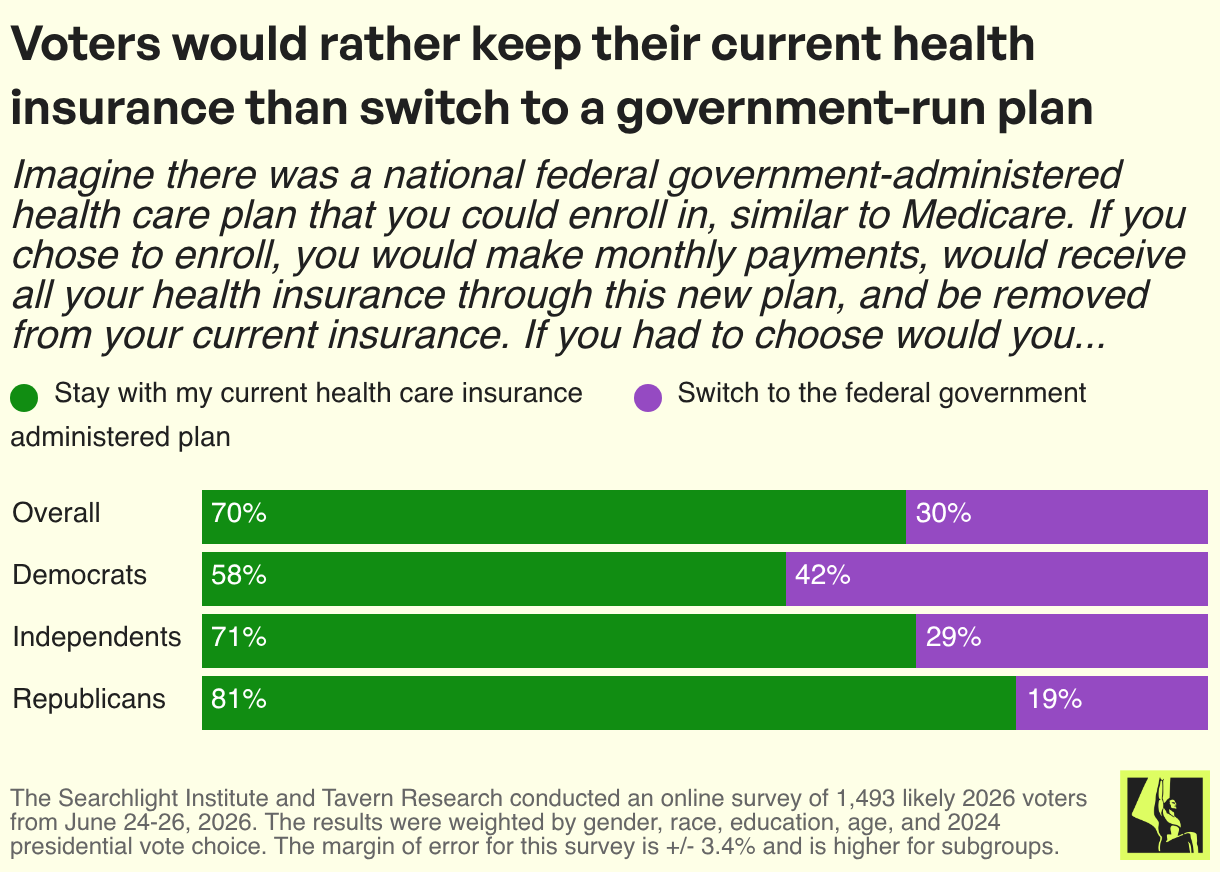
- Voters do not want to leave their current health care plans. In our June polling, a strong majority of voters, including 57% of Independents, said they do not have confidence that the federal government could successfully administer a national health insurance plan.
- Meanwhile, 70% of all voters said they would rather stay with their current health insurance than switch to a government-administered plan similar to Medicare.
Conclusion
Health care is an extraordinarily complex policy area, and voter opinion reflects that. Interested parties should be cautious about interpreting topline support of “Medicare for All” as an endorsement for the legislative proposal as it is currently designed by Sanders and Jayapal, as voters tend to understand it better as a slogan that means universal coverage than as specific legislation.
Democrats are on extremely strong ground in advocating for universal health care. Voters support universal coverage in concept — which itself is a strong signal for bold action to achieve these aims — and remain most supportive of a health care system that meets such a guarantee through a combination of private and public insurance.