
How VA and NJ Voters View their Governments
With two new governors planning their transitions and first acts in office, Searchlight’s research shows that New Jersey and Virginia voters are looking for leaders who prioritize fighting waste, delivering results for their constituents, and modernizing government systems.
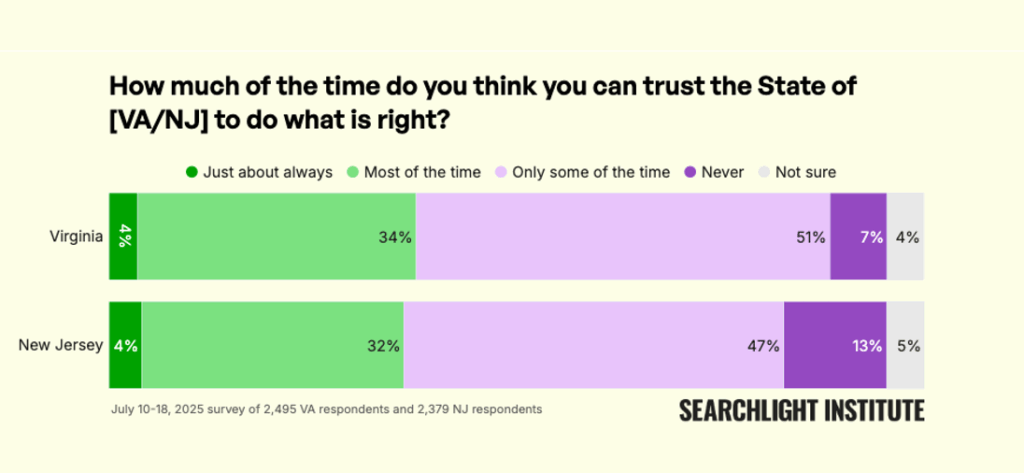
Only about a third of New Jersey and Virginia voters say they trust their state government to do what’s right “most of the time” or “always.” There is a significant trust gap by partisanship, with just 35% of Virginia Democrats having high trust in their state versus 53% of New Jersey Democrats. (As this poll was conducted pre-election, we may see some ongoing shifts in opinion as a Democrat takes over the governor’s mansion in Virginia.)
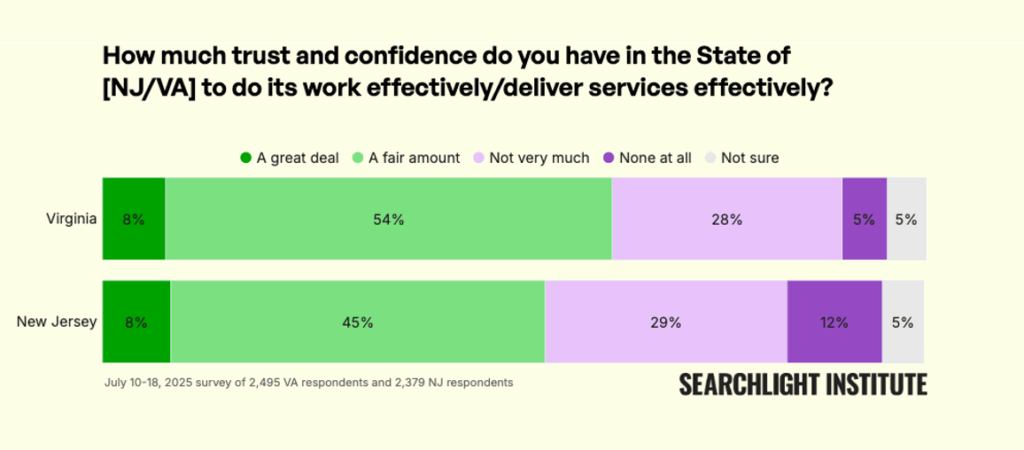
A similar trust gap exists when asking voters about the ability of their state to do its work effectively. Only 8% of voters in both Virginia and New Jersey have “a great deal” of trust in their respective state’s ability to deliver services effectively. The institution of state government does not have a great brand with voters.
That said, voters in both states rate their state government more highly than the federal government. Fewer than one in five trust the federal government to do what is right—with Virginia voters a net -63 (16% just about always/most of the time; 79% only some of the time/never) and New Jersey voters a net -60 (17% just about always/most of the time; 77% only some of the time/never). Similarly, 53% of Virginia voters believe their state government is better than the federal government; a plurality (41%) of New Jersey voters say the same.
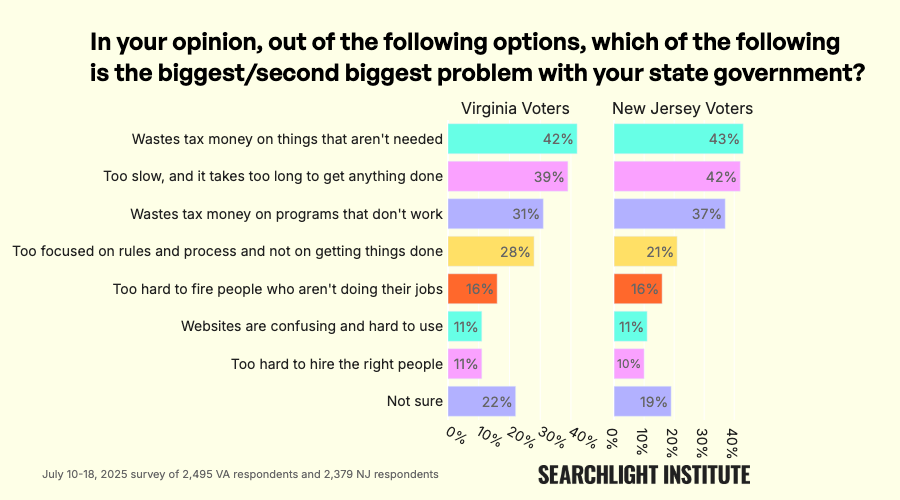
Despite higher ratings for state governments than the federal government, there is still evidence of widespread distrust and dissatisfaction with the Virginia and New Jersey state governments. When asked about the biggest problem with their state governments, a plurality of voters chose “wastes tax money on things that aren’t needed” (42% in Virginia; 43% in New Jersey) as their first or second choice. The government being “too slow” was a close runner-up, with 39% of Virginia voters and 42% of New Jersey voters saying as much. Despite the national focus on proceduralism versus deliverism, voters were less likely to select “too focused on rules and process and not on getting things done” as their primary or secondary concern (28% in VA; 21% in NJ).
In contrast to the low ratings for “state government” as a whole, users of specific government services tend to rate them well. Voters in each survey were asked which specific government services they interacted with, and how they would rate their experiences. The most frequently cited services that voters in both states reported using included driver’s license applications and renewals; vehicle registrations; birth, death, and marriage certificates; public transportation; and state parks, forest, and recreation systems. While more than three in four in each state rated their experience with state parks, forests, and recreation systems as good (86% in Virginia and 77% in New Jersey), narrower majorities had positive experiences with the other services (and only a 47% plurality in New Jersey had a positive rating of public transit services). In both states, the worst rated service was zoning and housing policy—just 30% of Virginia voters and 41% of New Jersey voters with personal experience rated this positively.
Voters’ concerns about government waste—particularly waste of taxpayer money—were evident throughout the survey. “Cutting wasteful contracts” was the most popular idea for making the state government better in both states, narrowly beating “cutting out excess process to make things go faster.” Investing in government technology did not seem to be a difference-maker for voters. When asked to choose between two potential focuses for the government, voters in both states opted nearly 2:1 for “making state programs more effective so they do more good with each dollar” over “redistributing resources from those who need it least to those who need it most,” with the first statement winning majorities even among Democrats. The message of efficiency, effectiveness, and fighting waste seems to resonate across the political spectrum.
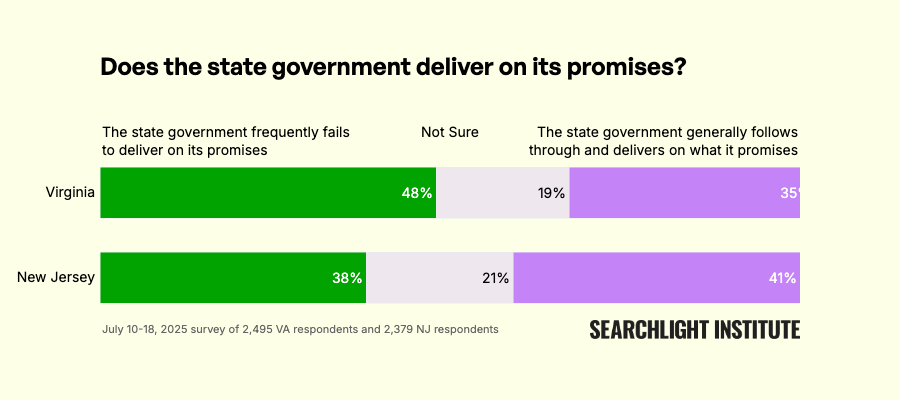
The states earn mediocre marks from voters on delivering on their promises, with 35% of Virginia voters and 41% of New Jersey voters saying the state government “generally follows through.” As in the earlier findings, this is more divided by partisanship in New Jersey, and more of a bipartisan consensus in Virginia. Due to this skepticism, and the high concern with waste, state governments may wish to avoid making big promises without a concrete plan to demonstrate progress to voters.
Methods
Tavern Research conducted two surveys on behalf of Searchlight Institute: one survey was conducted among 2,495 registered voters in Virginia from July 10-18, 2025; another survey was conducted among 2,379 registered voters in New Jersey from June 10-15, 2025. At a 95 percent confidence level, the margin of error for the Virginia survey is +/-2.7 percentage points and the margin of error for the New Jersey survey is +/-2.6 percentage points.
Policy Recommendations
Searchlight’s team of policy experts explores a series of tools that state leaders could use right now to build more housing rapidly and showcase an efficient and effective government function to voters hungry for it.