
Food Assistance in America: Opinion vs. Reality
The Trump administration and Republicans in Congress are seeking to make significant changes to the Supplemental Nutrition Assistance Program (SNAP), which helps put food on the table for roughly 42 million Americans. Steep funding cuts, cumbersome eligibility rules, and unfunded federal administrative mandates will lead to more bureaucratic red tape, more burdens on state operators, and more Americans going without food.
Our polling helps us to understand how Americans perceive the issue of food insecurity, and how they’d like it addressed. The topline finding is that Americans primarily believe food insecurity is a problem that should be solved by nonprofits and food banks, with 39% saying these are their most trusted institutions. This reality presents a challenge to those seeking to reform, expand, and defend SNAP. The federal government is trusted less than every other entity we named, except for “businesses and grocery retailers.”
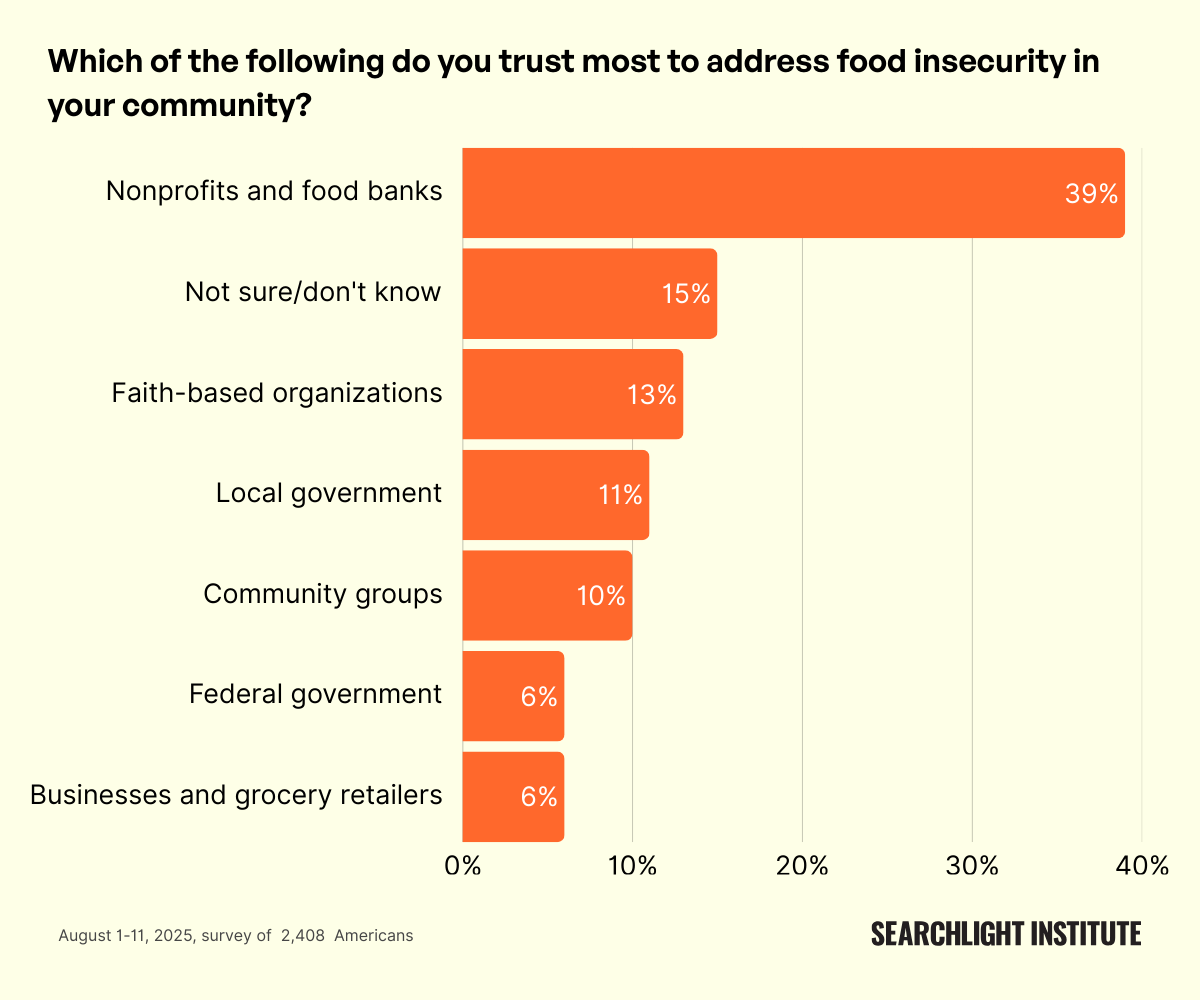
Americans’ trust in these institutions to address food insecurity appears entirely unrelated to how much each entity spends on food and nutrition. According to the USDA, the federal government spent $142.2 billion on food assistance in 2024, across SNAP, WIC, and other programs. An industry estimate of the top 300 food banks (including independent, faith-based, and nonprofit groups) puts them at around $16 billion in revenue. Governmental food assistance dwarfs any private effort by almost an order of magnitude, but trust is significantly lower.
This survey was run in the wake of SNAP cuts included in the One Big Beautiful Bill Act, so we were also interested in how people felt non-governmental entities should fill the gap. Results are consistent with the above, with a preference for food banks and nonprofits, rather than federal protections for SNAP benefits.
While the wording of this question was somewhat imprecise (it’s unclear where respondents expect “more support” for food banks to come from), overall findings point toward a strong preference for private action. State-level assistance is a less-trusted solution. Expanding federal protections is also not particularly trusted as a way to address hunger.

The bottom line: Americans’ preferences for food assistance provision are fundamentally misaligned with the reality of a federal program whose scale is impossible to duplicate with private efforts. Americans seem to prefer a dramatically different, and less practical, model of food assistance distribution than the one that exists.
This is a case where we believe it is important to understand public opinion, and to not allow it to dictate public policy.
Methodology
Tavern Research surveyed an online sample of 2,408 Americans (ages 18 and up), fielded over web panels from August 01, 2025 to August 11, 2025 and weighted by gender, race, education, 2024 vote for president, and birth year. Respondents were also weighted by whether they passed attention checks. The margin of error is 2.8%. This was an omnibus poll, and some results have been previously released in our work on party vibes and the doom chart. This post contains the full survey results, including previously released questions.