
Economic Precarity Fuels Isolationism
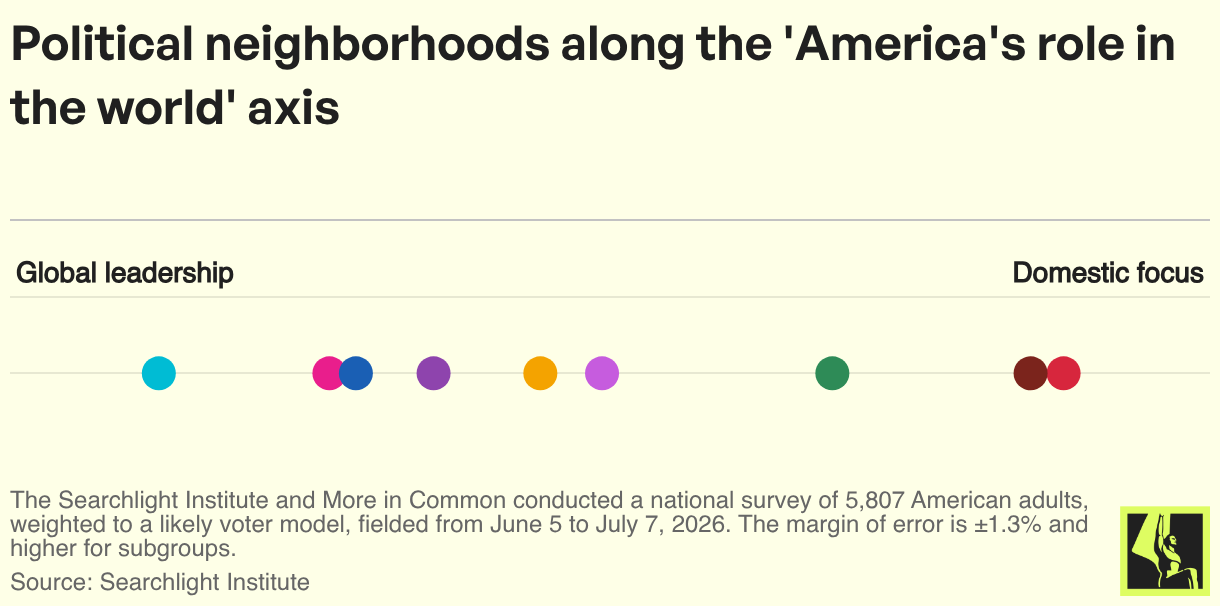
Our project, How to Build a Supermajority, identified five axes of public opinion that meaningfully divide the American electorate. One of these axes is “America’s role in the world,” encompassing the level to which voters want America to be a leader on the global stage, our responsibilities toward refugees, and preferences on whether funding should be spent on humanitarian causes abroad or domestic issues at home.
Despite partisan stereotypes that Democrats support involvement in global issues while Republicans take solidly isolationist and “America First” positions, we find that the segments are much more scattered on this axis. Liberal segments such as the Liberal Arts Left, conservative (Stars, Stripes, and Steeple), and heterodox middle (Trad-Digital) all prefer global leadership to a sole focus on domestic issues.
Instead of partisanship, we find that attitudes towards America’s international role are correlated with political ideology and self-reported economic stability. We asked voters: “Thinking about your life right now, how stable or unstable does your financial situation feel?”
The correlation between economic stability and opinions on America’s role abroad is much stronger among moderate and conservative voters and is virtually nonexistent among liberal voters. Our most left-wing segment, the Liberal Arts Left, reports being the most economically precarious, but also the most likely to favor an expansive global footprint.
One possible explanation for why this pattern does not exist for liberal voters comes from another axis: should the government prioritize keeping society open and free or maintaining law and order? Our two most liberal segments, the Liberal Arts Left and Lawn Sign Liberals, mostly strongly agree that government should prioritize keeping society open and free. When read through this lens, it might be that liberal voters’ support for international engagement is less about the financial cost of an American presence abroad than it is about a broader commitment to openness.
Among moderate and conservative voters, the relationship between personal economic precarity and attitudes toward America’s role in the world is statistically significant and holds up in a regression analysis. Importantly, this relationship is present only for perceived economic precarity; there is not a strong relationship between attitudes toward America’s role in the world and income.
In other words, what predicts a person’s willingness to retreat from the world is not how much money they make, but how secure they feel about it. With demographic and ideological controls in place, each step toward feeling less financially stable shifts moderate and conservative voters about 0.17 points toward a preference for a domestic focus. When moderate and conservative voters feel that their economic footing is uncertain, they are more likely to say that money and resources spent abroad are coming at their own expense.
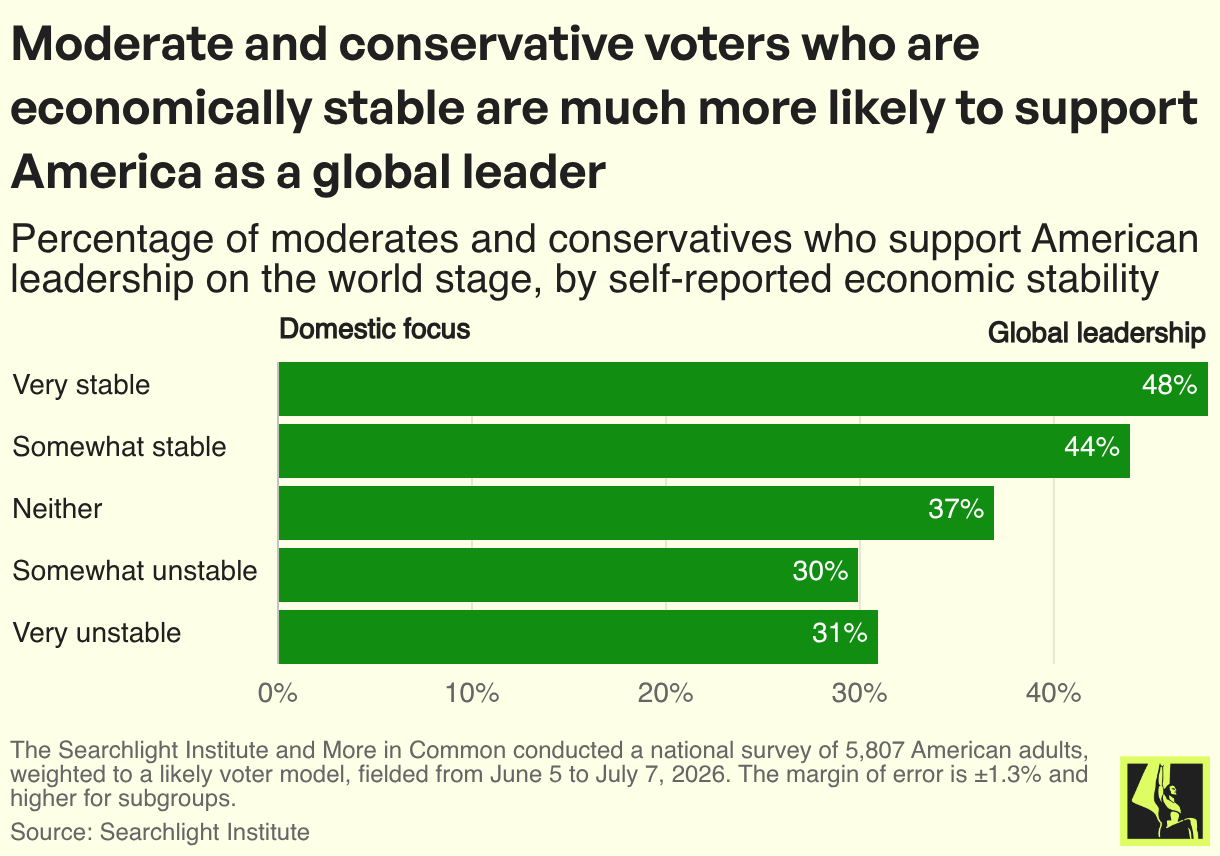
When shown visually, the step pattern is stark. Nearly half (48%) of moderates and conservatives who describe their financial situation as ‘very stable’ favor maintaining America’s leadership and engagement with the world. That number falls 11 points to 37% among moderates and conservatives who say their financial situation is ‘neither stable nor unstable’ and 17 points to 31% among those who say their financial situation is ‘very unstable.’ It is important to note that there is not a meaningful difference between those who say their financial situation is ‘somewhat unstable’ and those who say it is ‘very unstable.’ It does not seem to matter how unstable a voter feels, only that they feel unstable is sufficient for them to support pulling back America’s engagement abroad.
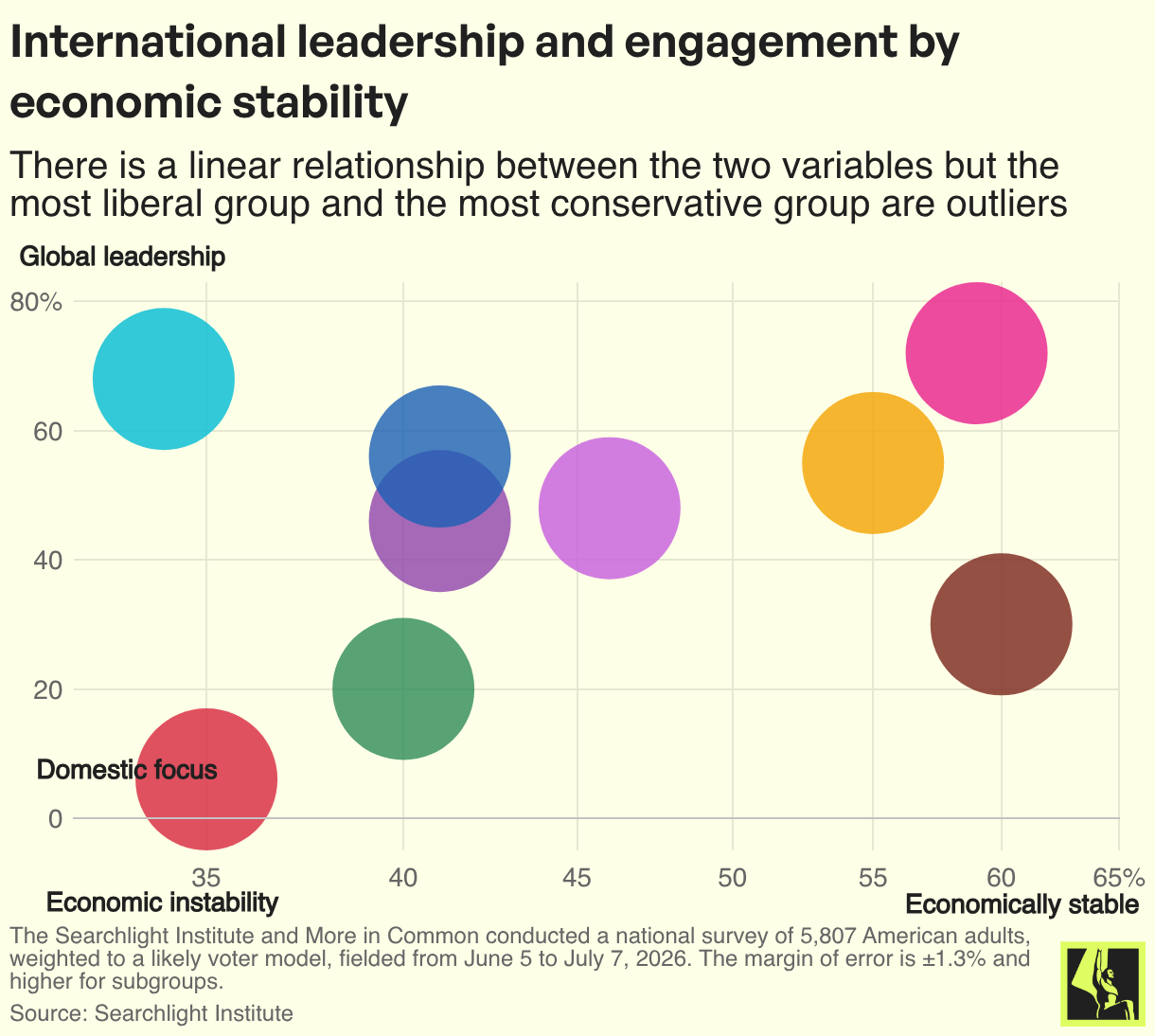
This pattern holds up with our voter segmentation. Our two most financially insecure conservative segments (No Trespassing Populists and Sticker-Shocked Skeptics) are also the most skeptical of global leadership, while our more economically stable conservative segment (Stars, Stripes, and Steeple) is much more supportive. Yet again, however, we have an important outlier in our most conservative segment, Cul-de-Sac Conservatives, which reports high levels of financial stability and a preference for the government to focus solely on domestic issues. Just like our most liberal group, our most conservative group has opinions on America’s role abroad that appear to be downstream from ideology and worldview rather than economic anxiety.
Conclusion
The relationship between economic precarity and international engagement, even when controlling for partisanship, can help convince many conservative voters to care about engaging with the world again. While liberal lawmakers will always have a difficult time convincing the most ideological conservatives that America should play a leading role on the world stage, there are many other conservative and moderate voters whose opinions on the issue are less rigid.
Unfortunately, addressing Americans’ feelings of economic precarity is no small order. Those making the case for American engagement abroad will need to address these concerns in two directions: they need to both enact policies that make voters feel economically secure and present international engagement as integral to domestic economic stability.
Moderate and conservative voters pit global and domestic priorities as in conflict with each other. It is the responsibility of lawmakers who want to restore global order to convince these voters that the two issues are complementary.