
Dignity in Looking for Work: Enhancing Unemployment Insurance Benefits the JFK Way
Key Takeaways
- Current unemployment insurance benefit levels fail to cover key expenses in many states. The average unemployment benefit replaces only about 40% of an average worker’s prior wages, well below what’s needed to cover the cost of housing, food, utilities, healthcare, and transportation.
- To provide better UI benefits to the median American worker, reforms must raise the maximum weekly benefit(s) and the wage replacement rate(s) offered by states to cover as much as 75% of workers’ wages.
- Similar reforms to those backed by President John F. Kennedy — and his successor, President Lyndon B. Johnson — could be enacted today to better support American workers and their families.
- Unemployment due to job automation was a concern during those presidential administrations and is a growing fear now with AI. Federal lawmakers can help by reforming the unemployment insurance system.
- In particular, the taxable wage base of the Federal Unemployment Tax (known as FUTA, based on the act that established it) could be raised to help cover the cost of enacting new benefit standards. FUTA would also be leveraged as an incentive to encourage state participation.
- To manage federal funds raised for this purpose, a new Unemployment Trust Fund (UTF) account known as the Federal Adjustment Account (FAA) would be created. This account would not replace the function of existing trust fund accounts — it would serve to complement those functions.
- Some of the new FUTA revenue — raised primarily to improve benefit levels — could be leveraged to fix issues with the existing trust fund accounts. Most importantly, more reliable resource levels would be delivered to UI agencies through the account that finances program administration. This would help reinforce program integrity as benefit levels rise.
Introduction
If you’re like me, you rarely think about the crumple zone of your car but are glad it is there. The whole purpose is to minimize the force experienced by the driver and passengers when a collision occurs. What could otherwise be a catastrophic accident is transformed into a manageable setback.
A robust unemployment insurance (UI) system functions as the economic crumple zone for workers. When unexpected layoffs hit, UI benefits help shield Americans and their families from the brunt of financial impact. However, this buffer support is too weak in the United States. Benefit amounts are often not generous enough to cover the unavoidable expenses that crop up in daily life.
Two unemployment program design features drive this problem: inadequate maximum weekly benefits offered and an insufficient percentage of prior wages insured. The maximum benefit amounts offered by many states are capped too low, resulting in middle-income workers seeing a smaller fraction of their wages insured than lower-income workers. States will also sometimes provide subpar wage replacement rates — the percentage of past wages received as weekly benefit payments — to workers. These related dynamics make it difficult for workers to search for and secure quality jobs.
This is bad for American workers and the economy as a whole. In order for workers to withstand sudden economic shocks without experiencing permanent financial ruin, reforms must enhance the size of unemployment benefits offered to workers going through job transitions. Congress can and should play a role in these efforts, especially as technological developments impact the labor force at the national scale. To this end, we propose adopting a reform approach similar to what President John F. Kennedy endorsed. This proposal includes 1) establishing a new federal Unemployment Trust Fund account that funds a share of regular unemployment benefits and 2) new national benefit generosity standards — helping to insure up to 75% of workers’ wages — that will be funded by this new trust fund account.
Refocusing ideas from the middle of the 20th century
As policymakers think through ways to better support workers facing unavoidable job loss due to AI and other disruptions to the labor market, there is a role for Congress to play — both for ensuring stronger benefit amounts and helping fund the expansions. State-level reforms are useful, but cannot guarantee adequate program standards for working- and middle-class Americans across the entire country. Although the federal government has typically only stepped in to help cover UI benefit costs during recessions, past presidential administrations and Congresses have considered a more permanent and supplemental role that could be adopted today.
Deliberations between the 1940s and 1960s, in particular, can help inform current reform efforts. After the creation of the unemployment insurance system, presidents in both parties — Harry Truman and Dwight Eisenhower — supported proper federal benefit level standards.1 However, their efforts and those of subsequent presidents — John F. Kennedy and Lyndon Johnson — never came to fruition.2 That legislative stagnation occurred despite concerns surrounding job automation, similar to those seen today:
“The advance of automation — is already threatening to destroy thousands of jobs and wipe out entire plants. It is creating fear among workers, and among the families of workers. It is menacing the existence of entire communities. And it can create poverty and want and even hunger — as it has already done in the coal mines of West Virginia where I saw the sad spectacle of men, displaced by machines, unable to find work, unable to shelter their families, and unable to feed their children — the forgotten children of the richest country in the history of the world.”3
– John F. Kennedy, 1960 AFL-CIO Convention
“No one knows as yet what the net effect of automation will be, but it is certain that it will result in major changes in occupational and industrial employment. It is also certain that large numbers of workers will experience either temporary or long-duration unemployment in the process. As President Johnson said in his 1964 Manpower Report to the Congress: ‘Automation offers the possibility of rapid economic progress — even greater freedom from want and freedom from toil. But it brings with it problems of dislocation and readjustment for large numbers of individuals.’”4
– William Haber (University of Michigan) and Merrill Murray (Upjohn Institute for Employment Research), 1966
These were not the only proposals foregone: Multiple presidential administrations proposed ways for the federal government to help fund benefit costs, too.5 One reform route proposed during the Truman administration was to supply “reinsurance” grants, where states with structurally higher unemployment rates due to the makeup of their industries would have a portion of their costs insured by the federal government.
A separate bill in the early 1960s proposed “equalization” grants to assist states in their ability to meet high benefit costs; if benefit costs exceeded a set percentage of a state’s total payroll, the federal government would cover two-thirds of the “excess” cost. States would have only been eligible for these grant funds if they met the required benefit amount standards. More importantly, the grants would have been funded by raising more revenue via the Federal Unemployment Tax (FUTA). 6 This approach was backed by Kennedy, under the basis that “weekly benefits are often too low in relation to lost wages to enable the worker to meet his basic and nondeferrable expenses.”7 States would have to choose to follow the new benefit standards for their employers to receive tax credits that offset their FUTA tax obligations.8
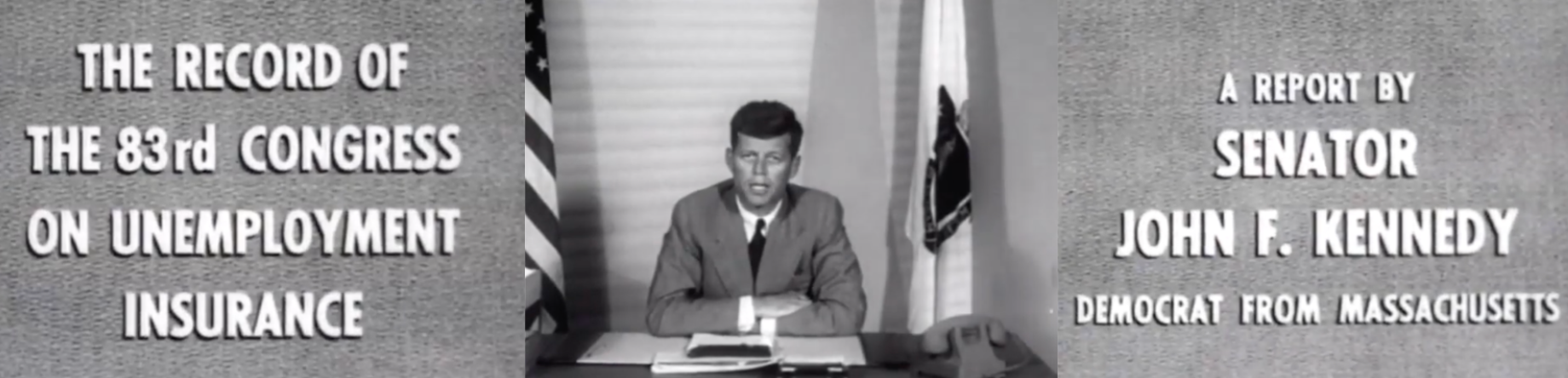 Pictured above: Then-Senator John F. Kennedy, making the case for stronger nationwide unemployment benefit standards. Kennedy discussed a federal reform that would help return unemployment benefit standards to the levels established by the “framers” of the Social Security Act.9
Sixty years later, we propose adopting a version of the JFK model. The federal government should take a supportive stake in benefit payments alongside improved benefit standards.10 Congress could incentivize and finance more generous benefit standards by leveraging and increasing the Federal Unemployment Tax.
The current state of affairs for unemployment insurance benefits
Right now, the UI benefit amounts that eligible workers receive are inadequate. State UI benefits tend to replace around 40% of an average worker’s wages.11 That level of wage replacement is not enough for workers to cover basic costs — an individual worker spends around 75% of their income on food, housing, utilities, transportation, healthcare, and other household expenses.12
A key reason why some states supply paltry wage replacement rates is that their maximum weekly benefits are capped at low levels, often failing to adjust them for average wage growth over time.13 This is an issue for a range of states and a real penalty for middle-income workers. Mississippi has the lowest max benefit level at $235, but more liberal states like California also have failed to update their best benefit offerings. California’s maximum weekly benefit sits at $450, and has not been adjusted for two decades. In practice, it replaces under 30% of an average Californian worker’s wages.14
However, many states have set the maximum weekly benefit equal to a percentage of the state average weekly wage. The average worker in these states can expect more generous insurance coverage than the average Californian, relative to their past earnings. At the lower end, the maximum weekly benefit in Illinois is 49% of the average weekly wage in the state; Hawaii applies the most robust maximum, which equals 70% of the state average weekly wage. The vast majority of states set their maximum weekly benefit below 60% of the state average weekly wage. States should follow Hawaii’s lead to help ensure that middle-class workers can cover core expenses while temporarily unemployed.
With that said, larger maximum benefit levels are insufficient on their own. Greater wage replacement rates are also required. It is common for state unemployment programs to replace around half of an eligible worker’s wages from their previous job.15 Even if a state’s maximum benefit level is set to two-thirds or three-quarters of the average weekly wage, the average worker cannot receive that benefit level if only half their wages are insured by the program.
In fact, just five states replace 60% or more of a median-income American worker’s wages if they lose their job and qualify for UI (Figure 1).16 The worst wage replacement rates for this individual worker — earning an annual salary of approximately $43,000 — are strictly in states with low maximum weekly benefit levels. Yet, raising the maximum weekly benefit would not impact this worker in a majority of states, while raising the wage replacement rate would.17 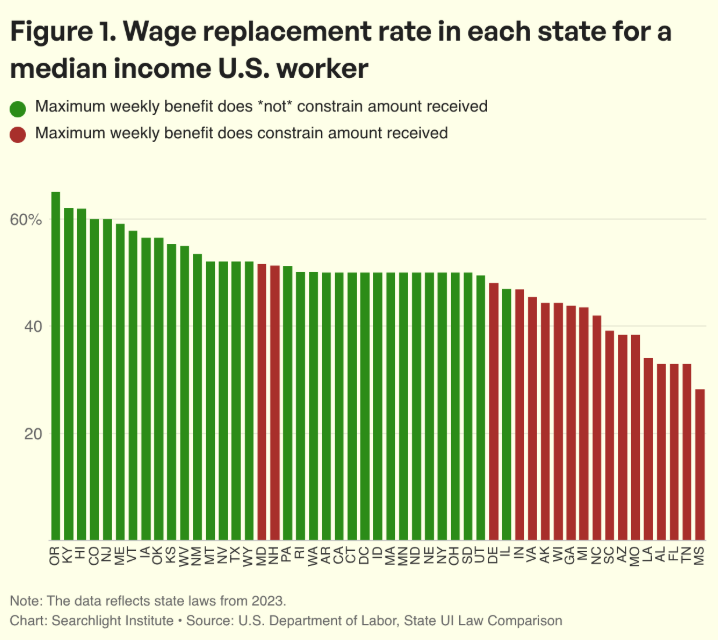 In order to insure 75% of wages for the average earning worker — or shift more in that direction — policymakers must consider adjusting both policy levers.
Optimizing the advantages of bigger benefits
Like any policy reform, there are pros and cons to increasing UI benefit sizes. Far too often, though, outsized focus during reform discussions has gone toward one downside in particular: the moral hazard effect. Unemployed workers could be incentivized to stay out of work longer due to larger cash payments. But moral hazard is not the only dynamic at play, nor is it the largest.
Bigger benefits alleviate financial constraints that would otherwise limit job searches. This is because workers can better afford the time to look for a quality job as a result. In a 2021 paper, Harvard economist Raj Chetty shows that this “liquidity” effect is the main reason why UI benefits produce longer unemployment durations.18 Households strapped for cash are the most affected by the provision of bigger benefits — and consequently able to extend their job searches.
This elevated financial security should not be underestimated. As recent research from the Federal Reserve Board of Cleveland has shown, more generous UI benefits can raise wage levels for recipients and non-recipients alike.19 These effects are strongest for those at the lower end of the wage distribution. A potential reason is that greater UI benefits disproportionately alleviate the liquidity constraints of lower-wage workers and provide them with a bit more bargaining power.20 Because firms are unable to tell which workers are receiving UI, non-recipients indirectly benefit from the UI reforms as well, in the form of higher wages.
Bigger benefits also hold positive implications for labor force participation. More generous UI payments can incentivize workers on the verge of dropping out of the labor force to remain.21 In such cases, longer unemployment spells can actually be a good thing. The alternative is that those workers — often disabled or older Americans with worse odds of securing employment — give up on ever rejoining the workforce and are forced to turn to other forms of government assistance.22 Better benefit levels give these workers more motivation to keep searching, and to return to employment. The enactment of higher state benefit levels has led to greater employment rates over time, with about 20% of the cost offset by reduced uptake of public assistance programs.23
There is still plenty of room to grow. Wage replacement rates remain well below optimal levels and limit these pro-employment effects. States and the federal government can both support these reform efforts. A majority of states have already made real progress in this regard by indexing their maximum benefit levels for wage growth to help insure middle-class workers. 24
Lawmakers could choose to raise the wage replacement rates offered as well. The added costs could then be covered by simultaneously broadening and indexing the program taxable wage bases — a step many states have not taken yet.25
Although states should not wait for Congress to act, there’s a clear role for the federal government to ensure that working Americans have access to generous unemployment insurance benefits. This is especially true given the prospect of AI-induced unemployment. American workers across the country require sufficient wage coverage if they lose their job due to AI, or any cause outside of their control. Yet, there is too much variation between state UI programs right now, and individual states face fiscal constraints that limit their ability to enact benefit increases. As a result, workers in identical jobs receive drastically different benefit levels just by being located in different states. 26
Congress should not remain a passive bystander. After decades of inaction, federal lawmakers can establish renewed national standards and help cover the cost of improved benefit levels.
How the federal government finances facets of the UI system now
Before detailing what congressional reforms could look like to improve benefit levels via a new enhanced benefits program, it’s important to understand how the federal government currently provides financial support to state UI programs. As laid out in statute, there are three three different avenues:
- Program administration is primarily funded by Congress. These administrative funds are raised via the Federal Unemployment Tax (FUTA) and held in an account specifically used for financing administration, called the Employment Security Administration Account (ESAA).
- The federal government is responsible for 50% of the cost of Extended Benefits (EB), which are additional weeks of UI eligibility that kick in when unemployment is sufficiently high. The revenue required to cover the federal share of the cost is also raised via FUTA and stored in an account known as the Extended Unemployment Compensation Account (EUCA).
- The federal government supplies loans to states if their UI programs become insolvent. This support is delivered through the Federal Unemployment Account (FUA).
These accounts — ESAA, EUCA, and FUA — reside in the federal Unemployment Trust Fund (UTF), overseen by the Department of Labor. The accounts are interconnected, and every state program depends on federal funds delivered through them (Figure 2).27 States must abide by a comprehensive set of program standards in order to receive this support, although reforms to these UTF accounts and the FUTA tax — critical to enforcing those standards — are necessary.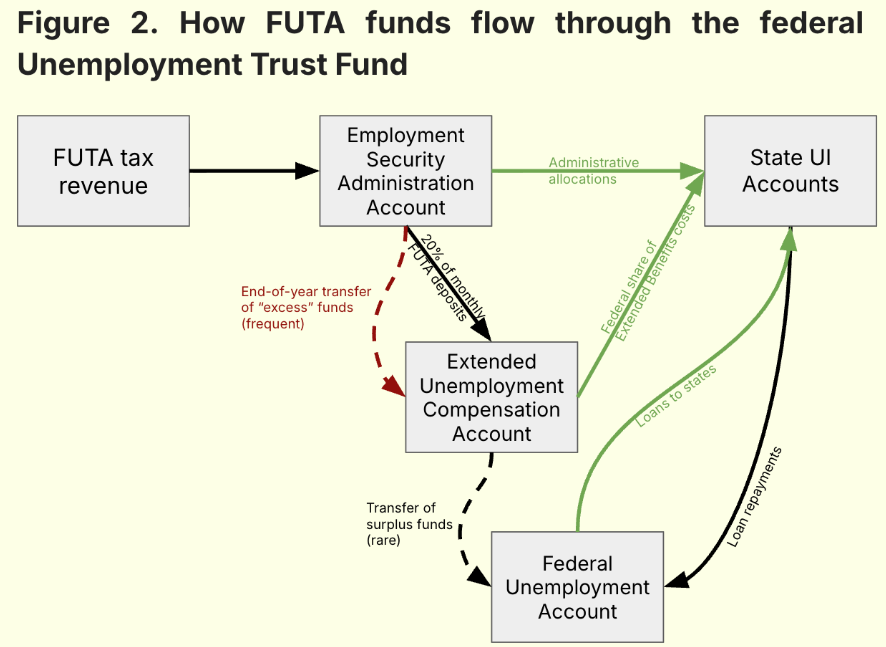
During the pandemic, state agencies were unable to efficiently process the surge in benefit claims or limit fraudulent payments. Likewise, numerous states were unable to cover the cost of the regular — and often paltry — benefit payments on their own. As a result, loans from the federal government were required. Design flaws and limitations of the UTF accounts — primarily via ESAA, the administrative funding account — and erosion of the FUTA tax play a critical role in these programmatic problems.
An enhanced benefits account and program could successfully complement the existing UTF accounts, but only if lawmakers fix those accounts in addition to the FUTA tax.
The Federal Unemployment Tax (FUTA)
Before giving an overview of each trust fund account, it’s worth discussing the Federal Unemployment Tax (FUTA). The FUTA tax is the primary source of revenue used to fund the functions of the federal accounts. While FUTA is technically a 6% tax that employers must pay on the first $7,000 of each employee’s wages, businesses broadly receive a 5.4% FUTA credit that reduces the overall rate to 0.6%. As a result, businesses tend to pay $42 per full-time employee.
Businesses can only receive the FUTA credit if they reside in a state choosing to adhere to the baseline standards set by Congress. Congress is limited in its ability to enforce mandatory program requirements, but it is able to leverage the FUTA tax as an incentive for states to follow optional ones.28 Among other conditions, each state must set its own UI taxable wage base — used to cover the cost of benefit payments — equal to at least the FUTA wage base of $7,000 to qualify for the FUTA credit.29 Likewise, states can only receive federal administrative grants — funded with FUTA tax revenue — if voluntarily following the set of program standards detailed in statute and certified by the U.S. secretary of labor.30
Although the FUTA tax remains a critical feature of the unemployment insurance system, revenue levels have steadily eroded over time. Costs have continued to rise, but the FUTA wage base has not. The last time the FUTA wage base was updated was 1983, when it was raised from $6,000 to $7,000.31 The FUTA wage base would sit at around $24,000 today if it had been automatically adjusted for inflation since then, and would be tens of thousands of dollars higher if indexed to inflation from the outset of the program.32 The FUTA wage base had comparable value to the Social Security wage base in 1940 but the two have since diverged, with the Social Security wage base sitting $177,500 higher in 2026.33
Consequently, there’s worse fiscal capacity via FUTA to fund program administration and the federal share of Extended Benefits — and provide a quality standard for states’ own wage bases. FUTA reforms are insufficient on their own, but necessary for each state to maintain proper administrative capacity and deliver better benefit levels in a fiscally sustainable way.
Employment Security Administration Account (ESAA)
The Employment Security Administration Account is arguably the most critical federal trust fund account on a year-to-year basis. In short, the funding supplied to states is necessary to keep the lights on. State unemployment agencies receive their annual administrative allocations through ESAA, enabling them to pay staff and perform core functions, such as screening new applications and processing eligible applicants’ benefit claims, while identifying and preventing fraudulent claims.
FUTA funds collected are periodically deposited into ESAA. Twenty percent of the deposits are automatically directed to the account for Extended Benefits, known as the Extended Unemployment Compensation Account (discussed next).34 The remaining 80% of FUTA deposits are retained in ESAA, and used to cover the administrative allocations approved by Congress each fiscal year.35 States are guaranteed to receive the approved base allocations, and can receive “above-base” allocations if the unemployment claims level exceeds expectations.
Despite the value of the administrative funding supplied to states via ESAA, there are significant shortcomings with how the federal government funds program administration.36 Most importantly, the size of the discretionary base allocations that state agencies must plan their fiscal years around have been substantially eroded. Those base amounts have shrunk by more than one-third over the last two decades, after accounting for inflation. States also see their base allocations fluctuate wildly from one year to the next due to the distribution formula used — which is based on unstable unemployment claims projections and efficiency metrics — making it difficult to plan long-term projects and investments. And because base allocations are structured according to the projected claims load, states receive worse administrative funding totals when unemployment is low — denying UI agencies the resources to improve their systems precisely when they have the best capacity to do so.
The way ESAA operates reinforces the funding issues facing UI agencies. At the end of each fiscal year, a strict statutory account balance limit results in funds raised specifically for administration to be repurposed (the red arrow seen in Figure 2). Rather than these “excess” administrative funds being sent back to states to help modernize and reinforce their systems over time, any funds exceeding the balance limit are sent to the account for paying Extended Benefits (EUCA) — on top of the 20% share of FUTA funds that account is already guaranteed. Consequently, billions of administrative dollars that could be dedicated to improving program performance are kept from UI agencies.
These funding dynamics certainly help explain why state agencies struggled to limit UI benefit fraud during the COVID-19 pandemic, estimated to exceed $100 billion.37 In the four fiscal years leading up to 2020, nearly $5 billion in spare administrative funds — almost two fiscal years worth of funding — could’ve been applied to improve state system performance, but was instead swept away to the account for Extended Benefits.38 Many of the vulnerabilities that opened up state UI agencies to significant pandemic fraud are still present, but this end-of-year transfer mechanism remains. Billions of administrative dollars that should be delivered to state agencies continue to be directed away.39 This occurs at the same time that UI agencies struggle to retain core staff due to financial struggles.
If Congress is to consider permanent benefit enhancements, those reforms must be paired with fixes to how administration is financed. Otherwise, UI agencies will struggle to deliver the improved benefit totals in a timely manner to legitimate applicants without sizable risk of fraud. Returning program administrative funding back to even the levels seen in the mid-2000s requires updating the FUTA tax to generate sufficient revenue. To guarantee all the administrative funds are delivered to states in a cost-effective manner, the mandatory end-of-year transfer from ESAA should instead direct all available funds to states (and through a distribution mechanism that secures a stable share of revenue to each state, unlike the process for base allocations).40
Extended Unemployment Compensation Account (EUCA)
The Extended Unemployment Compensation Account (EUCA) funds the federal government’s share of Extended Benefits (EB). EB is meant to give unemployed Americans extra weeks on the program when the labor market environment is in particularly rough shape. Extended Benefits are triggered “on” when state-level unemployment levels reach a sufficient threshold. The additional set of benefit weeks that can be offered through EB equals half of the maximum regular benefit weeks offered.
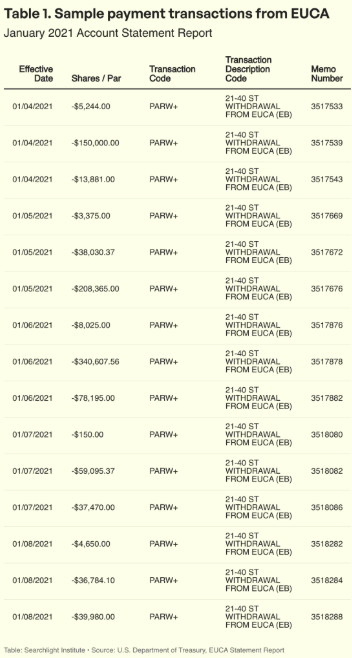
The Extended Benefits program and EUCA are meaningful in a couple of ways. First, EB represents a true statutory partnership between the federal government and states to cover the cost of unemployment benefit payments. The federal government must cover 50% of the cost of EB. Second, the federal government has payment infrastructure in place to ensure that states can receive funds from EUCA on a daily basis when EB is active, even amid national and global crises (Table 1). This is to say: If Congress chose to fund a permanent share of all UI benefit payments, lawmakers would be building off existing precedent and administrative functions via EUCA and the EB program.
The Extended Benefits program is not without problems. It was implemented in 1970 and meant to replace temporary UI benefit week extensions passed by Congress.41 In practice, though, Congress has stepped in to cover the full cost of EB during major economic crises and fund additional benefit week expansions during recessions. The EB activation triggers have been unreliable, failing to keep the program on during economic recoveries. The pandemic programs in place between 2020 and late 2021 hid some of the biggest shortcomings from EB’s activation triggers.42
Separately, EUCA has dealt with frequent insolvency. EUCA has struggled to maintain a positive balance despite receiving 20% of monthly FUTA deposits, as FUTA tax revenue has eroded over time due to inflation.43 Some may argue EUCA’s shortfall is reason to continue the end-of-year transfers of “excess” funds from ESAA (the red arrow in Figure 2), but this rationale should be resisted. As a matter of program performance, it is more valuable for all revenue explicitly raised for administration to be provided to UI agencies. Those excess administrative funds could be invested in program modernization and integrity efforts — tangible improvements — while the sole purpose of providing those dollars to EUCA would be to change a number reflected on a balance sheet.44 The more straightforward and durable way to resolve EUCA’s solvency issues is by updating and indexing the FUTA taxable wage base, the same reforms that could be leaned on to fix how program administration is financed and fund an enhanced benefits account.
Federal Unemployment Account (FUA)
The Federal Unemployment Account (FUA) delivers loan payments to states when their UI program trust funds run dry. Such loans are typically required when economic downturns hit and claims levels rise, placing extra fiscal burden on the state programs. Workers continue to receive normal benefit sizes when states take out federal loans, while the state government is on the clock to repay those loans. States must pay interest if the loans are not repaid the same fiscal year they were taken out.45
The FUTA tax is leveraged to ensure prompt repayment. A state that fails to cover its interest obligations risks losing federal grants for UI program administration, while employers in such noncompliant states can lose the standard 5.4% FUTA tax credit, causing their federal tax liabilities to spike upward. Even if interest is being paid, the FUTA credit amount will be reduced for employers in states with outstanding loan balances over time. If a state has still not repaid its loan balance after the end of two fiscal years, the 5.4% FUTA tax credit for employers in that state is reduced by 0.3 percentage points each subsequent year.46 This FUTA tax credit reduction continues to accumulate annually until the loan is fully repaid.
States with smaller, unindexed taxable wage bases have been at greater risk of insolvency — and reliant on loans via FUA — despite less generous benefit offerings.47 A key reason for this development: the stagnant FUTA taxable wage base. While initially serving as a worthwhile baseline standard that states must follow to qualify for the FUTA business credit, the FUTA wage base has lost its effectiveness. As mentioned above, the FUTA wage base would be around $24,000 today if it had been adjusted for inflation. In that scenario, states would still have access to FUA loans, but would be less reliant on them because their wage bases would be more robust.
Notably, lawmakers opted for the federal UI loan system as an alternative to the “reinsurance” and “equalization” grant proposals introduced in the 1950s and ’60s.48 But the two could go hand in hand. The federal government could help cover a portion of program costs as part of a renewed effort to improve benefit levels in partnership with states, while any benefit expenses outside of the federal share that cause program insolvency would require states to take out loans via FUA.
Filling out the federal role today
While the federal government has typically only stepped in to cover a share of benefit costs — or provide loan support — during economic downturns, times are changing. A stronger, ongoing financial partnership is warranted. Technological progress driven by AI could grow the economy,49 while also causing unavoidable job disruptions that impact workers across the country. Federal UI reforms can help ensure that those national labor market shifts are not painful, just temporary inconveniences. But new tools must be added to the shed.
To protect against involuntary unemployment spells, Congress could set new benefit standards for states and bring in more federal revenue via the FUTA tax to help cover the new benefit costs. The rationale today remains the same as Kennedy detailed in a 1963 speech to Congress.50 State benefit levels remain below the levels workers need to cover basic costs.
Kennedy called for baseline federal standards for both the wage replacement rate and the maximum weekly benefit offered by states.51 Lawmakers today should pursue this combination of benefit reforms as well, and look to cover the federal government’s share of the costs by broadening the FUTA tax, as Kennedy proposed. The main difference is that the federal government would be a permanent partner, and cover a consistent share of benefit costs — not just when overall costs exceed a set percentage of total state payroll.
New FUTA funds raised to cover a federal share of regular benefit costs could be stored and distributed through a new Unemployment Trust Fund account, known as the Federal Adjustment Account (FAA). This new account would add a new federal function, not replace the purpose existing federal trust fund accounts (ESAA, EUCA, and FUA).
Better benefit level options
Federal lawmakers should consider new benefit standards for state programs that help elevate the wage replacement rates and maximum weekly benefits offered.52 In general, raising the wage replacement rate would enhance the benefit levels of UI recipients below the maximum weekly amount, while raising the maximum benefit amount would directly help recipients with uninsured income due to low maximum weekly benefit caps in states. A few federal standards are suggested below, but they are not the only combinations lawmakers could consider.
The most generous reform proposal for lawmakers to weigh would be a 75% standard. Under this approach, Congress would require every state to set its maximum weekly benefit equal to 75% of the state average weekly wage and the wage replacement rate equal to 75% of a worker’s prior wages.53 This would ensure that a typical American worker can cover all of their monthly expenses between jobs (i.e., income not including income going toward taxes or savings). In the median U.S. state, this worker would receive a benefit size that is 50% larger than they would now. Unsurprisingly, program costs would rise quite significantly. No state currently provides this level of wage replacement.
Congress could also opt for a 66% standard. Every state would need to set its maximum weekly benefit level equal to two-thirds the average state weekly wage, and replace two-thirds of eligible workers’ prior wages. For a median-income American worker, this would be enough to cover five core expenses while temporarily unemployed: housing, food, transportation, utilities, and healthcare. Oregon basically provides this wage replacement rate. Kentucky, Hawaii, Colorado, and New Jersey are the other four states that provide 60% wage replacement to that worker now.
On the less expensive side, Congress could establish a 55% standard for states to follow. States would need to set their maximum weekly benefit equal to 55% of their average weekly wage and provide 55% wage replacement to eligible workers. This level of benefit generosity is unlikely to be enough to cover all key household expenses for the median worker, but would still represent a meaningful improvement in most states. This is the wage replacement level that a median-income American can receive in Kansas and West Virginia today (See Figure 3 for how each of the proposed standards would adjust a median-income worker’s benefit level in each state).
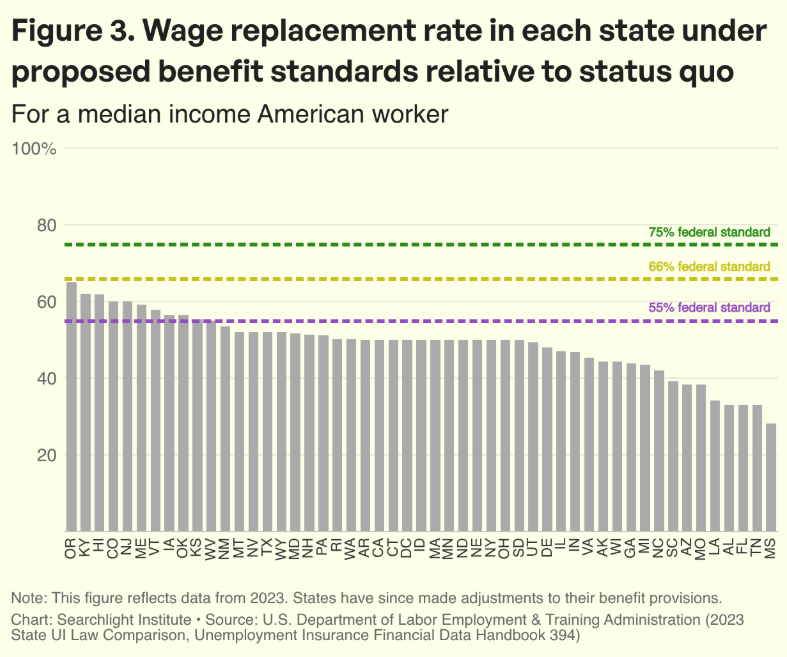 Alternatively, Congress could pass the benefit standards that Kennedy endorsed: a minimum wage replacement of 50% alongside a minimum maximum weekly benefit equal to 66.6% of a state’s average weekly wages.54 These reforms would lift benefit levels for the median-income American in 20 states, fewer than the 55% standard detailed above. At the same time, this set of reforms would improve the wage replacement rate in most states for middle-class workers who would otherwise receive a higher benefit total if the maximum benefit level was higher.
The viability of any reform option depends on the willingness of Congress to raise taxes. Federal lawmakers could set the new standards and fully offset the new cost, or opt to cover a portion of the new expense burden. If the average wage replacement rate seen nationally from 2023 to 2025 was brought up to 55% rather than the actual 42.5%, the additional benefit cost would have been around $10 billion more a year.55 Shifting to a wage replacement rate closer to 75% could have cost closer to $30 billion or more per year beyond the existing benefit outlays those years. Over a full 10-year period, somewhere between tens of billions and a few hundred billion dollars more in revenue may be needed, depending on the benefit standard. No matter the benefit baseline selected, the necessary amount of revenue could be collected by updating the FUTA tax — and at a reasonable cost per employee — rather than applying new, separate taxes.
Establishing a new trust fund account
To help manage the federal funds raised for enhanced benefit levels, Congress should look to add a new account to the federal Unemployment Trust Fund (UTF): the Federal Adjustment Account (FAA), applying the name proposed in the Kennedy administration bill.56 The existing UTF accounts that fund program administration, emergency benefits, and loans to insolvent states would continue to exist. This new account, FAA, would complement and add to those trust fund functions.
New revenue generated — preferably by raising the FUTA taxable wage base — could be stored in this account. All FUTA deposits would continue to be directed first to the administrative funding account, ESAA. Any revenue raised from the first $7,000 of the FUTA wage base would continue to be split 80%/20% between ESAA and EUCA. But any revenue raised beyond that through a larger wage base — i.e., FUTA taxes collected on wages above $7,000 in covered employment — would be treated differently. A significant share of those FUTA funds could be directed to the new FAA.
Similar to the Extended Benefits (weeks) program, the federal payments provided to states via FAA could cover a share of the regular benefit sizes paid out to each claimant. And like the EB program when active, these payments could happen on a regular basis. As an example, states could be on the hook for covering 40% of workers’ prior wages, while the federal government would insure wages between that level and the specified minimum benefit thresholds. If the 75% standard was adopted, then the federal government would cover 35% of an average worker’s wages and send that payment to the relevant state after such a claim is processed; under a 55% standard, the federal obligation would be around 15% of an average worker’s wages from their previous job. States with benefit levels close to the new standards would still receive the federal coverage, meaning they could adjust their own unemployment tax rates down. Any benefit amounts provided beyond the federal standard would be on states to pay.
State fiscal capacity should certainly be factored into the equation, too. Applying the same tax structure, richer states are much more able to generate revenue than states with weaker tax bases.57 To account for that disparity, lower-fiscal capacity states could receive additional support per claimant beyond whatever share of benefit costs the federal government has committed to covering for all states. This type of support could actually help equalize the relative support provided to each state, given that states with higher-income workers would receive more federal dollars per claimant than lower-income states.
Leveraging FUTA to raise necessary revenue
Although updating the FUTA tax is suggested above, Congress does have the option to fund UI benefit reforms by raising general revenue through new taxes outside the UI system. Use of general revenue could help avoid new taxes on labor, and allow lawmakers to shift more tax burden onto capital if there is a rise in job automation. With that said, raising the FUTA tax remains an effective way to cover the cost of reforms and should be prioritized first and foremost if a reform opportunity presents itself under a new administration in 2029.
For one, the $7,000 FUTA wage base has not been updated in over 40 years, resulting in employers paying FUTA taxes on a small fraction of covered employees’ wages. Any increases to the FUTA wage base will apply broadly across covered employment, meaning that a lot of revenue can be generated via small increases per covered job. As an example, increasing the wage base to $14,000 and adjusting for wage growth would bring in $59 billion over 10 years.58 If in place this year, this FUTA increase would translate to just $42 in additional FUTA taxes per employee earning equal to or greater than $14,000 — enough to cover a 10-plus percent increase in benefit outlays annually.
More ambitious benefit expansions would require a higher FUTA wage base. The FUTA wage base Kennedy discussed in May 1963 as part of his proposed reforms would roughly equal $57,000 today — and could certainly generate enough revenue for significant improvements to the unemployment benefits offered to eligible workers.59 However, federal policymakers would not need to raise the wage base that high. If the FUTA wage base was raised to roughly the level of a median-income worker in 2023 (roughly $43,000) and subsequently indexed for inflation, north of $250 billion could be raised over a 10-year period.60 While this is certainly a significant amount of revenue, that worker and their employer would only shoulder $216 more a year in FUTA taxes, collectively.61 A standard Netflix subscription without ads costs more.62
States would need to update their wage bases in order to remain in compliance with FUTA credit standards, but could pair those increases with reduced state unemployment tax rates to raise similar amounts from employers as they do now.63 Congressional documents detailing the reforms backed by the Kennedy and Johnson administrations in the 1960s relayed this flexibility, saying that states would need to update their wage bases but would have “complete freedom in the revision of tax rates to fit the new wage base.”64 The Congressional Budget Office projects this would occur soon after federal wage base reforms are enacted.65
Another reason to focus on FUTA is the ability to condition receipt of the FUTA credit, equal to $378 for most covered employment now. Congress cannot mandate that states update their benefit levels, but it can incentivize states to follow new standards.66 Namely, this existing authority — upheld by the Supreme Court — can be leveraged to encourage better baseline benefit offerings. The FUTA tax conditionality would be in pursuit of improvements to general welfare, would entail explicit benefit standards to meet, and would directly relate to the unemployment insurance system that the federal government has a vested interest in.67 Congressional reforms could incentivize better benefit standards across states by conditioning the existing FUTA credit size, or a larger credit amount given that the FUTA wage base would be raised to help cover the cost of better benefits. Lawmakers should just be mindful that conditioning a substantially larger credit amount could be deemed coercion by the Supreme Court.68 As such, Congress should consider conditioning the existing FUTA credit amount plus only a portion of the updated credit related to employee wages above $7,000.69
Leaning on the FUTA tax also helps to maintain a strict contributory foundation for the program that reinforces the view that unemployment insurance is a deserved, earned benefit.70 Unemployment taxes would continue to be applied to the wages of workers to fund the enhanced benefits. Perhaps more importantly, though, reform plans should not expect outside revenue to be available.
If there is a pot of new general revenue, what is the likelihood that lawmakers prioritize unemployment insurance reforms? There are a ton of competing priorities ahead across a range of policy areas from childcare to energy to housing to healthcare. This is to say nothing about Social Security’s impending insolvency, which policymakers could respond to (in part) by lifting the Social Security taxable wage base, and use up much of the revenue that could be generated from additional taxes on the wealthiest Americans. Unemployment insurance reforms likely would play second fiddle to all of the above. While worsening labor market conditions could alter those dynamics, it would be ill-advised to base an entire reform strategy on it.
Two (or three) birds, one stone
There’s an additional reason to raise the FUTA tax: The new wage base and subsequent revenue raised could fund better benefit levels and be leveraged to permanently fix long-running issues with the existing Unemployment Trust Fund accounts. The biggest issues hampering the existing trust fund accounts relate to the erosion of FUTA revenue over time. Updating the FUTA wage base could be used as an all-of-the-above revenue-raising reform to revitalize the federal government’s role in the UI system.
Figure 4 presents how FUTA dollars could flow through an updated Unemployment Trust Fund, with the most valuable changes in green. The new Federal Adjustment Account would receive the lionshare of new FUTA revenue — 80% of new revenue is suggested — which would be used to pay for the federal share of the improved unemployment benefit levels to be paid out to claimants. Meanwhile, the other 20% share of new FUTA revenue could be applied toward other reforms.
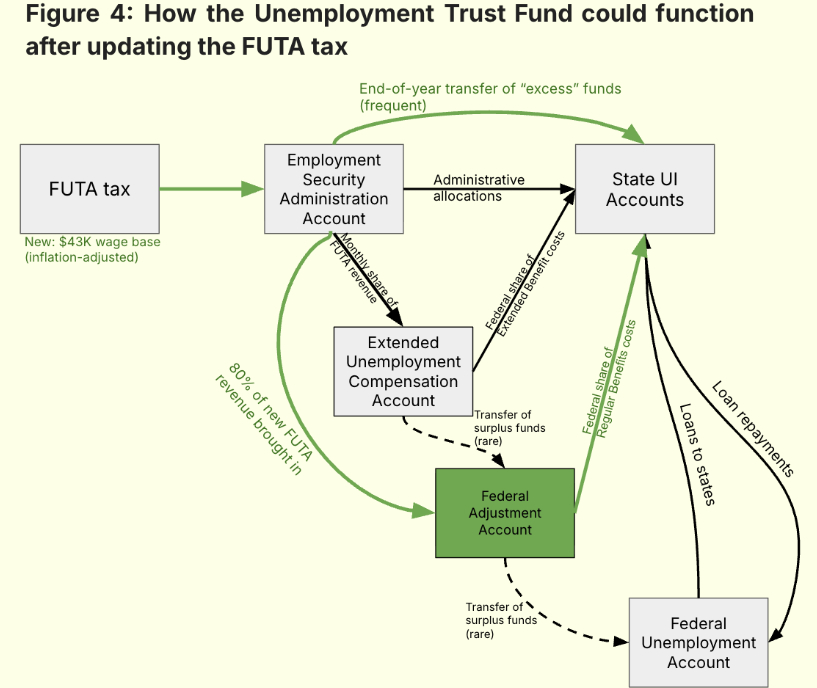
In addition to bigger benefits, new FUTA revenue could help update program administration financing. In particular, a share of the new FUTA revenue could offset some of the funding erosion that UI agencies have experienced due to inflation over the last few decades. While additional administrative dollars could be delivered via discretionary appropriations, lawmakers should seriously consider statutory reforms that direct “excess” dollars in ESAA back to states at the end of fiscal years. Doing so would provide UI agencies with greater clarity on the resource levels they can plan around over longer time horizons. Additional administrative funding would support agency efforts to update their systems to reflect the new federal standards. And critically, greater administrative resources would help reinforce program integrity — as benefit generosity rises, so will the risk that criminal actors try to steal from the program.
The function of the other two trust fund accounts — EUCA and FUA — could be improved as well, albeit for different reasons. By directing a share of new FUTA revenue to ESAA, EUCA (the Extended Benefits account) could receive an automatic monthly share. This would help build up proper account reserve levels that are missing right now. The Extended Benefits activation triggers could be reformed as well. Meanwhile, reliance on FUA could actually go down by updating the FUTA tax. States would retain access to loans when needed. But by raising the FUTA wage base, states struggling with insolvency — most notably, California — could become less reliant on federal loans after adjusting their own wage base(s).
Fixing the dedicated revenue stream established by FUTA would enable these improvements permanently — and in ways that general revenue could not.
Conclusion
No one knows how exactly the labor market will change in the coming years. But even if the unemployment rate stays low, lawmakers should still enact reforms that provide workers with the necessary financial security.
Congress can establish a proper program partnership with states and improve the generosity of unemployment insurance benefits. While concerns around job automation offer an immediate incentive, such reforms would be worthwhile even if large-scale displacement due to AI does not occur. UI benefits currently cover 40% of workers’ prior wages on average, well short of what’s needed to continue covering the cost of key expenses like housing, groceries, utilities, healthcare, and transportation. New federal benefit standards could be funded by updating the FUTA wage base, ensuring that eligible workers receive the insurance coverage needed to remain financially stable when transitioning between roles.
This isn’t a new idea. Similar reforms were backed by President John F. Kennedy and his successor, President Lyndon B. Johnson. Those legislative efforts stalled in the 1960s, but could be returned to now as we enter a new economic era. In states across the country, the median American worker remains unable to receive sufficient benefit coverage because the maximum weekly benefit and wage replacement rate offered are too low. Improving on the UI benefit coverage offered by states will allow workers to successfully maneuver through all the uncertainty that lies ahead.
- Stephen A. Wandner, Options for Unemployment Insurance Structural and Administrative Reform: Proposals and Analysis (Kalamazoo, MI: W.E. Upjohn Institute for Employment Research, April 2020).
- Annual Message to the Congress (1965): The Manpower Report of the President — President Lyndon B. Johnson (Santa Barbara, CA: Online by Gerhard Peters and John T. Woolley of The American Presidency Project).
- Remarks of Senator John F. Kennedy at the AFL-CIO Convention, Grand Rapids, Michigan, June 7, 1960 (Boston, MA: JFK Presidential Library and Museum).
- William Haber and Merrill G. Murray, Unemployment Insurance in the American Economy: An Historical Review and Analysis (Homewood, IL: Richard D. Irwin Inc., 1966).
- Congress passed legislation that established a federal loan fund. These proposals would have had the federal government supply grant funding that did not need to be repaid.
- William Haber and Merrill G. Murray, Unemployment Insurance in the American Economy: An Historical Review and Analysis (Homewood, IL: Richard D. Irwin Inc., 1966).
- Message to Congress: Kennedy Calls for Unemployment Compensation Reform, In CQ Almanac 1963, 19th ed., 1000. (Washington, DC: Congressional Quarterly, 1964).
- U.S. House Ways & Means Committee of the 89th Congress, Material concerning H.R. 8282 and the “Employment Security Amendments of 1965” (Washington, DC: U.S. Government Publishing Office, 1965); U.S. Senate of the 85th Congress, Report No. 1625: Temporary Unemployment Compensation Act of 1958 (Washington, DC: U.S. Senate Finance Committee, May 1958); William Haber and Merrill G. Murray, Unemployment Insurance in the American Economy: An Historical Review and Analysis (Homewood, IL: Richard D. Irwin Inc., 1966).
- John F. Kennedy, “The Record Of The 83rd Congress On Unemployment Insurance: A Report By Senator John F. Kennedy, Democrat From Massachusetts” (David Von Pein JFK Channel, March 2020).
- President Lyndon B. Johnson backed this approach too. See: U.S. House Ways & Means Committee of the 89th Congress, Material concerning H.R. 8282 and the “Employment Security Amendments of 1965” (Washington, DC: U.S. Government Publishing Office, 1965).
- Department of Labor, Unemployment Insurance Chartbook (Washington, DC: DOL Employment & Training Administration, 2026).
- Will Raderman, Establishing Unemployment Insurance as a True Worker Benefit (Washington, DC: Niskanen Center, September 2023).
- Will Raderman, The need for balanced unemployment benefit expansions (Washington, DC: Niskanen Center, March 2025).
- Department of Labor, State UI Law Comparison, Chapter 3: Monetary Entitlement (Washington, DC: DOL Employment & Training Administration, 2023).
- Department of Labor, State UI Law Comparison, Chapter 3: Monetary Entitlement.
- Figure 2 was constructed using Department of Labor report data from 2023. States have made adjustments since then. For example, Michigan raised its maximum weekly benefit level from $362 to $614, thereby improving the wage replacement rate for the median worker. See: Social Security Administration, Wage statistics for 2023 (Washington, DC: SSA, 2023); Will Raderman, The need for balanced unemployment benefit expansions.
- In a number of these states, the weekly benefit calculation depends on wages from the highest quarter. As a result, a worker with $20,000 in the highest earning quarter and $30,000 in base period earnings overall may qualify for the maximum benefit while a $43,000 worker with earnings evenly spread out across each quarter may not. The analysis in Figure 1 is performed with a median-income worker in mind that earns an annual salary.
- Raj Chetty, Moral Hazard vs. Liquidity and Optimal Unemployment Insurance (Berkeley, CA: UC Berkeley and NBER, April 2021).
- Kevin Rinz and David Wasser, Unemployment Insurance Generosity and Wage Determination (Cleveland, OH: Federal Reserve Bank of Cleveland, May 2026).
- In practice, the counterfactual has also been true. Benefit cuts enacted by states have resulted in worse starting and posted salaries for jobs. Workers have suffered worse quality job matches as well. See: Gordon Dahl & Matthew M. Knepper, Unemployment Insurance, Starting Salaries, and Jobs (Cambridge, MA: National Bureau of Economic Research, June 2022).
- The provision of better benefits could improve the hiring rates of recent workforce entrants as well. The Federal Reserve Bank of Cleveland paper argues that more intensive job searches from UI recipients can correspond with greater hiring of individuals along the extensive margin of the labor force. While the temporary pandemic benefit expansions were unique, academic Arin Dube had a similar finding when assessing the provision of enhanced UI benefits in 2021. See: Kevin Rinz and David Wasser, Unemployment Insurance Generosity and Wage Determination (Cleveland, OH: Federal Reserve Bank of Cleveland, May 2026); Arin Dube, Early withdrawal of pandemic UI: impact on job finding in July using Current Population Survey (Amherst, MA: UMass Amherst, August 2021).
- It can be more straightforward for disabled and older Americans to secure new work while active labor force participants rather than after they exit, hold resume gaps, and cannot afford to risk losing disability benefits. See: Will Raderman, Unemployment insurance expansions could reduce disability benefit utilization (Washington, DC: Niskanen Center, October 2024).
- Zachary Parolin and Clemente Pignatti, IZA Discussion Paper No. 17095: Optimal Unemployment Insurance with Program Interactions (Milan, Italy: Bocconi University, June 2024).
- Wayne Vroman, The Funding Crisis in State Unemployment Insurance (Kalamazoo, MI: W.E. Upjohn Institute for Employment Research, 1986).
- Department of Labor, State UI Law Comparison, Chapter 3: Monetary Entitlement; Will Raderman, Back to the base-ics: How taxable wage base reforms can strengthen unemployment program solvency (Washington, DC: Niskanen Center, February 2026).
- Will Raderman, Establishing Unemployment Insurance as a True Worker Benefit.
- Figure 2 is a simplified breakdown of the cash flows between trust fund accounts. For example, states technically can also receive special Reed Act distributions when ESAA, EUCA, and FUA all have hit their balance limits. However, this type of distribution has effectively become obsolete. See: Julie M. Whittaker, Unemployment Compensation (UC) and the Unemployment Trust Fund (UTF): Funding UC Benefits (Washington, DC: Congressional Research Service, December 2020).
- Congress cannot mandate that states follow a set of program standards for constitutional reasons. However, receipt of the FUTA credit can be conditioned upon states voluntarily choosing to adhere to basic standards set by Congress. See: Steward Machine Co. v. Davis, 301 U.S. 548 (1937).
- Julie M. Whittaker, Unemployment Compensation: The Fundamentals of the Federal Unemployment Tax (FUTA) (Washington, DC: Congressional Research Service, December 2020).
- 42 U.S. Code § 503.
- Julie M. Whittaker, Unemployment Compensation: The Fundamentals of the Federal Unemployment Tax (FUTA).
- Andrew Stettner, Increasing the Taxable Wage Base Unlocks the Door to Lasting Unemployment Insurance Reform (Washington, DC: The Century Foundation, July 2021).
- Social Security Administration, Contribution and Benefit Base (Washington, DC: Social Security Administration, 2026).
- Tilly Finnegan-Kennel, Katelin P. Isaacs, and Julie M. Whittaker, Funding the State Administration of Unemployment Compensation (UC) Benefits (Washington, DC: Congressional Research Service, December 2024).
- Most of the FUTA funds deposited in ESAA for administration are sent out to UI agencies. However, a minority of the funds go to help cover the cost associated with Employment Services, programs for veterans, and statistical collections done by the Bureau of Labor Statistics. See: Department of Labor, Estimated FUTA Receipts vs. Amounts Returned (Washington, DC: DOL Employment and Training Administration, 2026).
- Will Raderman, Getting the job done on unemployment insurance: How Congress can reinforce program administration and integrity with finance reform (Washington, DC: Niskanen Center, April 2024).
- Will Raderman, Testimony for the United States House Ways and Means Committee, Work and Welfare Subcommittee Hearing on: “Reforming Unemployment Insurance to Support American Workers and Businesses” (Washington, DC: Niskanen Center, June 2024).
- Will Raderman, AI Isn’t Really Stealing Jobs Yet. That Doesn’t Mean We’re Ready for It (Washington, DC: Barron’s, August 2025).
- U.S. Department of the Treasury, Unemployment Trust Fund: Account Statement Report for EUCA (Washington, DC: U.S. Department of the Treasury, 2026).
- Although it would be useful for Congress to update how the fiscal year allocations are structured, there are political constraints that make it preferable to reform the end-of-year mechanism. For one, the cost of shifting all administrative allocations from discretionary to mandatory would receive a much higher CBO score than mandating that all unused funds at the end of fiscal years be sent to states. Second, focusing on how to distribute available end-of-year funds will help avoid stalemates over updating the formulas used for base allocations each fiscal year.
- National Employment Law Project, Background Paper on Extended Benefits: Restoring Our Unemployment Insurance Safety Net for Workers and Communities Impacted by Long Term Unemployment (Washington, DC: NELP, March 2001).
- Will Raderman, Federal UI Hid the Shortcomings of State Extended Benefits (Washington, DC: Niskanen Center, January 2022).
- If EUCA reaches its statutory balance ceiling, any surplus funds spill over into the Federal Unemployment Account (FUA), which supplies loans to insolvent state programs. However this mechanism has become obsolete — the balance cap on EUCA is substantially higher than for ESAA.
- The federal government still covers its share of Extended Benefits costs if EUCA has a negative account balance.
- State unemployment tax revenues raised for benefit payments cannot be used to cover interest payments on federal UI loans. See: Julie M. Whittaker, CRS Reviews Funding of Unemployment Trust Fund (Washington, D.C: TaxNotes, 2010).
- FUTA credit reductions can become even more severe if still unpaid after three years. See: Julie M. Whittaker, The Unemployment Trust Fund (UTF): State Insolvency and Federal Loans to States (Washington, DC: Congressional Research Service, January 2023).
- Will Raderman, Back to the base-ics: How taxable wage base reforms can strengthen unemployment program solvency.
- William Haber and Merrill G. Murray, Unemployment Insurance in the American Economy: An Historical Review and Analysis (Homewood, IL: Richard D. Irwin Inc., 1966).
- John Iselin and Ryan Nunn, How potential AI futures would play out in the current tax system (New Haven, CT: The Budget Lab, July 2026).
- Message to Congress: Kennedy Calls for Unemployment Compensation Reform.
- Message to Congress: Kennedy Calls for Unemployment Compensation Reform.
- While not the focus of this paper, Congress should consider benefit eligibility standards as well. Otherwise, states could respond to benefit benefit levels by restricting eligibility and making it harder for workers to access these benefits.
- To ensure that workers with earnings in fewer quarters receive benefit levels reflecting their annualized wage amount, these standards could allow for benefit calculations to be based on a worker’s highest quarter wages.
- Message to Congress: Kennedy Calls for Unemployment Compensation Reform.
- Average annual benefit costs totaled $36.3 billion from 2023 to 2025. See: Department of Labor, Unemployment Insurance Chartbook.
- U.S. House Ways & Means Committee of the 89th Congress, Material concerning H.R. 8282 and the “Employment Security Amendments of 1965.”
- U.S. Department of Treasury, Total Taxable Resources: Dollars Per Capita (Washington, DC: U.S. Department of Treasury, 2025).
- The Budget Lab, Budgetary Effects of Federal Unemployment Tax Act Reform (New Haven, CT: The Budget Lab, November 2025).
- The proposed reforms back then also involved a new tax rate alongside the higher wage base.
- Per static revenue estimates from PolicyEngine, the model’s unadjusted output comes within about 5% of actual IRS FUTA collections for fiscal years 2024 and 2025. PolicyEngine does not include additional state-side UI revenue collected due to FUTA reforms as CBO has done, which could lead to an underestimate. See: PolicyEngine, FUTA taxable wage base dashboard (Washington, DC: PolicyEngine, 2026); U.S. Congressional Budget Office, Increase Taxes That Finance the Federal Share of the Unemployment Insurance System (Washington, DC: CBO, December 2018).
- While paid by employers, the workers could shoulder a majority of the new payroll tax burden. See: U.S. Congressional Budget Office, Revisiting the Extent to Which Payroll Taxes Are Passed Through to Employees: Working Paper 2021-06 (Washington, DC: CBO, June 2021).
- Netflix, Plans and Pricing (Los Gatos, CA: Netflix, 2026).
- Will Raderman, Back to the base-ics: How taxable wage base reforms can strengthen unemployment program solvency.
- U.S. House Ways & Means Committee of the 89th Congress, Material concerning H.R. 8282 and the “Employment Security Amendments of 1965.”
- U.S. Congressional Budget Office, Increase Taxes That Finance the Federal Share of the Unemployment Insurance System.
- Steward Machine Co. v. Davis, 301 U.S. 548 (1937).
- South Dakota v. Dole, 483 U.S. 203 (1987).
- To avoid the dynamics of NFIB v. Sebelius (2012), the financial incentives here can and should be much less significant by design. In the 2012 case, the Supreme Court determined that conditioning a state’s entire share of federal Medicaid revenue on participating in the Medicaid expansion constituted financial coercion. States receive hundreds of billions of dollars in federal Medicaid support each year. In contrast, the proposed unemployment benefit reforms detailed in this paper — and the conditional FUTA credit amount necessary to serve as an effective incentive — are worth tens of billions of dollars a year. It is also worth noting that the financial implications are larger here than in South Dakota v. Dole (1987), but would still remain a small fraction of the size of overall state expenditures (a percentage in the low single digits). See: National Federation of Independent Business v. Sebelius, 567 U.S. 519 (2012); KFF, Federal and State Share of Medicaid Spending (San Francisco, CA: KFF, 2024); U.S. Department of Transportation, Federal, State, and Local Transportation Financial Statistics: Fiscal Years 1982-1994 (Washington, DC: U.S. DoT, 1997); National Association of State Budget Officers, 2025 State Expenditure Report (Washington, DC: NASBO, 2025).
- If the FUTA wage base was increased to $43,000, the FUTA tax amount collected from employers for each respective worker would rise by no more than $216 in states following federal standards. The FUTA credit amount that is already conditioned is 75% larger than the size of that tax increase, meaning it would likely serve as an effective incentive. Under a $43,000 FUTA wage base, the FUTA credit would become much larger, and it may be advisable that just a portion of the credit pertaining to individual employee wages over $7,000 come with federal conditions.
- Alix Gould-Werth, “Workplace Experiences and Unemployment Insurance Claims: How Personal Relationships and the Structure of Work Shape Access to Public Benefits” Social Service Review Volume 90, Number 2 (Chicago, IL: University of Chicago Press, June 2016).