
Capture More Corporate Tax Revenue
Part of Searchlight’s Tax Framework: A Contributory State of Mind
Net estimated revenue: $1.5 trillion+ over the 10-year budget window
Background
Corporate tax revenues in the United States are low, with some businesses paying little to no corporate income tax, despite a statutory corporate tax rate of 21%.1 While most improvements to corporate taxation are possible through reducing loopholes, simplifying the tax code, and dedicating resources to dispute resolution and certainty — steps to ensure that taxes paid are closer to the statutory level, and tax rates are more neutral across business types — it is also important to change the corporate tax rate and structure.
Corporate income taxes are imposed differently than personal income taxes on individual wage-earners. Rather than being a percent of total revenue, as the name would suggest, only taxable income (i.e., profits) is subject to the corporate income tax.2
The Tax Cuts and Jobs Act of 2017 (TCJA) marked the largest changes to corporate tax rates since the 1970s. Prior to 2017, the United States had the third-highest top corporate tax rate (35%) of the 38 OECD member countries, which had an average tax rate of 23%.3 Corporate tax rates were also graduated, with marginal rates changing with increasing amounts of corporate profits. TCJA changed this, adjusting corporate tax rates to a flat 21%, bringing U.S. corporate tax rates just below the current OECD average of 22% and acting as a tax cut for most corporations. These rate changes were expected to cost $1.3 trillion over the 10-year budget window.4
Lawmakers should consider raising the corporate rate as a primary option for raising significant revenue. Corporate tax rate reforms should include both increases to the base corporate rate and a return to a graduated-rate structure.
There is an argument that lower tax rates are pro-growth and, conversely, that corporate tax increase will hurt growth. Low corporate rates can free up business capital to make investments and boost GDP.5 However, some question the actual magnitude of this investment, and claims that tax-cutting boosts the economy may be overstated, if not null.6 At minimum, lawmakers should keep in mind that the TCJA tax cuts may not have led to the expected economic growth, and that higher tax rates or revenues and growth are not mutually exclusive.7 The corporate tax rate that properly balances revenue and growth could be higher than what proponents of low rates prefer.
We must also be cautious of looking to growth alone when reforming tax policy. Even if tax cuts do contribute to growth, that doesn’t necessarily translate to worker well-being. Rising profits for companies, like those that result from low corporate tax rates, have not been linked to higher pay, with profits rising faster than employee compensation.8 TCJA’s tax cuts boosted earnings at the top with little impact on worker wages.9 Furthermore, the law reduced federal revenues, making it more fiscally challenging to enact benefits reforms that would support children and low-income workers.10
This is not to say federal lawmakers should return corporate rates to their pre-2017 levels. Corporate tax rate increases may not rest entirely on shareholders, with some studies finding that over a third of the incidence rests on workers and consumers.11 This negative impact should be reduced if 100% bonus depreciation — a provision where businesses can deduct certain capital investments immediately rather than over time — remains in place.12 These potential downsides should be kept in mind when proposing increases to the corporate tax rate.
Policymakers must also consider international tax competitiveness. Raising rates too much has the potential to drive businesses abroad to countries with lower corporate tax rates — through legitimate relocation or tax avoidance — especially as tax rates across the OECD have decreased on average. There is some indication that international agreements reduce evasion and help competitiveness to a greater extent than rate cuts, and these efforts should be pursued when raising domestic corporate rates.13
Regardless of the tax rate, it makes sense to shift away from a flat corporate tax that applies the same rate to all businesses. Opting for lower corporate tax rates for small businesses can make it easier for them to enter markets and grow sustainably. Additionally, large businesses with the highest profits have the greatest ability to make deductible investments, further lowering their tax burden compared with lower-profit or smaller businesses. Through implementing a simplified graduated system, lawmakers can help secure the growth benefits of generally low and competitive taxes, bring in more revenue from the biggest corporations, and further encourage businesses to hire and invest.
Mechanism
Lawmakers should increase corporate tax revenue by amending 26 U.S. Code § 11 to slightly increase the base corporate tax rate and implement a graduated-rate taxation system.
First, the base tax rate should be increased by at least 1%, from the current rate of 21% of profits to 22%. The revenue crisis we face in the U.S. will impact all businesses, and remediation cannot be borne entirely by the very richest. Shortfalls or instability of funding for public goods, like infrastructure or education, would diminish the ability for businesses of all sizes to succeed. Consequently, all businesses must shoulder some additional taxes, although that burden should be lighter for smaller businesses.
Corporate taxes are paid on profits, not total revenues. Companies can immediately deduct more investments from their taxable income than before TCJA, decreasing tax burdens and changing the incidence and impact of the corporate income tax. Full expensing — the ability to deduct an entire investment in the year it was made — concentrates the corporate tax burden on supernormal returns, allowing for a higher tax rate with fewer economic distortions than under standard depreciation, where businesses deduct the cost of a capital investment over a set period of time.14
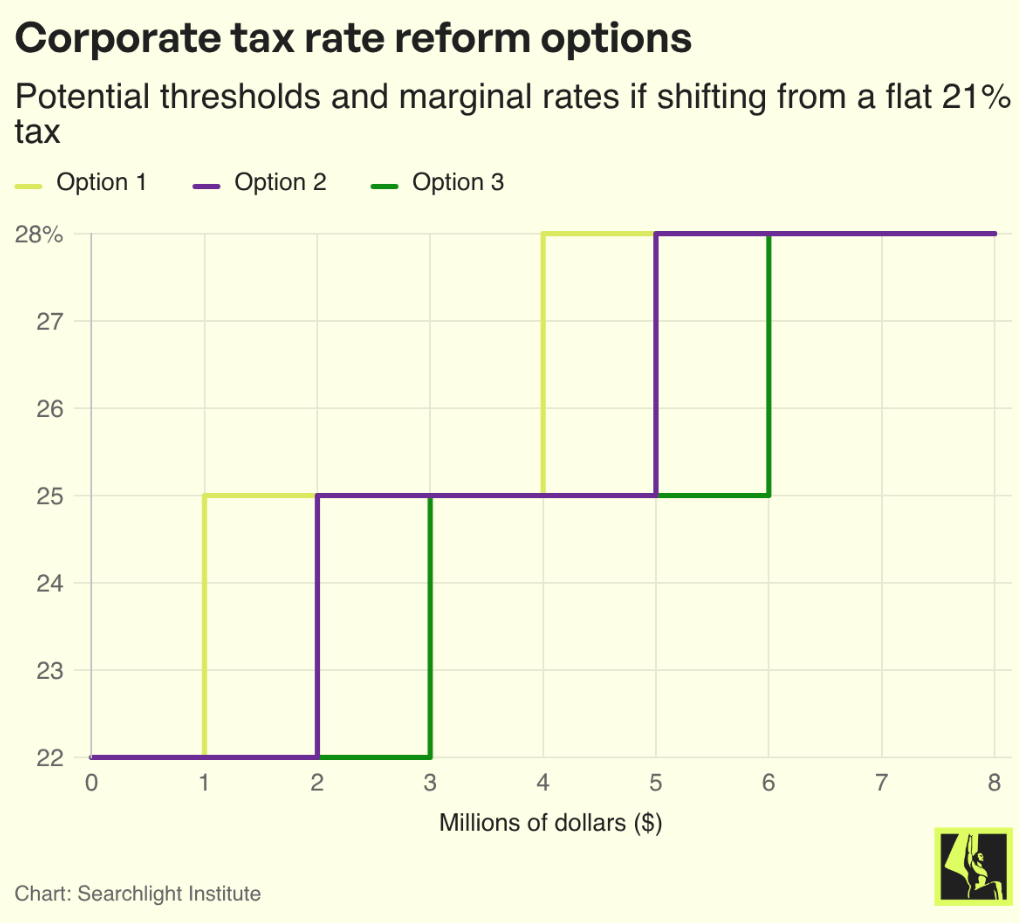
Second, a graduated system should be implemented. The new system would be simpler than the pre-2017 rate structure (i.e., fewer tax brackets), and would only levy higher rates on the top 5%-10% of corporations. The system would have two rate changes (three total brackets).15 The first bracket would be the base rate, and all taxable income under the first threshold would be subject to that rate. The first threshold should fall somewhere between $1 million and $3 million, and the second threshold should begin $3 million above the first. The second and third bracket would each raise rates on the relevant marginal income by 2%-3%.16 Implementing marginal rates at these high profit levels would leave over 90% of corporations that owe tax unaffected.17 As an example, corporate taxable income under $2 million would be subject to the 22% base rate, income between $2 million and $5 million would be subject to a 25% rate, and income over $5 million would be subject to a 28% rate (Option 2 in the figure below).
This proposal is presented in ranges because lawmakers should consider the behavioral and revenue impacts of the entire suite of corporate reforms, not just rate changes.18 Other reforms may impact the tax base and change the optimal levels for corporate rate thresholds. Lawmakers should target a tax base for higher rates large enough that the tax is not levied on an unreasonably small subset of businesses, but not so large that a majority of businesses are impacted by higher rates.19
The final reform would be a surtax equal to 10% of tax liability on taxable income above at least $25 million, ensuring the top tax rates are only imposed on those with the highest levels of profit. This would raise the effective tax rate on taxable incomes over $25 million to about 31% (up from 28%).20 Crucially, this provides a flexible levy on the highest level of supernormal profits, about 1% of corporations that owe tax.21
These reforms and rate changes would leave most businesses’ taxes competitive with other countries, while drawing a reasonable additional share of revenue from the highest-profit businesses. This would help balance a need to raise revenues with the need to improve employment levels and wages.
Lawmakers may consider tying brackets to inflation or other measured annual rate increases. Adjusting bracket thresholds to inflation would prevent a situation similar to that which occurred prior to 2017, where thresholds were at nominal brackets set 25 years prior, making their placement outdated. Such a provision would be useful for ensuring the durability of a bracket structure and is applied elsewhere in the tax code.22 On the other hand, this may cause some uncertainty: Because future thresholds depend on variable inflation, businesses near a threshold may be uncertain which rate they will face on marginal income, complicating the planning of capital investment and future deductions. A fixed annual adjustment, which would improve predictability for businesses but would likely not fully compensate for outdated brackets after a long period of time, may also be considered.
It is also imperative that lawmakers consider parity with non-corporate business tax rates. Pass-through businesses, such as partnerships and sole proprietorships, are impacted by changes to the personal income tax rates, rather than corporate ones. Perceived lack of parity has led to questionable tax provisions attempting to equalize taxation of pass-throughs and corporations.23 Effective tax rates for both corporations and pass-throughs should be considered to prevent future implementation of such distortionary policies.24
Revenue Estimate
$1.5 trillion+ over a 10-year budget window
We estimate the potential revenues resulting from the proposed reforms to corporate taxes by reviewing the scoring performed on similar proposals.
Increasing the base corporate tax rate would likely raise between $135 billion and $592 billion over the budget window. A flat 1% increase, to 22%, is expected to raise $135 billion over the 10-year budget window.25 A 4% increase, to 25%, would be expected to raise $592 billion over the budget window,26 and should be seen as the upper bound of how much the base corporate rate should be raised.27
Applying new tax rate brackets and a surtax on the highest levels of profit would likely result in the proposal raising at least $1 trillion over a 10-year budget window. A 2019 proposal to levy an additional 7% tax on corporations with over $100 million in global net income was projected to raise $1.05 trillion over the budget window.28 This proposal would likely raise more than the 2019 proposal. This is because the total rate on the most profitable corporations is similar, although the 2019 proposal has a narrower and differently measured tax base. A Hamilton Project proposal by Kim Clausing, which preserves the current 21% rate and applies a single bracket changing the rate to 27% for income above $5 million, and includes a surtax on income exceeding $50 million, is projected to raise $2.2 trillion over a budget window from 2030-39.29 The brackets in this proposal are broader, but apply at a lower rate than in Clausing’s proposal, which may result in comparable revenues. Overall, revenue projections are presented on the basis that they would be expected to raise at least $1.5 trillion over the budget window, with the potential for more depending on specific behavioral and market factors.
- Urban-Brookings Tax Policy Center, How Do US Corporate Income Tax Rates and Revenues Compare with Other Countries’? (Washington, DC: Urban-Brookings Tax Policy Center, updated January 2024); Maureen Leddy, Experts Find Profitable Corporations Paid Little or No Federal Income Tax in 2025 (Thomson Reuters Tax & Accounting News, April 16, 2026).
- Taxable income is gross income less any allowable deductions, generally amounting to profit as calculated under tax rules. It does not always match the profit, or “book income,” reported to shareholders due to differences between tax and accounting practices. For simplicity, this paper uses “profit” interchangeably with “taxable income.”
- Organization for Economic Co-operation and Development, Corporate income tax (CIT) – statutory and targeted small business rates 2016-2026 (OECD, July 20, 2026).
- Based on the 2018 to 2027 budget window. See: Joint Committee on Taxation, Estimated Budget Effects of the Conference Agreement for H.R. 1, the Tax Cuts and Jobs Act, JCX-67-17 (Washington, DC: Joint Committee on Taxation, December 18, 2017).
- Erica York, The Benefits of Cutting the Corporate Income Tax Rate (Washington, DC: Tax Foundation, updated August 14, 2018).
- Chye-Ching Huang and Nathaniel Frentz, What Really Is the Evidence on Taxes and Growth? A Reply to the Tax Foundation (Washington, DC: Center on Budget and Policy Priorities, February 18, 2014); Laura Kawano, John S. Olson, Joel B. Slemrod, and Meng Hsuan Hsieh, How Taxes Affect Growth: Evidence from Cross-Country Panel Data (Rochester, NY: SSRN, March 28, 2025); and Sebastian Gechert and Philipp Heimberger, Do Corporate Tax Cuts Boost Economic Growth? (European Economic Review 147, 2022): 104157.
- There is skepticism that the TCJA rate cuts resulted in increases to investment, and that resulting economic growth did not bring in sufficient revenue to “pay for” the tax cuts. See: Owen Zidar and Eric Zwick, The Next Business Tax Regime: What Comes After the TCJA?, in Building a More Resilient US Economy, ed. Melissa S. Kearney, Justin Schardin, and Luke Pardue (Washington, DC: Aspen Institute, November 8, 2023); Jane G. Gravelle and Donald J. Marples, Economic Effects of the Tax Cuts and Jobs Act, R48485 (Washington, DC: Congressional Research Service, April 7, 2025); Gabriel Chodorow-Reich, Owen Zidar, and Eric Zwick, Lessons from the Biggest Business Tax Cut in US History, Journal of Economic Perspectives 38, no. 3 (2024): 61–88. Estimates of the outcome of corporate tax increases and cuts vary somewhat, depending on the friction associated with relocating a firm, while competitive tax codes can still bring in meaningful federal revenues. See: Penn Wharton Budget Model, Options for Raising Corporate Income Tax Rates (Philadelphia, PA: Penn Wharton Budget Model, April 1, 2021); Alexander Ljungqvist and Michael Smolyansky, To Cut or Not to Cut? On the Impact of Corporate Taxes on Employment and Income, Finance and Economics Discussion Series 2016-006 (Washington, DC: Board of Governors of the Federal Reserve System, 2016).
- Greg Ip, The Record Divide Between Corporate Profits and Worker Pay (The Wall Street Journal, May 28, 2026); Joint Economic Committee Democrats, Corporate Profits Are Growing Much Faster Than Employee Compensation, Weekly Economic Snapshot (Washington, DC: Joint Economic Committee, August 20, 2018).
- Patrick J. Kennedy, Christine L. Dobridge, Paul Landefeld, and Jacob Mortenson, Corporate Tax Cuts, Firm Growth, and Workers’ Earnings, American Economic Review 116, no. 9 (2026): 3380–3422.
- Reuven S. Avi-Yonah, Emily DiVito, and Niko Lusiani, Fifty Years of ‘Cut to Grow’: How Changing Narratives Around Corporate Tax Policy Have Undermined Child and Family Well-Being (New York, NY: Roosevelt Institute, January 23, 2024).
- Alex Durante, Who Bears the Burden of Corporation Taxation? A Review of Recent Evidence (Washington, DC: Tax Foundation, June 10, 2021).
- The 100% bonus depreciation (full expensing) provision shifts the corporate tax from a tax on profit to a tax on supernormal capital income by allowing the deduction of capital investment from taxable income. Supernormal capital income (also called supernormal returns, excess profits, or rents) refers to the profits a firm accrues beyond what is needed to maintain the current level of production. Because it theoretically would not impact business decisions regarding investment or employment, a tax on supernormal profits would reduce pass-through to workers and consumers, compared with a tax on normal profits.
- Kimberly Clausing, The Future of US International Corporate Tax Reform (Washington, DC: The Hamilton Project, Brookings Institution, June 16, 2026).
- Taxing supernormal returns has a less discouraging impact on investment than taxing simple profit. See: William G. Gale and Samuel I. Thorpe, Rethinking the Corporate Income Tax: The Role of Rent Sharing (Washington, DC: Tax Policy Center, May 2022).
- The overall structure of this proposal is similar to the proposal by Clausing, with key differences: Kimberly Clausing, The Future of US International Corporate Tax Reform (Washington, DC: Brookings Institution, June 16, 2026).
- Smaller brackets should decrease the behavioral reaction known as bunching, compared to a single-step system: Jörg Paetzold, How Do Taxpayers Respond to a Large Kink? Evidence on Earnings and Deduction Behavior from Austria, International Tax and Public Finance 26, no. 1 (2019): 167–197.; Josip Lesica, Investment Responses to a Corporate Tax Kink: Evidence from Small Businesses in Canada, Analytical Studies Branch Research Paper Series, 11F0019M, no. 2025007 (Ottawa, ON: Statistics Canada, September 19, 2025).; Jeffrey L. Coles, Elena Patel, Nathan Seegert, and Matthew Smith, How Do Firms Respond to Corporate Taxes?, Journal of Accounting Research 60, no. 3 (2022): 965–1006.
- Searchlight calculations, using: Internal Revenue Service, Statistics of Income Division, Table 4: Returns with Total Income Tax after Credits, Other than Forms 1120S, 1120-REIT, and 1120-RIC, Number of Returns and Selected Tax Items, by Size of Total Income Tax after Credits, Tax Year 2022, (Washington, DC: Internal Revenue Service, 2025).
- Larger changes to tax rates tend to result in larger behavioral responses. To minimize these behavioral impacts and distortions, lawmakers should consider making initial reforms on the low end of the provided ranges. Raising corporate tax rates should not be seen as a replacement for other, long-needed corporate reforms. Removing loopholes, simplifying the tax code, and improving IRS systems including dispute resolution and certainty mechanisms should be seen as the means through which to improve the corporate tax code the most.
- A reasonable target for this base would be between 5% and 10% of corporations that owe tax at such a time these thresholds are set.
- This surtax would be applied at the margin. A tax of 10% of tax liability would be a surtax equal to 10% of the highest tax rate; in a case where the highest tax rate was 28%, the surtax would be 2.8% and apply on top of the 28% rate. As a result, the surtax would be sensitive to the rates applied to the tax brackets.
- Less than 0.5% of corporations overall.
- Personal income tax brackets are adjusted for inflation, so similarly adjusting corporate rates for inflation would neutralize this aspect of predictability between corporate and pass-through taxation, the latter of which uses the personal income tax schedule.
- William McBride, Emily Kraschel, and Huaqun Li, Tax Treatment of the Pass-Through Business Sector: A Primer (Washington, DC: Tax Foundation, updated February 25, 2026).
- The requisite change may not be identical statutory rates. Scholars note that corporations are taxed twice: once on corporate profit and once on dividend. Conversely, corporate deductions contribute to differences in the effective tax rate. Effective tax rates and other robust measurements should be considered to ensure “harmonization” if not rate parity. Scott Greenberg, Should the Corporate Rate and the Pass-Through Rate Be Identical? (Washington, DC: Tax Foundation, updated July 24, 2023); Samantha Jacoby, Pass-Through “Parity” Argument Is Misguided and Misleading: Deduction Should Expire as Scheduled (Washington, DC: Center on Budget and Policy Priorities, July 11, 2024); Owen Zidar and Eric Zwick, The Next Business Tax Regime: What Comes After the TCJA (Washington, DC: Aspen Institute, November 2023).
- Congressional Budget Office, Increase the Corporate Income Tax Rate by 1 Percentage Point, in Options for Reducing the Deficit: 2025 to 2034 (Washington, DC: Congressional Budget Office, December 12, 2024).
- Penn Wharton Budget Model, Options for Raising Corporate Income Tax Rates (Philadelphia, PA: Penn Wharton Budget Model, April 1, 2021).
- Raising the rate past 25% would have larger impacts on international competitiveness, and as a result, evasion and other behaviors. A higher shift in the base rate should be paired with shallower tax brackets, which would have smaller rate increases. The shift to rents as the tax base would likely allow for higher rates without great economic distortions, in line with the previously proposed increase to 28%, as outlined here: The White House, Fact Sheet: The American Jobs Plan (Washington, DC: The White House, March 31, 2021). However, a rate of 25% would put the U.S. in line with several other OECD countries.
- Emmanuel Saez and Gabriel Zucman, Corporate Profits Tax Would Raise $1.05 Trillion, Economists Say (Tax Notes, April 2019).
- Kimberly Clausing, The Future of US International Corporate Tax Reform (Washington, DC: Brookings Institution, June 16, 2026).