
An Honest Assessment of Voter Attitudes Toward Government-Run Health Insurance
The Searchlight Institute recently partnered with the progressive new media organization Zeteo to field a joint survey regarding the level of government involvement voters would prefer in the American health care system. The purpose of this survey was to ensure that associates from both Searchlight and Zeteo could collectively write carefully-worded questions that best avoid common polling or advocacy biases — biases which might otherwise lead to the over- or under-stating of public support for any one particular health care policy proposal.
The results are illuminating — providing a first-of-its-kind honest assessment of voter attitudes on government-run health insurance. We believe these results can serve as critical general information to policymakers and advocates who wish to make their own case for reform proposals like single-payer health care, various versions of ‘Medicare for All,’ a public option for health insurance, and more.
We find that majorities of voters support the government covering many additional forms of health care. At the same time, majorities of voters also hold mixed or lukewarm attitudes about the very progressive proposals that would empower the federal government to administer national public health insurance.
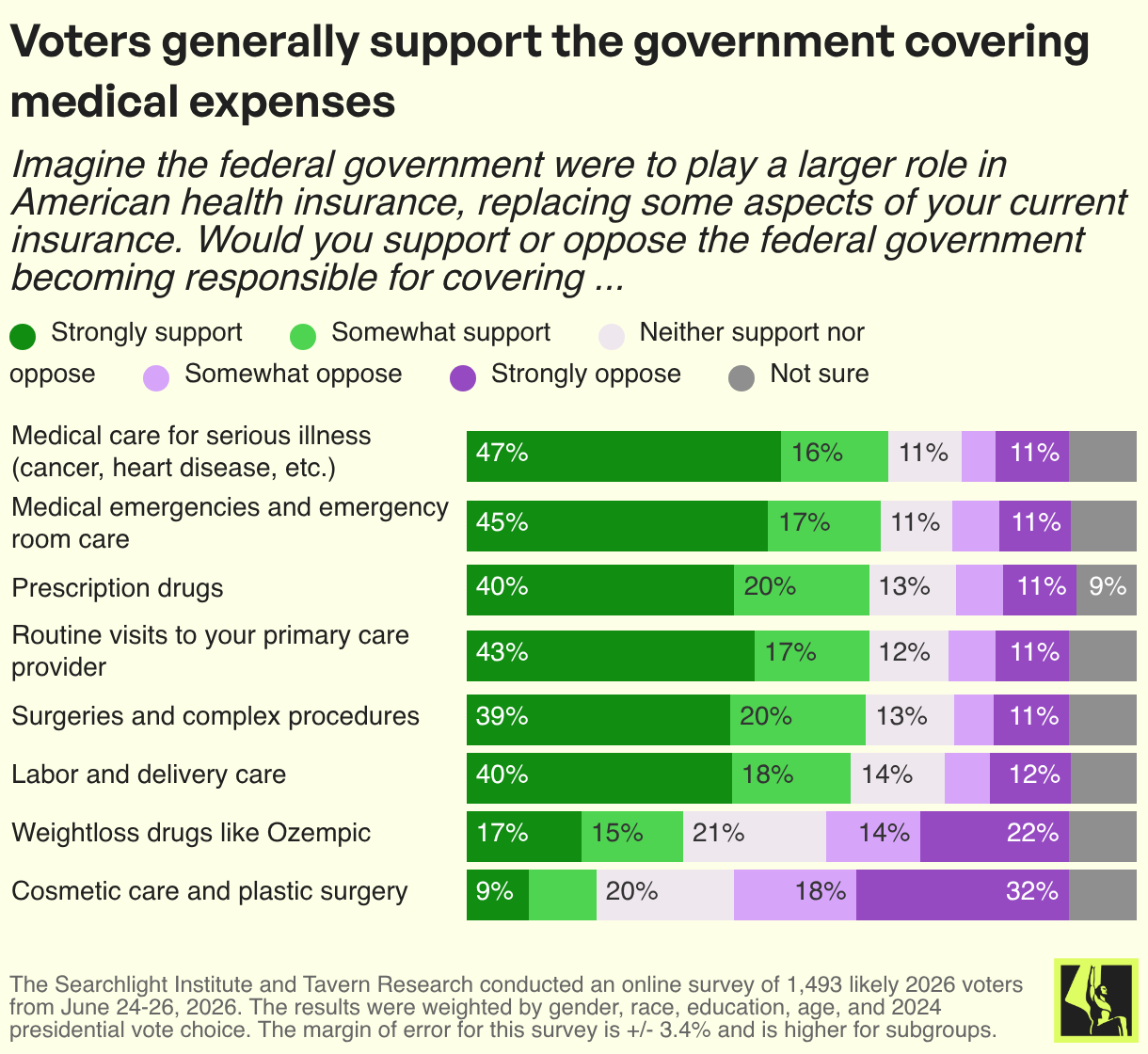
Majorities of voters support the federal government covering medical care for serious illnesses (63%), medical emergencies and emergency room care (62%), prescription drugs (60%), routine visits to primary care providers (60%), surgeries and complex procedures (59%), and labor and delivery care (58%). Only 32% and 19% of voters support the government covering weight loss drugs like Ozempic and cosmetic care and plastic surgery, respectively.
Why (and How) We Tested the Wording for Government-Run Health Insurance
In an effort to provide a fulsome look at voter opinions of government-run health insurance, Searchlight and Zeteo drafted three separate question wordings regarding Medicare for All and single-payer health insurance proposals.
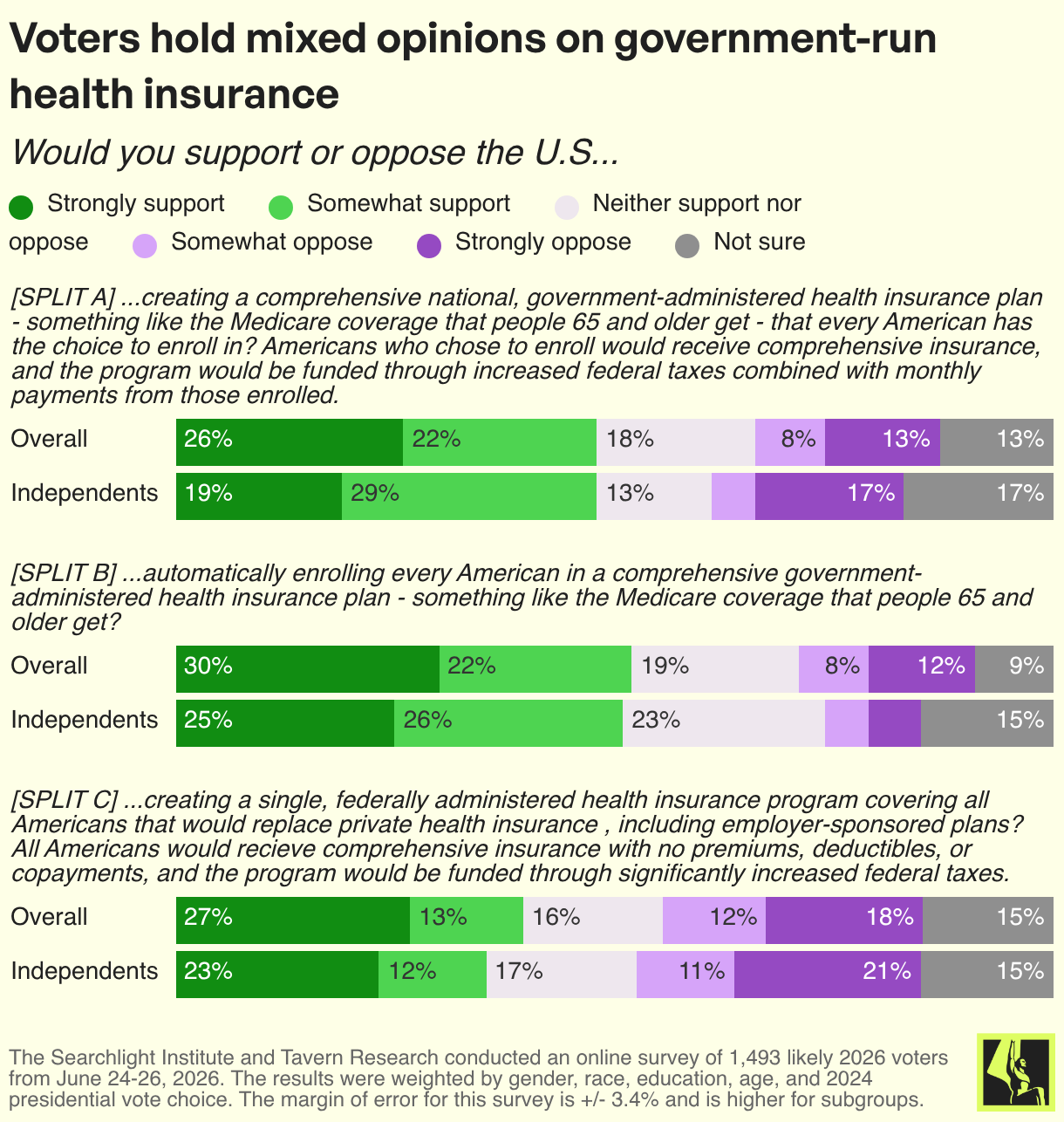
Many advocacy groups commission pollsters to conduct surveys asking voters whether or not they support Medicare for All; often these surveys are worded to produce more favorable or unfavorable results for the proposal. To understand the effects of question wording on the level of support for government-run health insurance, we prompted survey respondents with one of three different descriptions of such a program.
- For Split A, we asked voters: “Would you support or oppose the U.S. creating a comprehensive national, government-administered health insurance plan — something like the Medicare coverage that people 65 and older get — that every American has the choice to enroll in? Americans who chose to enroll would receive comprehensive insurance, and the program would be funded through increased federal taxes combined with monthly payments from those enrolled.”
- 48% of all voters say they would strongly or somewhat support such a proposal — while 18% say they would neither support nor oppose and 21% say they would somewhat or strongly oppose.
- For Split B, we asked voters: “Would you support or oppose the U.S automatically enrolling every American in a comprehensive government-administered health insurance plan — something like the Medicare coverage that people 65 and older get?”
- 52% of all voters say they would strongly or somewhat support such a proposal — while 19% say they would neither support nor oppose and 20% say they would somewhat or strongly oppose.
- For Split C, we asked voters: “Would you support or oppose the U.S. creating a single, federally administered health insurance program covering all Americans that would replace private health insurance, including employer-sponsored plans? All Americans would receive comprehensive insurance with no premiums, deductibles, or copayments, and the program would be funded through significantly increased federal taxes.”
- 40% of all voters say they would strongly or somewhat support such a proposal — while 16% say they would neither support nor oppose and 30% say they would somewhat or strongly oppose.
Crucially, the results find that a government-run health insurance program is least attractive to voters when they are provided an honest description of the program’s benefits and trade-offs. The description which yielded the least support among voters proposed replacing private health insurance — which would impact the 178 million Americans who are currently enrolled in employer-sponsored plans.
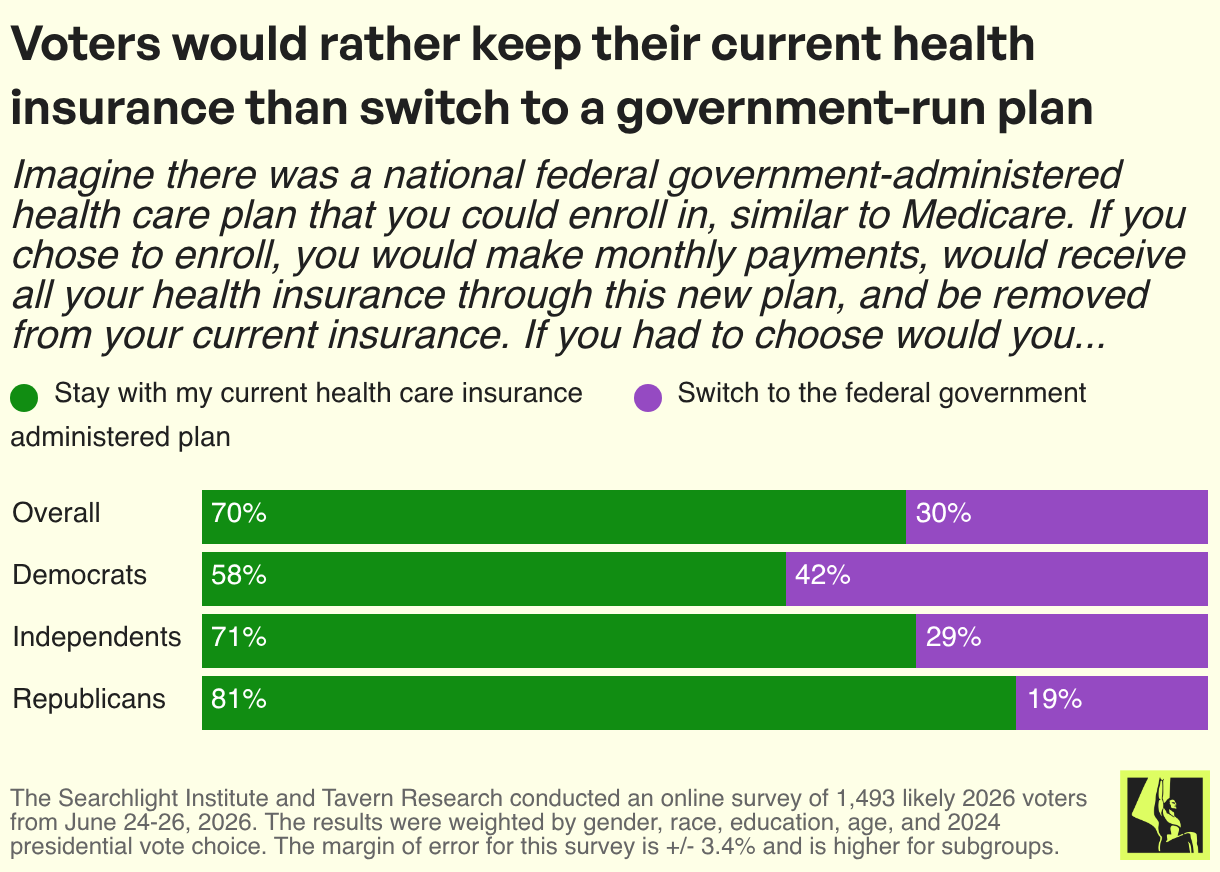
We also asked two questions about voters’ level of confidence in the federal government’s ability to administer a national health insurance plan and whether they would choose to enroll into a national health insurance plan similar to Medicare.
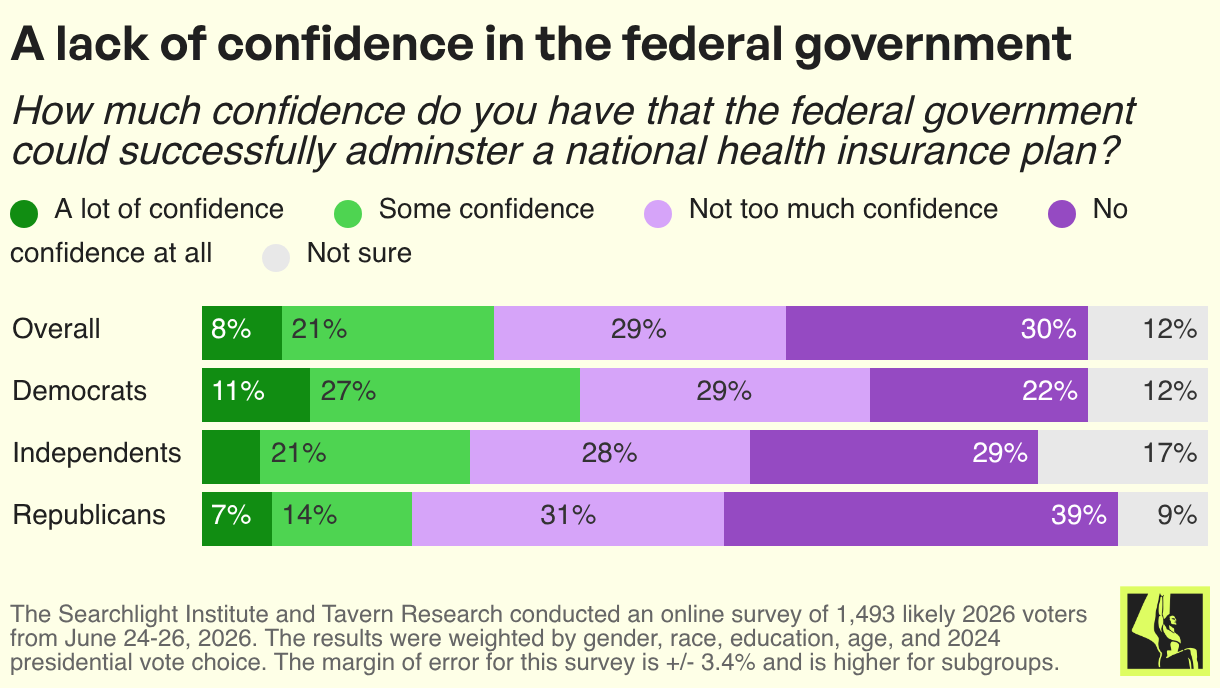
A strong majority of voters — including 57% of Independents — say they do not have confidence that the federal government could be successful in administering a national health insurance plan. Meanwhile, 70% of all voters say they would rather stay with their current health insurance than switch to a government-administered plan similar to Medicare.
The Great Debate Over Health Care Reform Should Agree on One Thing
As our team at Searchlight has previously found, the actual design of a particular policy proposal has a much stronger effect on its support among voters than the messaging behind said proposal. Knowing this, candidates and elected officials should focus on smart policy design and be clear about the specifics of their ideas beyond the message they share to voters.
The great debate over health care reform (including over Medicare for All) should at least agree on one thing: Forcing Americans off their preferred health insurance by eliminating private and employer-sponsored plans altogether would be an unforced error. Some Medicare for All advocates now support a version of the proposal that would explicitly preserve employer-sponsored and private health insurance — avoiding the mandatory-replacement trap in exchange for a ‘public guarantee’ of care.
Any serious proposal for health care reform should take into consideration the topline results of this poll: While voters say they support greater government involvement in health care, they hold mixed or negative views on government-run health insurance, lack confidence in the government’s ability to administer such a plan, and 70% say they would rather keep their current health insurance if given the option. As we work toward achieving universal health care, policymakers should be mindful of public opinion and consider clear attitudes regarding reform proposals and a lack of confidence in government.
Methodology
The Searchlight Institute and Tavern Research conducted an online survey of 1,493 likely 2026 voters from June 24-26, 2026. The results were weighted by gender, race, education, age, and 2024 presidential vote choice. The margin of error for this survey is +/- 3.4% and is higher for subgroups.