Americans’ Surprising Bipartisan Acceptance of Gun Control
In a recent poll, the Searchlight Institute explored how voters feel about gun rights, various gun control policies, and how different messages influence how Americans feel about greater restrictions on guns. Gun control is a low-salience issue, but there are still bipartisan policies that can help reduce homicides, suicides, and mass shootings. This information can provide lawmakers with an understanding of what common-sense policies they can support without alienating culturally conservative gun owners.
First, voters overwhelmingly support (69%) making it more difficult for Americans to purchase and use guns. This support spans across party identification and is even supported by a majority of gun owners (56%).
Only 10% of voters do not support civilian gun ownership. When asked to name their most important reason for why they support gun ownership, voters said self-defense (40%), constitutional right (23%), and hunting and sport shooting (15%).
We then asked voters what sort of specific gun control reforms they would be most open to. Overall, there was strong, bipartisan support for requiring guns kept at home to be stored in safes, making it easier to hold gun manufacturers accountable for selling guns to those who aren’t allowed to have them, encouraging lawful gun ownership, and increasing prison sentences for those who illegally possess guns.
The only policy that had negative support was taking guns away from people who once purchased them legally, but are no longer allowed to own them because of new laws.
We then tested whether information about gun policies would increase or decrease respondents’ likelihood to support enhanced gun control.
We did this by splitting voters into two groups: those who were given data and arguments about homicide rates, and those who were given data and arguments about the impact of guns on fatal accidents in the home.
All respondents saw the same opposing message to make it easier to track the effect of the supporting arguments we gave:
- Opponents of these laws say that the crime rate should have no impact on Americans’ constitutional rights. People should still be able to own guns, go hunting, and defend themselves from criminals or possible government overreach.
Both subsets were given either a fact about the recent decrease in homicide rates or a fact about the impact of guns on the likelihood of fatal accidents:
- According to FBI crime statistics, the United States homicide rate has fallen by 15% over the past 20 years and 16% in the last four years.
- According to recent studies, the presence of a gun in a home doubles the likelihood of fatal accidents in the home.
Both of these facts actually decreased support for greater restrictions on guns by 14 points. These changes are driven almost entirely by Republicans: while 54% of Republicans (net +21) believe it should be harder to buy a gun, only 40% (net -5) supported greater restrictions on guns after being given the facts about lower homicide rates and only 34% (net -18) of Republicans supported these restrictions after being given the facts about the increased likelihood of fatal accidents.
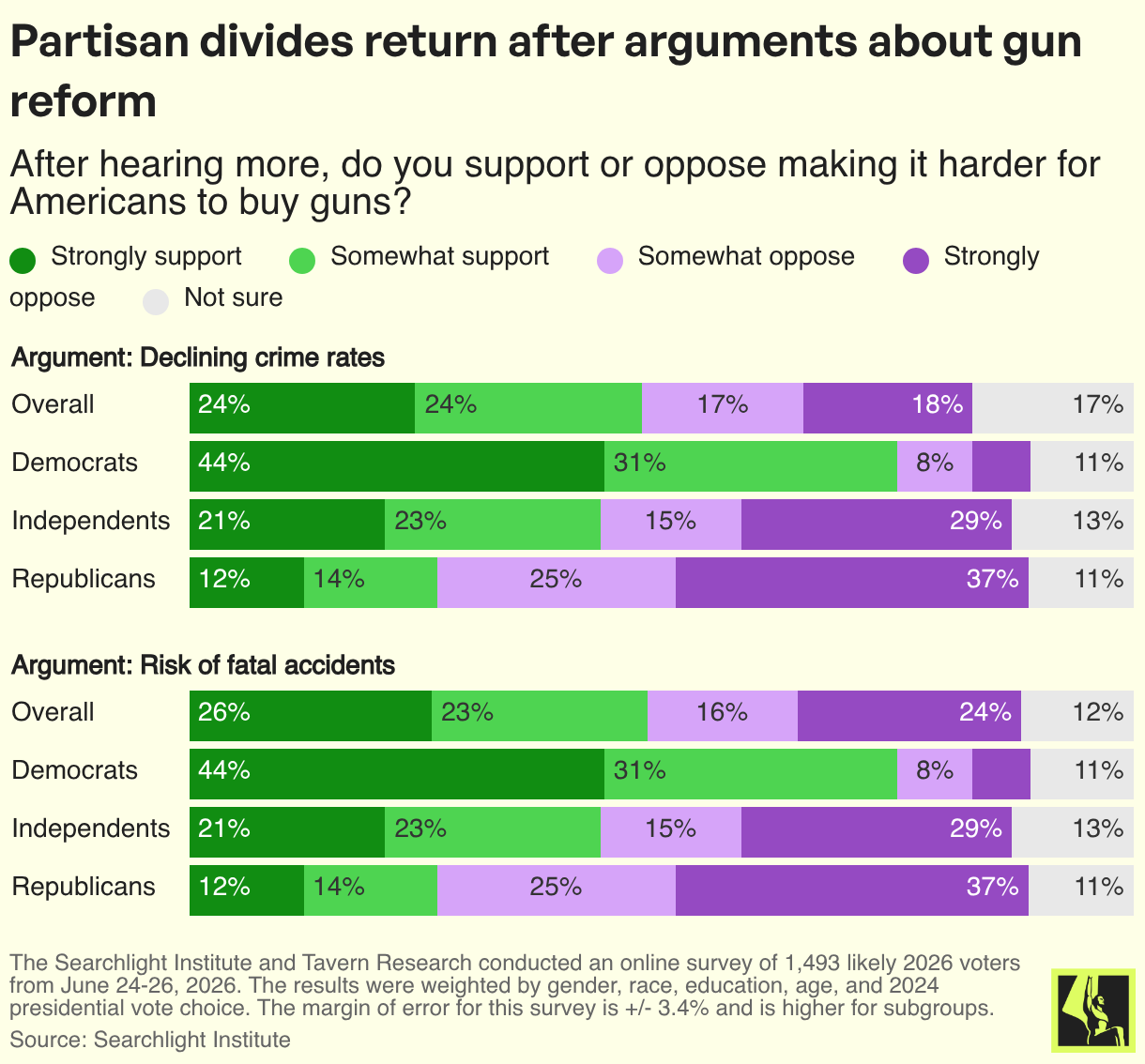
Next, each subset of respondents was provided an argument in support of greater restrictions on guns in light of these trends:
- Supporters of these laws say that low crime and homicide rates mean that people don’t need to worry as much about owning a gun for self defense.
- Supporters of these laws say that having a gun in the house puts you at higher risk for fatal accidents, so it is actually less safe to own a gun.
Once again, both groups saw the same opposing message, which focused on a separation between Americans’ constitutional rights and homicide rates:
- Opponents of these laws say that the crime rate should have no impact on Americans’ constitutional rights. People should still be able to own guns, go hunting, and defend themselves from criminals or possible government overreach.
These arguments decreased support for greater restrictions on guns dramatically: the homicide-related argument decreased by 21 points, and the fatal accident-related argument decreased support by 20 points. Again, this change is driven by Republicans. After the arguments on homicide, Republicans supported greater restrictions by net-13 points and by net -36 points after the arguments about fatal accidents.
Together, this polling finds that Americans support measures that restrict gun ownership through new policies that are not divisive—like deterrence measures towards illegal gun owners and gun manufacturers. However, general support of greater gun restrictions reverts quickly back to partisanship when there are attempts to persuade voters. Despite the decreases in support seen after the arguments, the net support for greater restrictions on guns remained positive throughout, reaffirming the idea that the policy itself—in this case, greater restrictions on guns—outweighs the messaging surrounding it.
Methodology
The Searchlight Institute and Tavern Research conducted an online survey of 1,492 likely 2026 voters from June 24 – 26, 2026. The results were weighted by gender, race, education, age, and 2024 presidential vote choice. The margin of error for this survey is +/- 3.4% and is higher for subgroups.
Together, this polling finds that Americans support measures that restrict gun ownership through new policies that are not divisive—like deterrence measures towards illegal gun owners and gun manufacturers. However, general support of greater gun restrictions reverts quickly back to partisanship when there are attempts to persuade voters. Despite the decreases in support seen after the arguments, the net support for greater restrictions on guns remained positive throughout, reaffirming the idea that the policy itself—in this case, greater restrictions on guns—outweighs the messaging surrounding it.
Methodology
The Searchlight Institute and Tavern Research conducted an online survey of 1,492 likely 2026 voters from June 24 – 26, 2026. The results were weighted by gender, race, education, age, and 2024 presidential vote choice. The margin of error for this survey is +/- 3.4% and is higher for subgroups.
_