
Americans Aren’t Buying What The AI CEOs Are Selling
The CEOs of artificial intelligence companies have promised that their technology will disrupt the labor force and increase future economic growth more than any technology in human history.
What does the rest of society think of the technology? Do they even know these companies exist?
According to recent polling, both from Searchlight and The Argument, a majority of Americans are aware of the two most popular AI companies — Anthropic and OpenAI. The favorability of these companies is positive, but the margin of support is narrow and has not reached a majority in either survey. At the same time, a recent Reuters poll found that 53% of Americans are fearful that AI could take their jobs. Additionally, data center construction, which is the most physical representation of AI’s dominance in American life, has become overwhelmingly unpopular and a wedge issue in many elections this cycle.
In an effort to quell a potential AI backlash, AI CEOs have begun emphasizing the positive aspects of the technology in their public statements. In a recent conversation with Ezra Klein, the AI journalist Jasmin Sun summarized this change in rhetoric, “They were trying to win the vibes on A.I. Twitter in San Francisco, and I feel like they never realized everyone else could hear them. And so now they’re trying to take it back.”
Is this rhetorical turn effective?
We tested statements by two figures in AI, Dario Amodei (one of the quintessential doomers), and Yann LeCun (optimist and AI moderate), to see how their recent AI rhetoric is working. Below are two separate compilations of what Amodei and LeCun have said to the public — the respective ‘doomer’ and ‘optimist’ in this message test — that Searchlight presented to survey respondents.
Amodei Message: Here are some recent statements by a leader in AI.
Dario Amodei, the CEO of Anthropic told an audience at Davos that AI models would replace the work of all software developers within a year and would reach “Nobel-level” scientific research in multiple fields within two years. He said 50% of white-collar jobs would disappear within five years. “Software is going to become cheap, maybe essentially free.” and [in an ideal world] “cancer is cured, the economy grows at 10% a year, the budget is balanced — and 20% of people don’t have jobs.”
LeCun Message: Here are some recent statements by a leader in AI.
Yann LeCun, cofounder of Advanced Machine Intelligence Labs, said “The real revolution is not AI replacing humans, but AI helping humans think better, plan better, and understand the real world,” and “I think the most interesting thing that we’re going to build is an amplifier for human intelligence.” Comparing the present moment to earlier technological shifts, he said AI is “more like the new printing press” than electricity, emphasising its role in disseminating knowledge.”
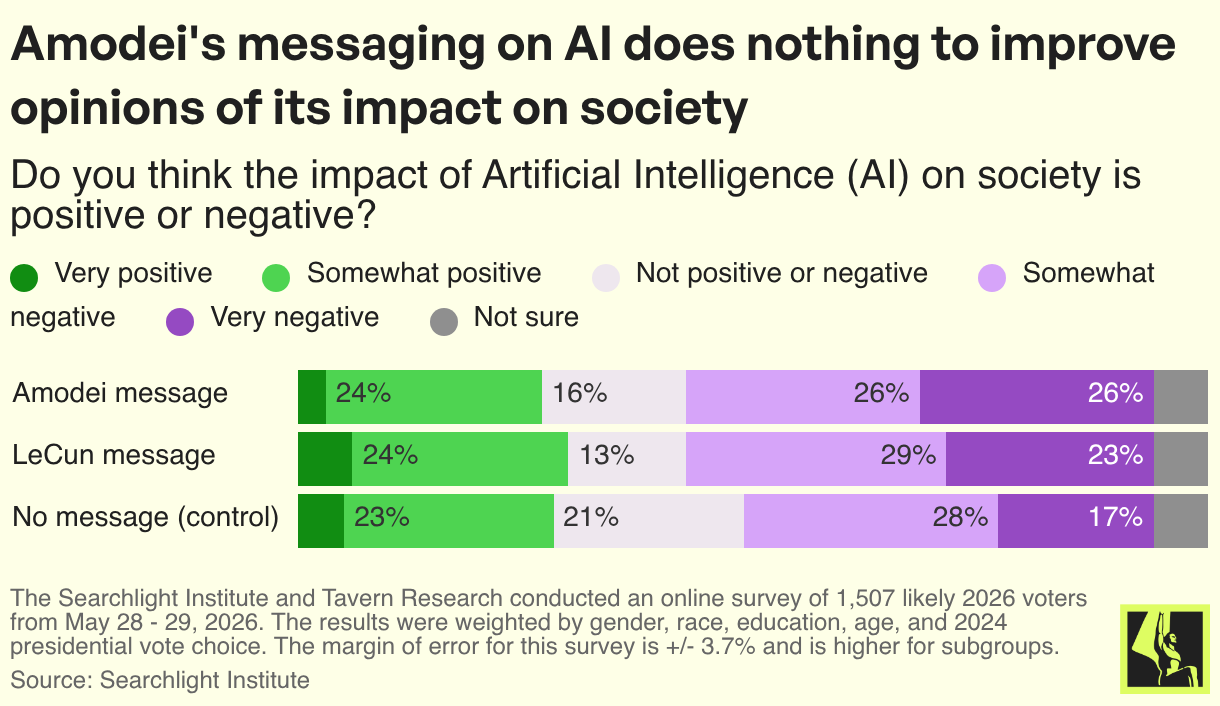
Our research shows that they’re not really helping themselves at all. Statements by Dario Amodei do nothing to increase favorability of AI, or to convince voters that AI has a positive impact on society. His line on AI and society is dramatic and alarming, including that [in his ideal world] “cancer is cured, the economy grows at 10% a year, the budget is balanced — and 20% of people don’t have jobs.” Voters did not react well to this, and it increased negative views of AI’s impact on society.
We also tested a collection of statements by Yann LeCun, godfather of AI and one of the more positive voices in the AI space. His line tends to be that AI will be a compliment to human expertise, rather than a replacement for it. This also did nothing to improve opinions of the technology. While his take is moderate in comparison to the doomers, it seems to not do much to reassure voters. He analogizes AI to the printing press, as an augment to human intelligence, but these high minded sentiments don’t seem to move opinion.
Beyond AI’s impact on society, we found that their messages did not actually impact people’s personal feelings towards AI.
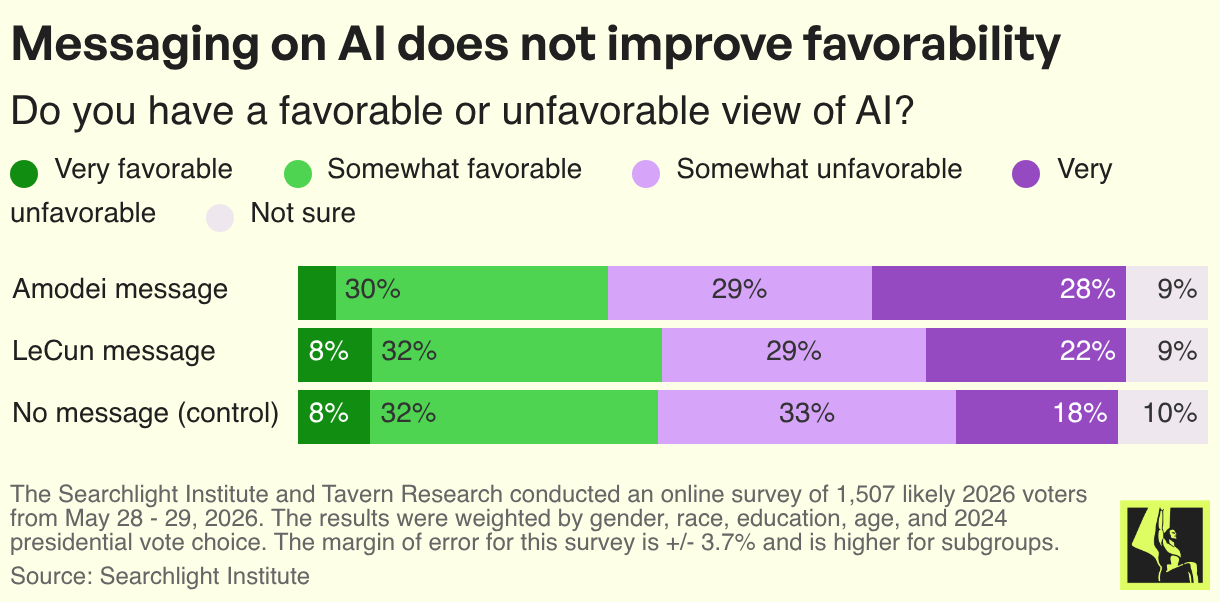
If Amodei and his peers are serious about their technology becoming pervasive without triggering massive backlash, they’re going to have to keep workshopping their messaging. Right now, favorability seems to be growing as people experience the technology in their everyday lives and the name ID of the companies increases. Everyday usefulness may be the most compelling argument, but it’s not what Amodei and his peers focus on.
Methodology
The Searchlight Institute and Tavern Research conducted an online survey of 1,507 likely 2026 voters from May 28 – 29, 2026. The results were weighted by gender, race, education, age, and 2024 presidential vote choice. The margin of error for this survey is +/- 3.7% and is higher for subgroups.