
2026 Texas Electorate
Blue Texas is finally here, and it wasn’t even particularly close. In a state that Donald Trump won by 14 points just two years ago, State Representative James Talarico beat Texas Attorney General Ken Paxton by a whopping 12 percentage points. Talarico’s performance was a 26 point shift from 2024 and an overperformance of 15 points relative to 2018, when Beto O’Rourke came up short against Ted Cruz. State Representative Gina Hinojosa defeated incumbent Republican Governor Greg Abbott by 7 points. Democrats also won virtually every statewide election on the ballot, including Lieutenant Governor, Attorney General, State Comptroller, Railroad Commissioner, Land Commissioner, Agriculture Commissioner, and multiple positions on the State Supreme Court. Democrats also flipped both the Texas State House of Representatives and the State Board of Education.
The Republican brand has taken a steep hit with Texas voters. Paxton limped into the general election after a bruising primary against incumbent Senator John Cornyn and was pegged as “most corrupt politician in Texas history” during his time on the trail. Strong Democratic candidates like Talarico, Hinojosa, and Bobby Pulido seized the unique opportunity to turn Texas blue.
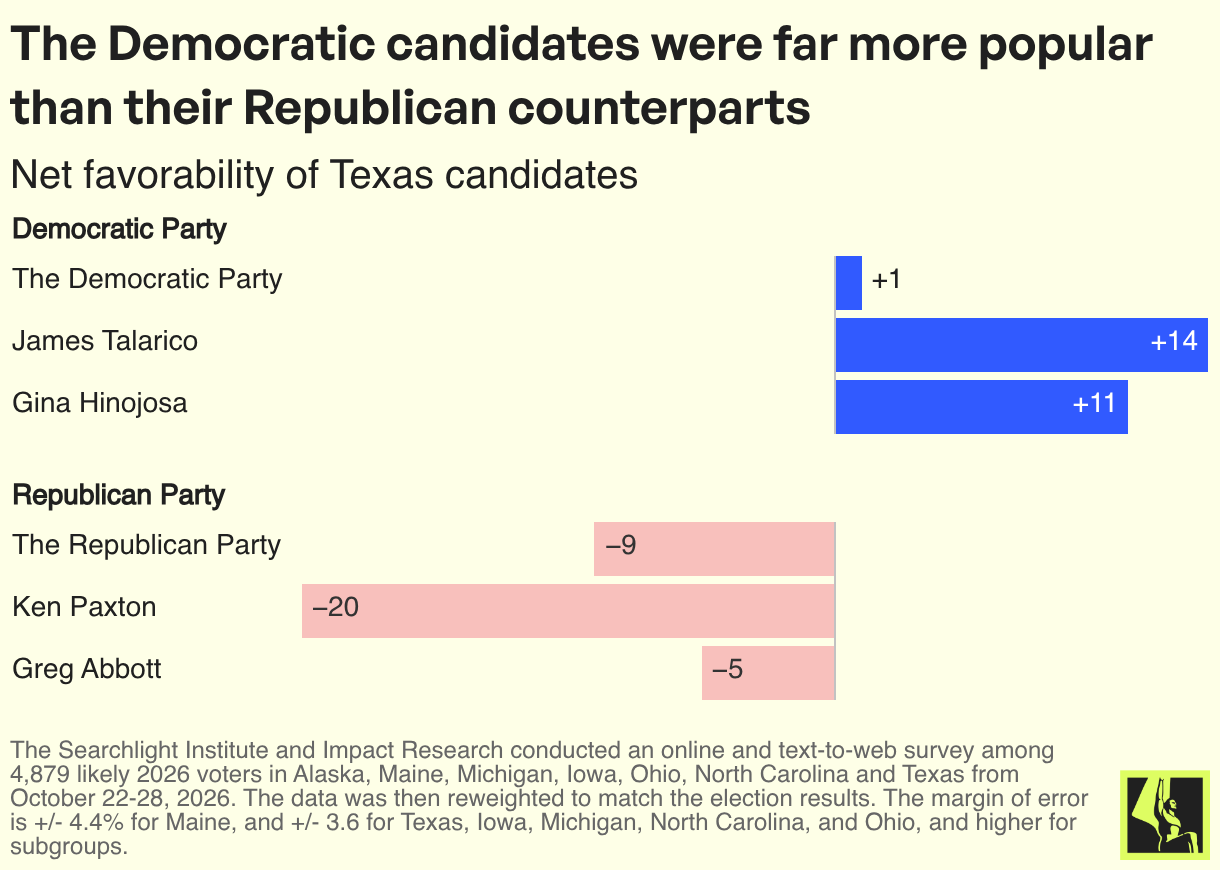
Importantly, Democrats staked out positions that broke from traditional Democratic orthodoxy. Talarico wore his willingness to “stand up to his own party” on energy policy as a badge of honor and framed his border policy as “a welcome mat out front and a lock on the door.”. As recently as last month, Hinojosa gave credit to President Trump for reducing illegal border crossings. By defining themselves as separate from the national Democratic Party, Talarico and Hinojosa were able to build their own brands. Each candidate had favorability ratings that exceeded the perceptions of their party, while their opponents and the Republican Party were all unpopular, particularly Paxton.
Sixty one percent of Texas midterm voters said the country was headed in the wrong direction, and though Trump’s favorability ratings were modestly negative at net -13 (43% favorable / 56% unfavorable), his net job approval was deeply underwater by 17 points (41% approve / 58% disapprove). Two-thirds of Texas midterm voters (68%) said their vote was an opportunity to show how they felt about Trump’s presidency. This anti-Trump strain was broadly powerful up and down the ballot. Talarico won voters who said that their vote was a way to show how they felt about Trump by a significant 24-point margin (61% Talarico / 37% Paxton), and Hinojosa won these voters by 19 points (59% Hinojosa / 40% Abbott).
Our oversample of Latino voters showed that they had soured more on Trump and were more pessimistic about the direction of the country than voters overall. Two thirds (67%) said that the country was going in the wrong direction. Just 31% approved of the job Trump is doing as president, while 68% disapproved. Importantly, nearly all of that disapproval was intense; 65% said they strongly disapproved of the president. Talarico and Hinojosa were both very popular with Latino voters, at net +39 (68% favorable / 29% unfavorable) and net +35 (62% favorable / 27% unfavorable), respectively, while Paxton (net -42) and Abbott (net -25) were both deeply underwater.
Paxton’s lengthy tenure in Texas and his close association with Trump likely contributed to the fact that seven in ten Texas midterm voters (71%) described Paxton as a typical Republican politician; only 53% thought Talarico was a typical Democratic politician. Talarico won voters who viewed Paxton as a typical Republican politician by 22 points (60% to 38%).
How voters perceived the candidates
Talarico was more popular than Paxton. Even though the Democratic Party brand was evenly divided among Texas midterm voters (net +1), Talarico had a net +14 favorability rating (55% favorable / 41% unfavorable). Hinojosa was also viewed positively with a net favorability of +11 (51% favorable / 40% unfavorable). Paxton, however, was significantly less popular than his party: though the Republican Party was rated at net -9, Paxton’s personal rating was 11 points lower at net -20 (38% favorable / 58% unfavorable). Abbott, at net -5 (46% favorable / 51% unfavorable) was viewed considerably more favorably than Paxton, this was ultimately not enough to keep him from being swept out in the blue wave.
The favorability gap was wider among Independents than voters overall for every candidate but Hinojosa. Talarico was viewed more favorably by a net +17 and Hinojosa held steady at net +11, while Paxton was underwater by a staggering 43 points and Abbott was net negative at -24.
Deciding issues
We asked Texas midterm voters to evaluate the Senate candidates on a number of different attributes, and voters strongly preferred Talarico on each of the characteristics we asked about. Voters were 30 points more in agreement that Talarico “will work with both parties to get things done,” 27 points more likely to believe Talarico “will work to bring change to Washington,” 24 points more likely to think Talarico “will work to lower costs for regular people in Texas,” and 21 points more likely to say Talarico “will prioritize the things I care about in Washington.” Nearly six-in-ten independents (59%) thought Talarico “will prioritize the things I care about in Washington” compared to just 17% who said the same for Paxton, and by 40 points felt Talarico “will work to lower costs for regular people in Texas” better than Paxton (62% Talarico / 22% Paxton).
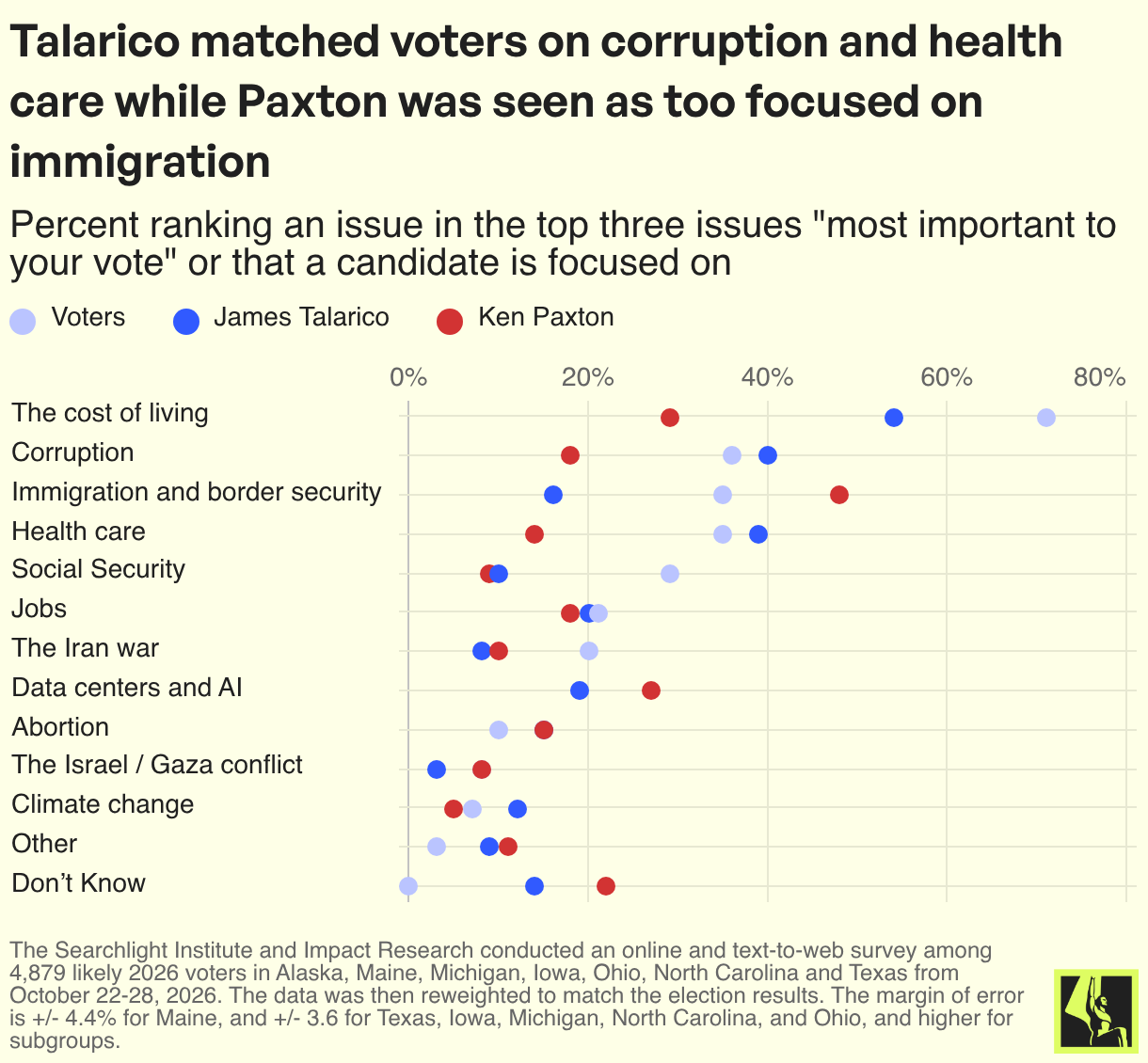
We asked voters to choose the three issues that were most important to their vote for Senate, and then, from that same list, the three issues that they thought each candidate was focused on. Talarico had a strong advantage on these issues too.
Seventy-one percent said cost of living was one of their most important issues, far outpacing the next most important issues like corruption (36%), immigration and border security (35%), and health care (35%).
Talarico was generally seen as more focused on the issues motivating voters than Paxton. 54% of voters said he was focused on the cost of living, 40% thought he was focused on corruption, and 39% said he was focused on health care. Far fewer thought Paxton was focused on the cost of living (29%), corruption (18%), or health care (14%).
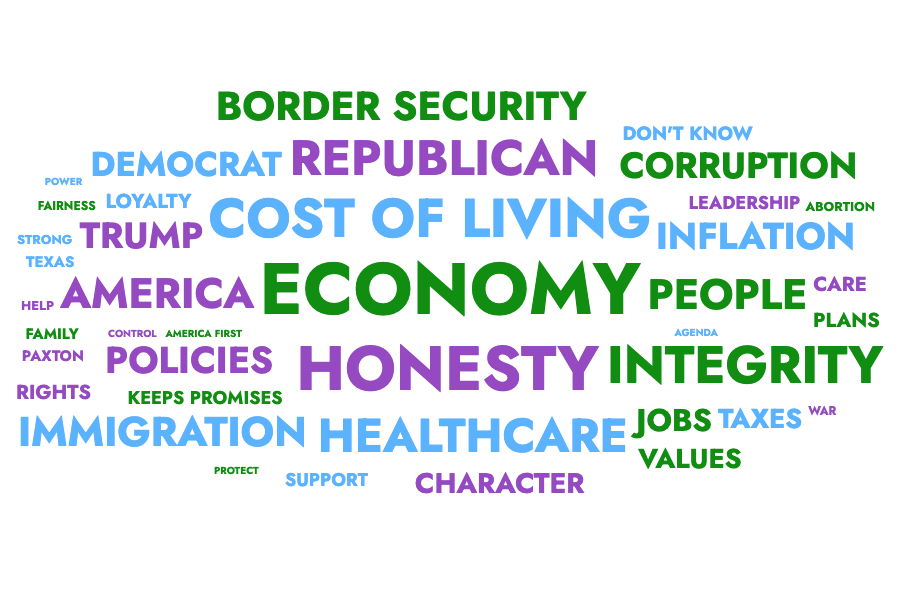
In their own words, Paxton voters frequently cited the economy, conservative values, and border security as the top reasons for their Senate vote. As one Paxton voter said, “I want a candidate that believes in a strong economy, lower taxes and strong border protection.” Meanwhile, Talarico voters frequently cited addressing the cost of living and his personal characteristics, making statements like “Economic policies and candidate’s integrity are very important to me.”
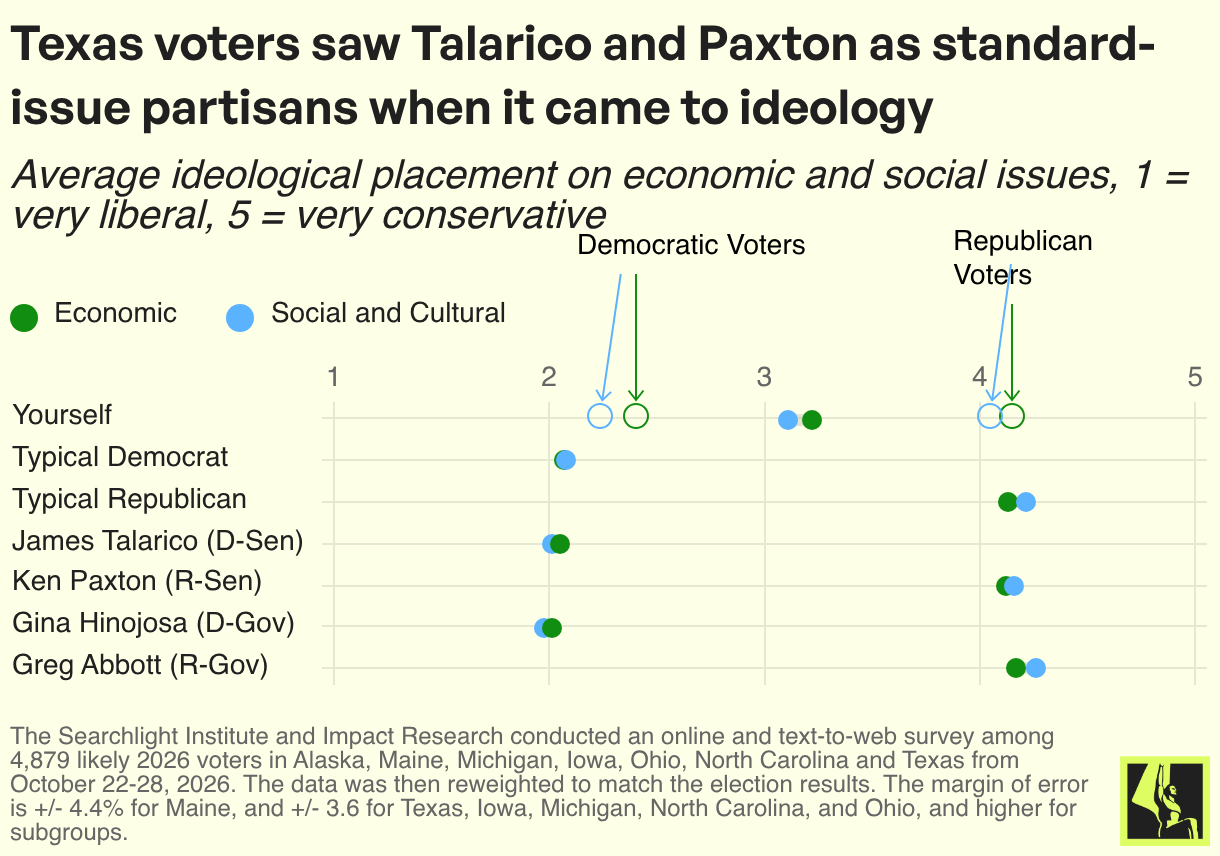
 The Paxton campaign was also unsuccessful in portraying Talarico as an extreme ideologue. When asked to place themselves, the candidates, and typical Democrats and Republicans on an ideological scale when it comes to both economics and social and cultural issues, voters placed themselves closer to Paxton than Talarico. Voters perceived Talarico to be nearly identical to a “typical Democrat” on economic issues and slightly to the left on social and cultural issues, but did not view him as meaningfully more ideologically extreme than the average Democratic politician. As a result, Talarico’s personal likeability combined with poor perceptions of Paxton, positioned him for electoral success in the state.
Discussion
As in every other state, voters in Texas were concerned about cost of living and deeply dissatisfied with the Republican Party. While immigration was prioritized here more than in other states, and Paxton had the advantage on it, it was not enough to overcome voters’ concerns about his corruption and perceived lack of interest in the economy. Talarico and Hinojosa both leveraged their credibility as outsiders, moderated on key issues, and took advantage of their opponents’ deep unpopularity to finally achieve the dream of Blue Texas.