
2026 Ohio Electorate
Since Donald Trump won the state in 2016, Ohio has been steadily trending redder — until this November, when Democrat Sherrod Brown won back his Senate seat over Republican Jon Husted and Democrat Amy Acton defeated Republican Vivek Ramaswamy to become the state’s first Democratic governor in nearly 20 years. Acton handily beat Ramaswamy by nearly 8 points, while Brown led Husted by nearly 5 points.
But the two Democrats won in very different ways. Brown, a three-term senator, was well known by the electorate and ran close to the Democratic Party. Voters overwhelmingly saw him as a typical Democrat but the national environment and his focus on costs were enough to pull him over the finish line. Acton, on the other hand, leaned into the fact that she became a household name in Ohio by serving in Republican Mike DeWine’s administration. She was not seen as much of a typical Democrat and was significantly more popular than her party broadly. While running on the old playbook was enough to carry Brown to victory this year, Acton’s overperformance underscores how much better Democrats can do.
After voting for Trump by double digits in 2024, Ohio voters were unhappy with the current state of U.S. affairs and had soured on the president. Just one third (32%) of Ohio voters said the country was headed in the right direction, while 64% said it was going on the wrong track. Trump’s job approval sat at net -16 (42% approve / 58% disapprove), including 46% who said they “strongly disapproved” of the president’s performance. Trump’s unpopularity did loom in the race, with 61% saying their vote in the Senate race was an opportunity to showcase their feelings about Donald Trump’s presidency, a sentiment shared by 74% of Brown voters and nearly half (49%) of Husted voters. That said, when asked in an open-ended question what issues were most driving their vote, only 12% of Democrats provided answers in line with “standing up to Trump.” Those who said they wanted Democratic control of the Senate outnumbered those who said Republicans (50% to 45%).
Sherrod Brown, a 3-term incumbent who lost his seat in a hard-fought battle against Bernie Moreno in 2024, ran a campaign linking Husted to Trump and big moneyed interests such as data centers, and touting his bona fides delivering for Ohio workers. Brown has long cultivated a persona that portrays him as a midwest populist and staunch champion of labor, health care, and Social Security. Yet, other than leaning on his populist streak, Brown did very little to distinguish himself from the national Democratic Party.
Amy Acton, the Ohio’s former health director, ran a campaign focused on affordability, especially health care costs. She drew from her background in public health, as well as her experience leading Ohio through Covid, to hone her message. Vivek Ramaswamy also tried to focus his campaign on affordability, but he focused more on rolling back property and income taxes. Importantly, the Ramaswamy campaign made a significant mistake. In the final weeks of the race, the campaign ran a controversial ad featuring Acton’s estranged mother. The Acton campaign then responded by opening up about Acton’s past and the fact that Amy and her brother were taken from their mother’s custody after their stepfather was indicted for raping Amy. The Ramaswamy ad drew significant and swift backlash, and polling suggested it damaged his standing in the race.
How voters perceived the candidates
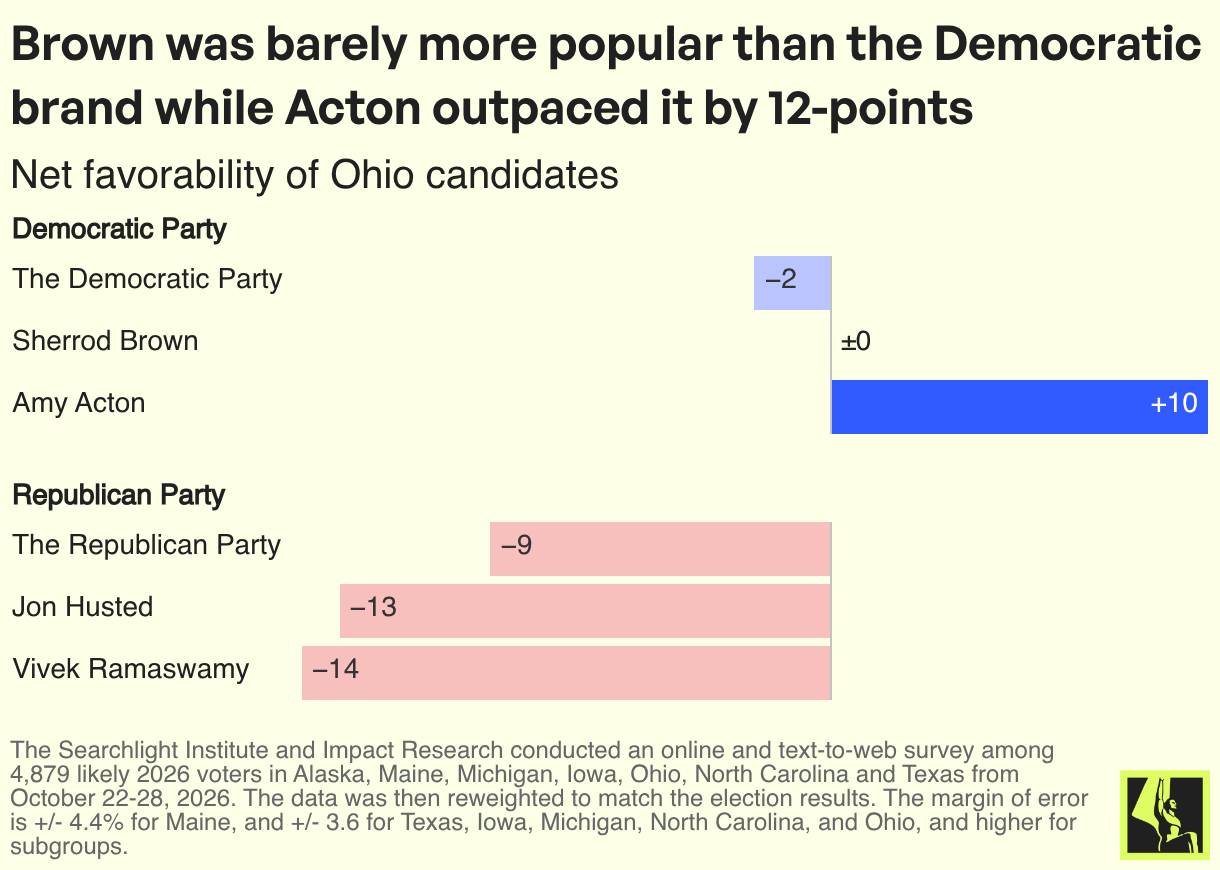
Ohio voters viewed the Democratic and Republican parties negatively (net -2 and net -9 net favorability, respectively). However, there were key differences in how voters viewed the candidates from each party.
While Brown’s net favorability barely beat that of the Democratic brand (Brown at net 0, 2-points better than the party), Acton not only ran ahead of the party brand, but also was the only candidate from either party who had a net positive favorability among Ohio voters (net +10, 12-points better than the party). Acton’s favorability was buoyed by Republicans, who disliked her less than Brown: 74% of Republicans rated her unfavorably, compared to 83% of Republicans who had unfavorable views of Brown. Among non-MAGA Republicans, just 67% had an unfavorable view of Acton, while 83% said the same about Brown.
Meanwhile, both Husted and Ramaswamy were viewed less favorably than the Republican Party brand, though voters viewed them roughly the same (-13 and -14 net favorability, respectively).
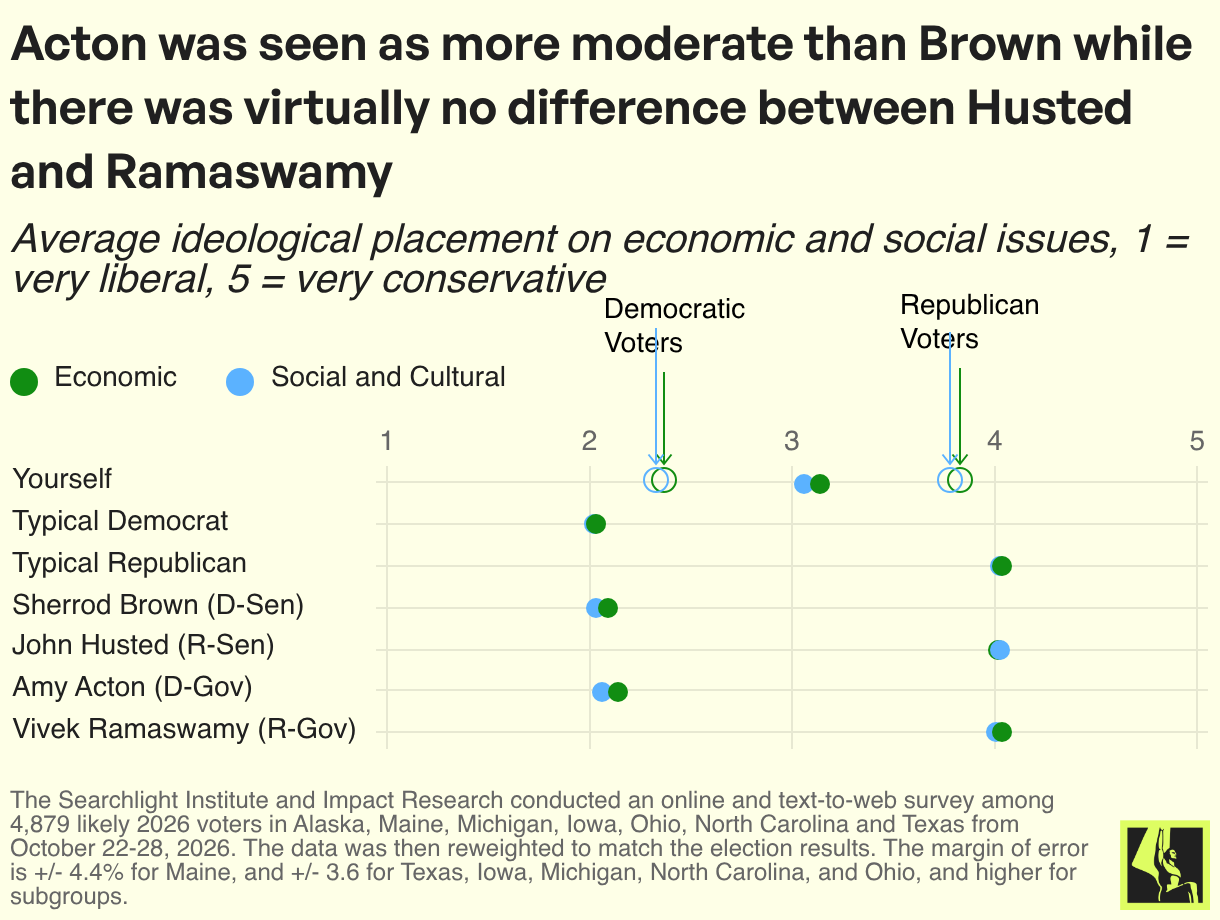
To get a more granular picture of how voters perceived the individual candidates relative to the national parties, we asked them to place themselves, the candidates, and typical politicians of each party on an ideological scale for economic and cultural issues.
Ohio voters placed themselves roughly in the middle regarding their ideology on both economic and cultural issues. While Acton sat closer to voters than Brown on both scales, the gaps were within the margins of error. Meanwhile, Husted and Ramaswamy were seen as almost identical ideologically, to the right of where Ohio voters placed themselves.
In the governor’s race, both candidates were viewed as less typical than their Senate counterparts. Thirty-five percent of voters said Acton was not a typical Democrat (compared to 24% who said the same about Brown). Meanwhile, 28% of voters said Ramaswamy was not a typical Republican (compared to 16% who said the same about Husted).
Having served three terms in the Senate, Brown was a known quantity. In fact, polling from Bowling Green University found that a quarter (25%) of voters thought that he was the incumbent in the race. Perhaps unsurprisingly then, roughly two-thirds of voters (67%) said that Brown was a “typical Democratic politician” — the highest share among the Democratic candidates in the seven states that we surveyed (note: Alaska results have been withheld until all votes are counted). However, Husted fared similarly, as 72% said he was a “typical Republican politician.” Within their own parties, 39% of Democrats said Brown was not a typical Democratic politician, while only 22% of Republicans said the same about Husted.
Among the series of attributes that we tested about the Senate candidates, voters were significantly more likely to say they described Brown better than Husted:
- Work to lower costs for Ohioans (49% Brown / 31% Husted)
- Prioritize the things they care about in Washington (46% Brown / 34% Husted)
- Work with both parties to get things done (44% Brown / 30% Husted)
- Bring change to Washington (45% Brown / 30% Husted)
However, among the seven states that we surveyed, voters were most likely to say “neither” Brown nor Husted fit the descriptions of bringing change to Washington (16%) and working with both parties to get things done (14%), another indicator that voters largely viewed Brown and Husted as in line with their own parties. Notably, Independents were significantly more likely to describe Brown as the candidate who would work to lower costs (47% Brown, 15% Husted).
The deciding issues
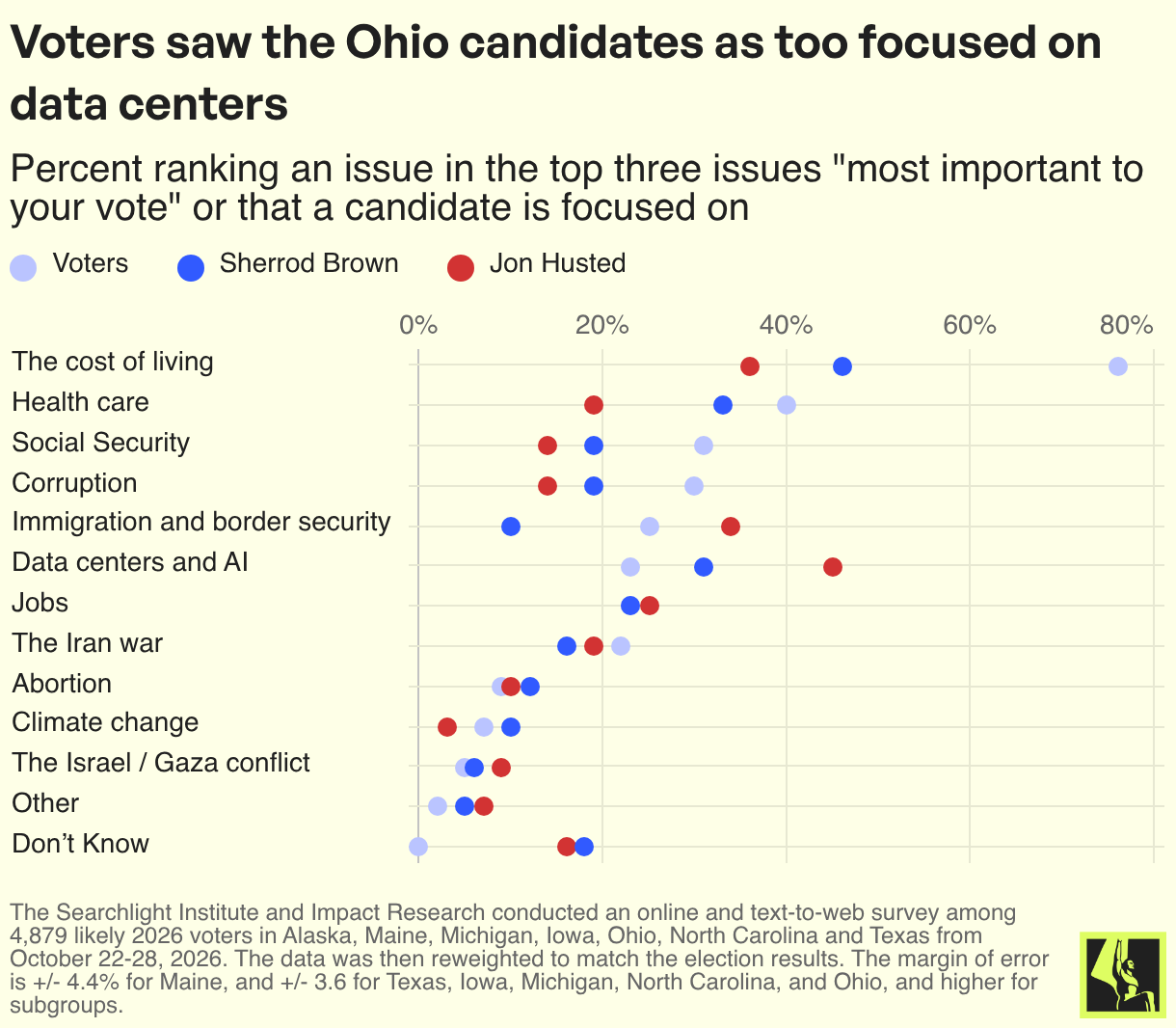
We asked voters to choose the three issues that were most important to their vote for Senate, and then, from that same list, the three issues that they thought each candidate was focused on. Out of the seven states we surveyed, Ohio voters were the most likely to say the cost of living was one of the top three issues that determined their Senate vote (76%). Specifically, voters were fed up with how costs are affecting their bottom lines right now: 65% of Ohio voters said that they were more concerned about how the cost of groceries, gas, and health care were affecting their current financial situation, compared to 25% who said they were more concerned that high costs right now will make it harder for them to afford big purchases like a home in the future.
Voters saw both candidates as significantly out of step on the cost of living. Just 46% of voters said Brown focused on the cost of living, the lowest of any of the Democratic Senate candidates that we tested in the seven states we surveyed. Despite this, Brown still edged out Husted, who only 36% of voters said was focused on the cost of living.
Healthcare was voters’ second most important issue, with 40% placing it in their top three. Brown was viewed as much more in step with voters’ focus on healthcare, with 33% of Ohioans saying he was focused on it, compared to a paltry 19% for Husted. Rounding out voters’ top issues were Social Security (31%) and corruption (30%). While both Brown and Husted were viewed as out of step with voters’ stronger prioritization of the issues, the gap was notably smaller than that for the cost of living, and voters placed Brown as closer to their own prioritization.
Data centers garnered a significant amount of attention in Ohio this cycle, though it was not a top issue determining voters’ choice for Senate. While 23% of voters placed data centers in their top three issues — the highest among all seven states we surveyed — they viewed both candidates as overly focused on data centers. 31% of voters said data centers were among Brown’s top issues, and a whopping 45% said the same about Husted. Importantly, Husted’s data center connection comes mostly from Brown’s voters: 54% of Brown voters say Husted is focused on data centers, compared to 35% of Husted voters. The Brown campaign and pro-Brown super PACs invested a significant amount in ads that tied Husted to data centers, and their efforts were clearly successful.
Among voters who did rank data centers as one of their top issues, 48% supported Brown while 40% supported Husted, which was roughly in line with voters’ overall vote choice — an indicator that despite Brown’s successful attempts at connecting Husted to the data center buildout, it wasn’t necessarily moving votes this cycle, though that may change in the future if it continues to be a flashpoint in the state.
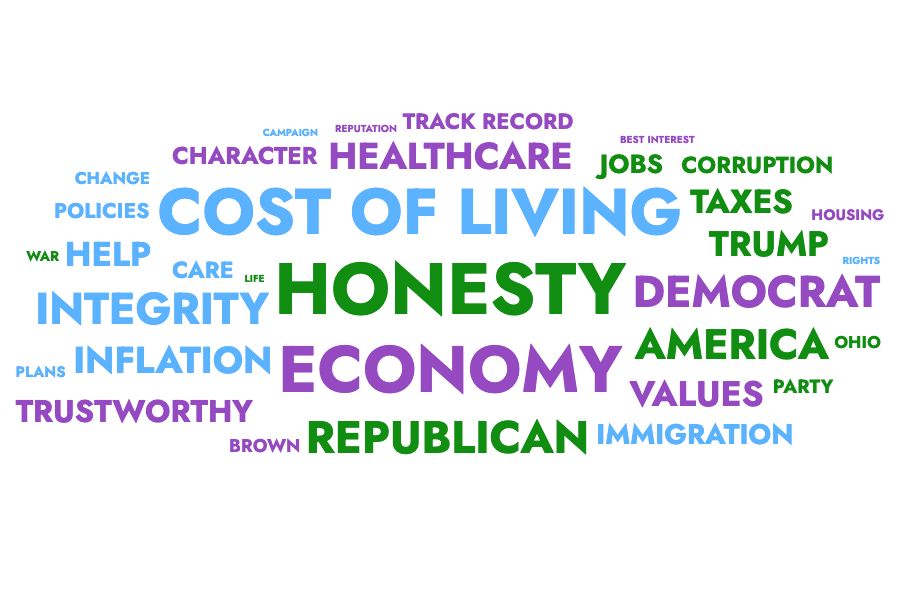
In their own words, both Brown and Husted voters frequently cited the cost of living as their top factor in deciding who to vote for.
As one Brown voter put it: “It seems that the Democrats are less corrupt than the Republicans and with the current state of affairs with high prices for every single thing. Something has to be done.”
Meanwhile, a Husted voter said: “The future of the economy. Will it ever become affordable to live comfortably again.”
Many voters on both sides also cited elements related to the candidates’ personal characteristics in addition to their policy stances. As one Brown voter said: “They must have integrity. Must try to maintain the BEST interests of the COUNTRY and their home constituents. They need to NOT succumb to pressure from bully’s [sic], or greed.”
Some Husted voters specifically cited Brown’s long tenure in public office as a reason to vote against him. As one bluntly put it, “Keeping Sherrod Brown OUT who is a liar and not done anything the past 50 years he has held an office.”
Democrats won important down ballot races as well. In OH-09, Democrat Marcy Kaptur held her seat by over 5 points, even after Ohio Republicans redrew her seat to be more conservative. Kaptur, who won by fewer than 3,000 votes in 2024, has carved out her own brand, though she came under fire for running anti-trans ads this cycle. In OH-07, Democrat Brian Poindexter flipped Max Miller’s seat by nearly 10 points. This had also been a scandal-ridden campaign for Miller, who had been accused of domestic abuse by Ohio Senator Bernie Moreno’s daughter.
Discussion
The Ohio results show the power of the national wave. Brown won his seat back because voters were frustrated with Trump and saw Brown as more focused on issues they cared about, like the cost of living, than Husted. Rather than differentiating himself from the party, Brown rode the blue wave back to the Senate. Acton, on the other hand, ran a stronger campaign and won over more Republicans. In order to hold these seats in less favorable years, Democrats must learn the lesson that candidates who break from the party brand can deliver bigger wins than those who are perceived as too tied with the party line.