
2026 North Carolina Electorate
The North Carolina Senate race flew under the radar this year, despite it being one of Democrats’ top pickup opportunities. The national media and major political parties saw it as a foregone conclusion early in the cycle, as two-term Governor Roy Cooper held a commanding lead in public polling over former RNC Chair Michael Whatley for much of the year. Frankly, the writing was on the wall on this one from the beginning. Republicans thought so too, pausing spending in the race in early October.
That perspective proved prescient. Cooper blew Whatley out of the water, winning by an almost unthinkable margin of nearly 20 points. This marks Roy Cooper’s seventh statewide victory, cementing him as the most dominant force in recent North Carolina political history.
Cooper began the race with a strong base of support, built up over 25 years as a popular statewide elected official. The chief reason for his continued success has been his ability to maintain a distinctly heterodox individual brand by staking out a mix of positions from across the ideological spectrum that make sense for him and his state.
He was a tough-on-crime Attorney General that also took on utility monopolies. He worked across the aisle to fight the opioid crisis as governor while also expanding Medicaid and vetoing Republican overreach from the state legislature. In this race, Cooper took advantage of his independent image and continued to lean into his well-established brand — making a point to stake out positions that highlighted his record on issues like public safety from the early days of the campaign.
Years as a consistently popular — and independent — figure in North Carolina politics made it difficult for Republicans to paint the Tar Heel-born-and bred Cooper as just another Democrat. Whatley, on the other hand, cut his teeth as a hyper-partisan Republican swamp creature and couldn’t name a single Carolina Hurricanes player when they were playing in the Stanley Cup Finals.
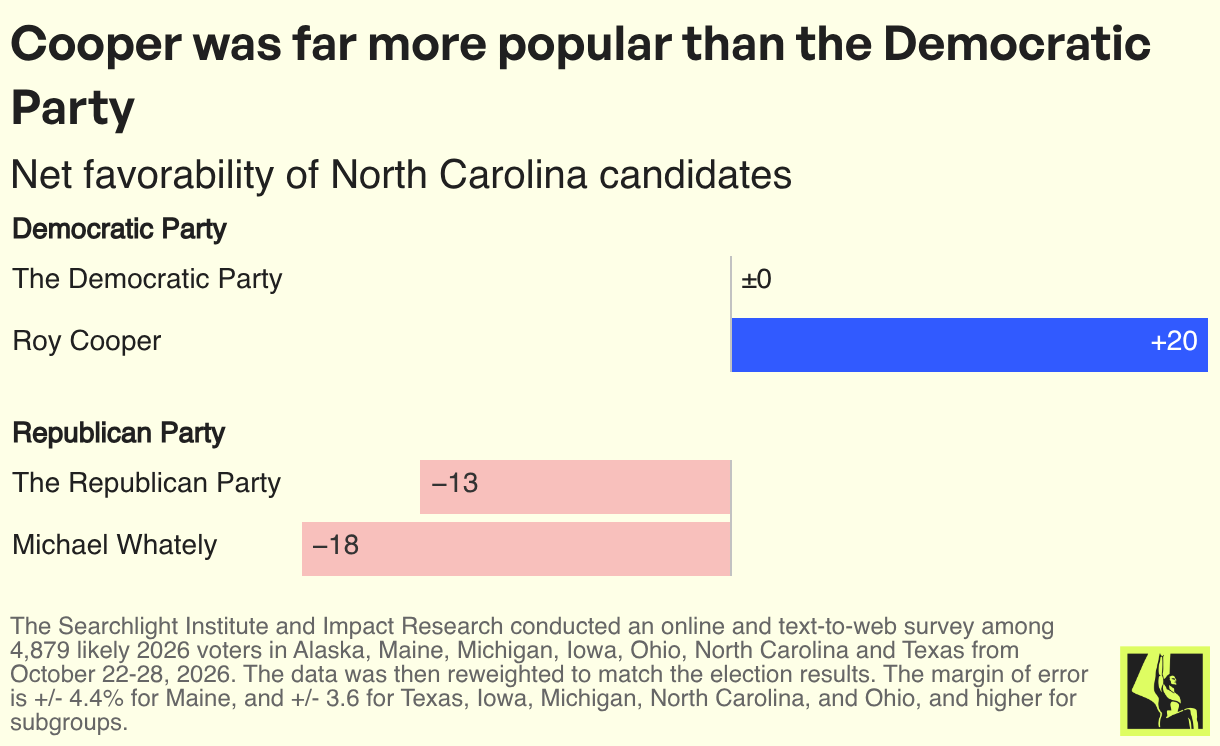
Voters clearly articulated Cooper’s unique strengths. They viewed Cooper 20 points more favorably than the Democratic Party writ large. He also benefited from a weak opponent who was seen as 5 points less favorable than the Republican Party. In an election where Republicans were underwater and Democrats were at net zero among North Carolinians, Cooper’s strengths as an uncharacteristic Democrat proved decisive. Voters didn’t want a generic Democrat, they wanted Roy Cooper.
One of the most important findings in this poll was the favorability rating of each candidate among independents. Cooper was popular among Independents by 15 points (53% favorable / 38% unfavorable). A 15-point margin is solid, but it looks especially strong next to Whatley’s abysmal -47 mark among Independents. Whatley, the former RNC Chair, was consistently attacked as a DC partisan actor. Those hits seemingly landed with independently minded North Carolinians.
Political gravity also worked in Cooper’s favor. Trump narrowly won the state in 2024, but he had a net -21 job rating among North Carolina voters. Additionally, 64% of North Carolinians felt that the country was moving in the wrong direction, compared to the mere 32% who felt it was moving in the right one. Fifty-three percent of voters overall, as well as Independents by 17 points, said they wanted Democratic control of the Senate. While it didn’t single-handedly clinch Cooper’s victory, the broader environment certainly played a role.
The various House elections across the Tar Heel state deserve a mention as well. Despite drawing themselves a map designed to be 11-3 in their favor, Tuesday proved to be a complete wipeout for North Carolina Republicans. “Mountain Democrat” Jamie Ager romped out west by nearly 16 points, running a campaign that tapped into voters’ anger over Republicans’ response to Hurricane Helene. Don Davis won by over 3 points out east, despite being drawn into a new district that Republicans viewed as a major pick-up opportunity. Underdog Chuck Hubbard looks likely to beat Virginia Foxx as of the time of this memo’s writing. Even NRCC Chair Richard Hudson lost to Richard Ojeda. All in all, Democrats should end up with upwards of 10-11 congressional seats out of North Carolina. The Republican gerrymander turned into a dummymander in the truest sense of the word.
How voters perceived the candidates
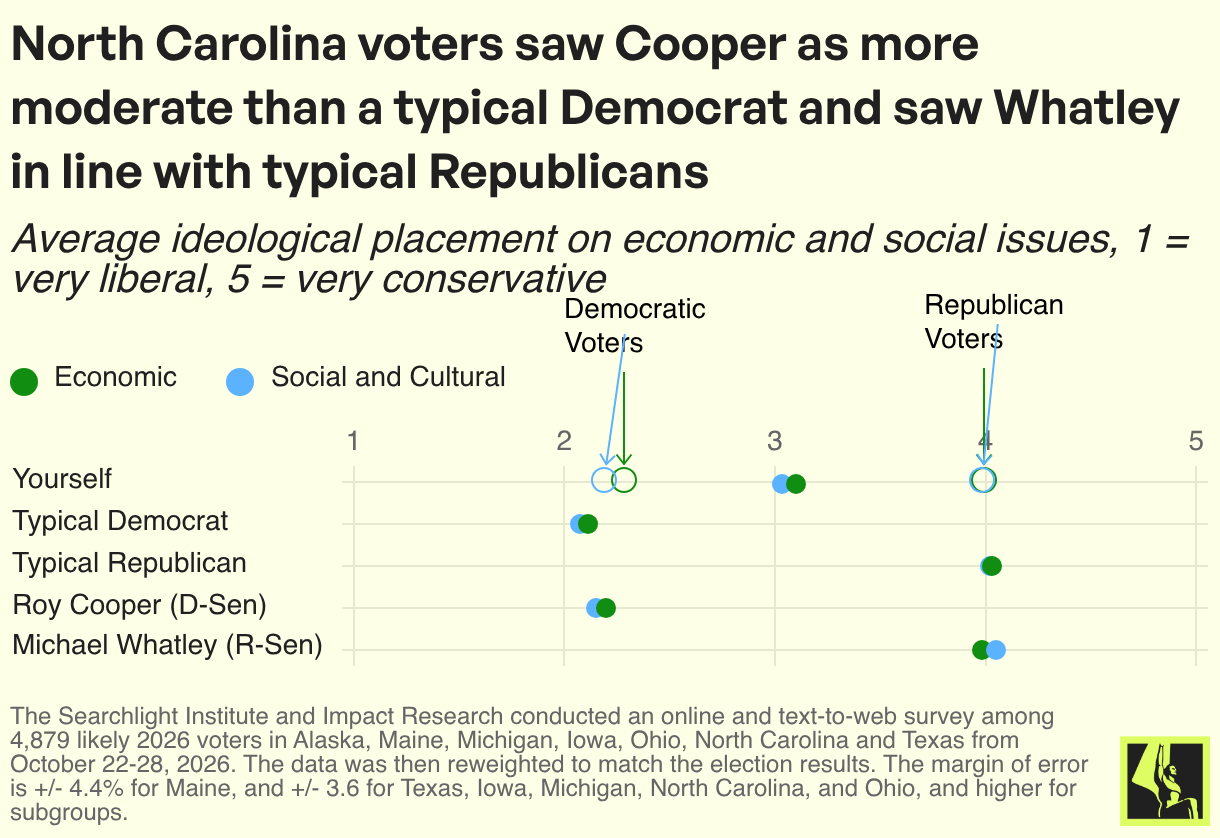
To get a more granular picture of how voters perceived the individual candidates relative to the national parties, we asked them to place themselves, the candidates, and typical politicians of each party on an ideological scale for economic and cultural issues.
We found that Cooper was seen as closer to the average voter than the typical Democratic politician on both economics and social/cultural ideology. Whatley, on the other hand, was perceived to be basically the same as a typical Republican politician on economics and social/cultural issues.
The impact of voters’ perception of Roy Cooper’s ideology can also be seen in his success with non-MAGA Republicans: Cooper secured over a quarter (27%) of their support.
The deciding issues
Cooper’s cross-ideological appeal can best be explained by his well-established personal brand, heterodox ideology, and attunement to the issues that North Carolina voters were most focused on.
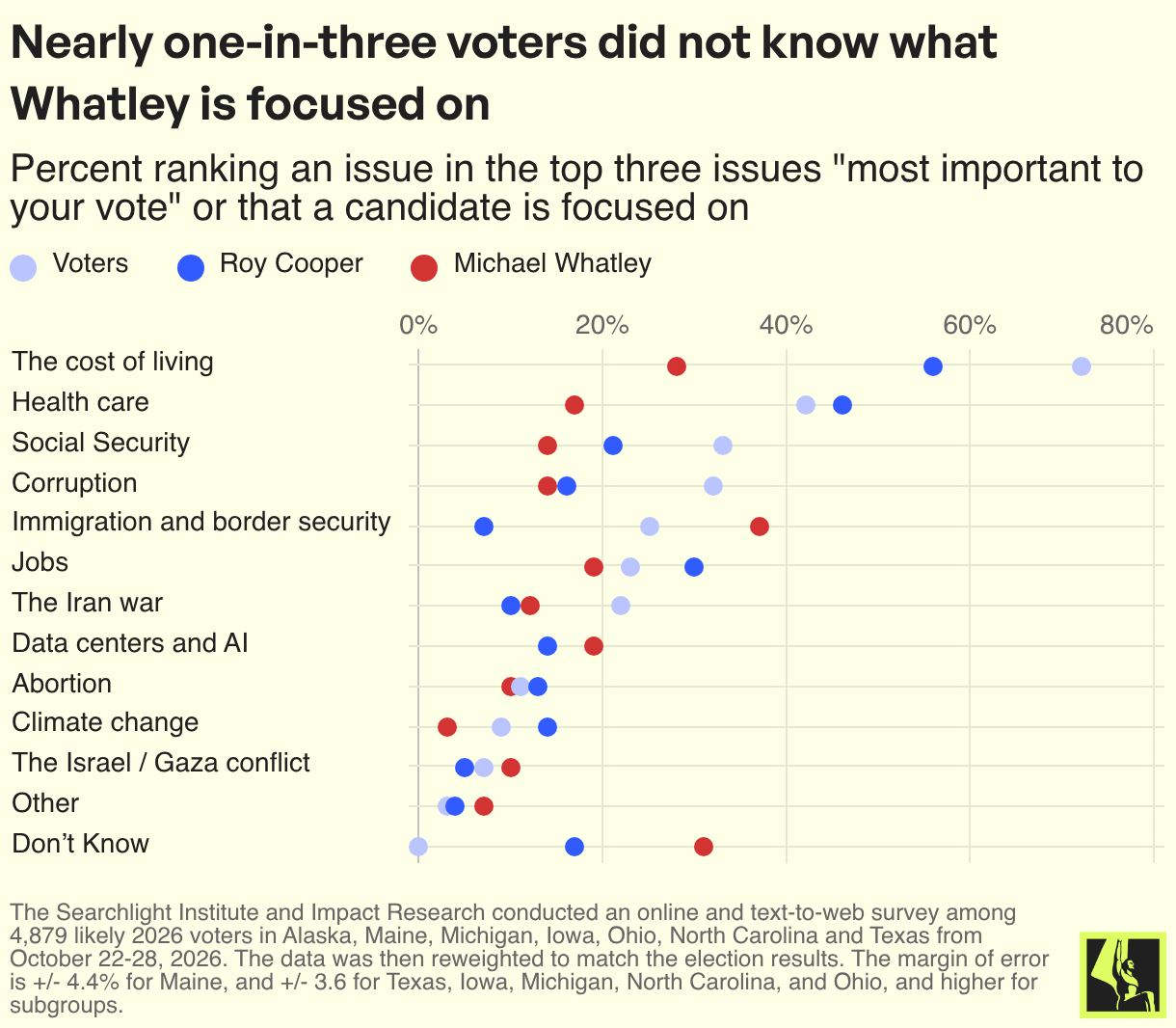
Unsurprisingly, the top issue among North Carolinians was cost of living. 72% of voters identified it as one of their top concerns. 56% of respondents perceived Cooper to be focused on that issue, while only 28% could say the same about Whatley.
Cooper also had an edge on health care (46%), Social Security (21%), and corruption (16%) — the second, third, and fourth most important issues to voters. Whatley was perceived to be significantly more focused on immigration (37%) than Cooper (7%), but the issues’ lower salience (fifth most important) netted the Republican less support. Whatley was also hamstrung by the fact that over 30% of voters didn’t know what he was focused on at all.
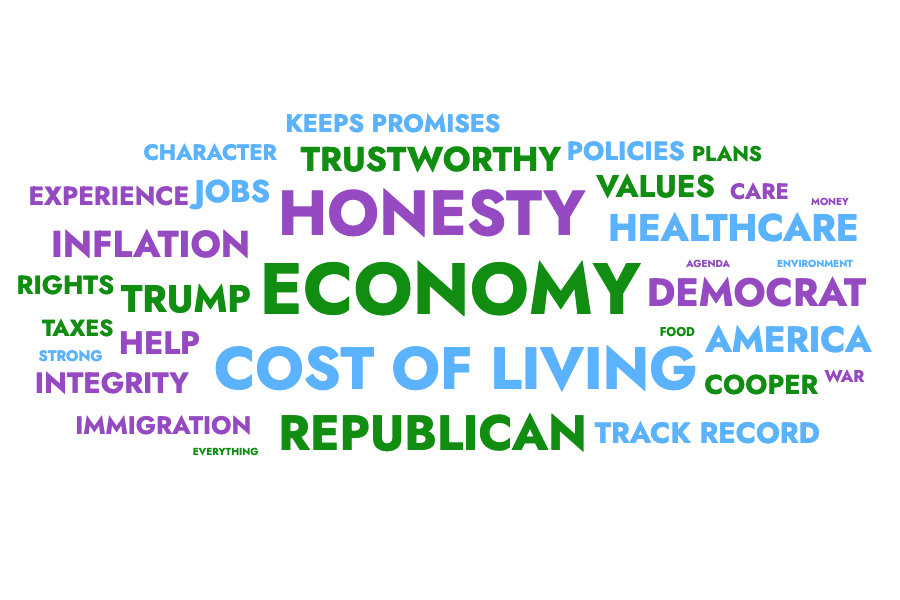
We also asked voters an open-ended question of “What is the most important factor for you in deciding who to vote for in the U.S. Senate race?” While 23% of respondents said something about the economy, 8% said that it came down to who was “experienced,” which likely benefitted the longtime statewide elected official Roy Cooper. As one Cooper voter put it, “I care most about whether they can get meaningful things done for the state. Their record matters more to me than campaign promises.”
 One of the stranger findings in this poll was that 61% of respondents said that Roy Cooper was a “typical Democratic politician.” On its face, that result doesn’t square with his massive favorability advantage over “the Democratic Party.” Or the perception that, ideologically, he is closer to the average voter than the average Democrat is. So, what explains this discrepancy?
Roy Cooper has been the best known statewide Democratic politician in North Carolina for the better part of a decade. He has defined his, and by extension the North Carolina Democratic Party’s, brand as independent from the orthodoxy of the national party to such an extent that “typical Democrat” may not be inherently negative in the mind of North Carolina voters.
There have been no Democratic senators in the Old North State since the days of Kay Hagan. There has been Roy Cooper. In a very real sense, he is the “typical North Carolina Democrat.”
Discussion
Roy Cooper was a uniquely strong candidate perfectly suited to capitalize on a favorable national environment and a fairly weak Republican opponent. His history of independence from a somewhat toxic national Democratic brand, proven heterodoxy, and the trust he built with North Carolina Independents over two terms as their governor proved too much for Michael Whatley to overcome.