
2026 Michigan Electorate
The battleground state of Michigan received significant attention this election cycle due to the Senate race between progressive Democrat Abdul El-Sayed and Republican Mike Rogers. The gubernatorial election between Democrat Jocelyn Benson and Republican John James garnered less national attention, but still had consequential policy ramifications for the state. On election night, both El-Sayed and Benson sent their opponents packing.
El-Sayed emerged from a contentious primary with Representative Haley Stevens looking to consolidate the Democratic base and win over swing voters. His campaign was defined by a focused message on Medicare for All, Canadian tariffs, the war in Iran, and how each of those issues connected back to voters’ concerns over affordability.
At the same time, he dropped some of the other issues most associated with left-wing candidates. He rarely discussed climate policy and emphasized the importance of an orderly border, even criticizing immigration advocacy groups who obstructed action under the Biden administration. One of his biggest ad buys was a message highlighting his agreement with MAGA Republicans. However, it’s important to note that a lot of this heterodoxy came later in the race and voters, as we will explain below, perceived him to be too ideologically extreme.
Mike Rogers struggled to break with Trump and the Republican party’s unpopular party brand. While he attempted to criticize the trade war with Canada and called to wind down the conflict in Iran, he still campaigned with Trump and did not craft a credible independent brand with Michigan voters. Together, these factors helped El-Sayed defeat Mike Rogers by 7 points.
Secretary of State Jocelyn Benson has a reputation in the state as a pragmatic and effective policymaker and was the highest statewide voter-getter during her last race in 2022. Her opponent, Rep. John James had lost two previous statewide bids. Like Rogers, James struggled against anti-Trump sentiment in the state. Benson defeated James by 10.8-points.
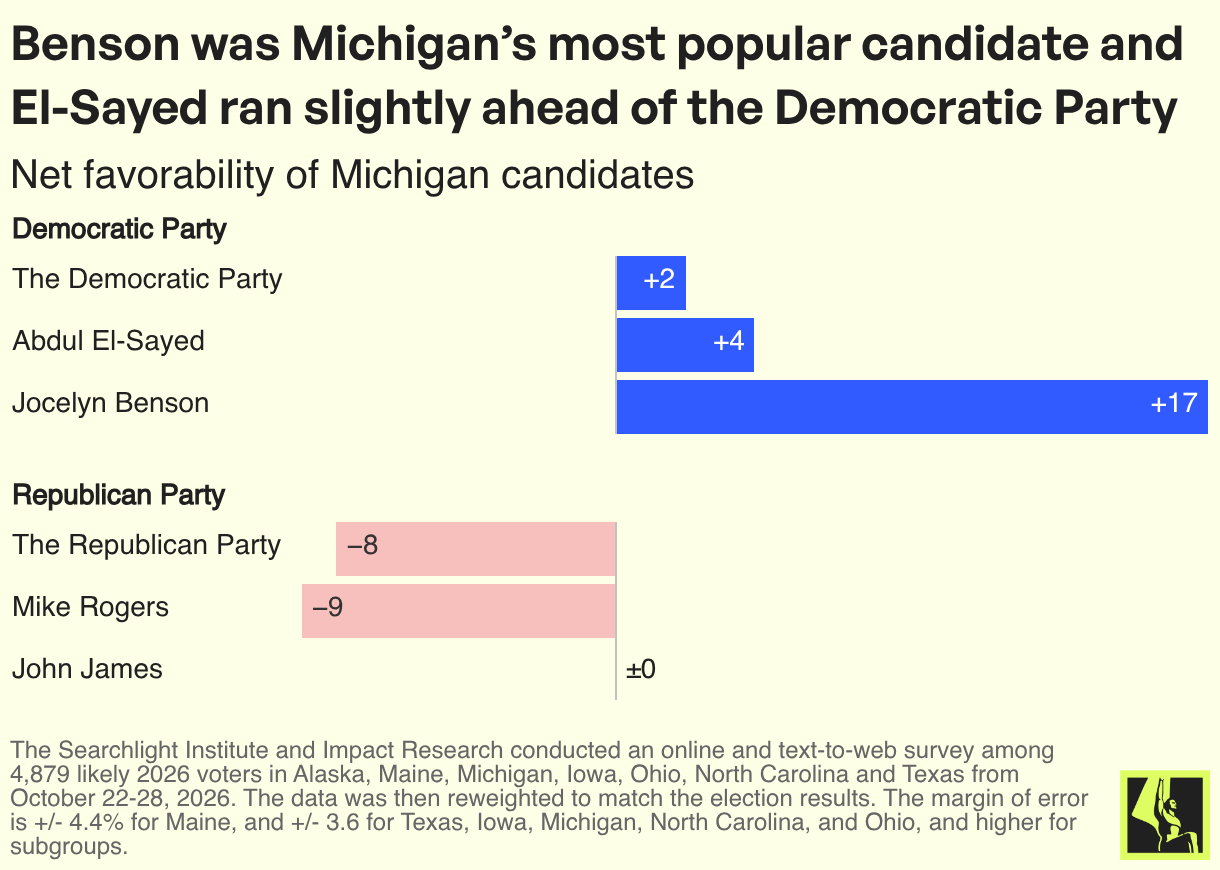
Looking beneath the top-line election results, the reason Benson won by a larger margin was simple: She was more popular. Our entrance poll showed Benson with an approval rating of net +17, whereas El-Sayed was marginally popular at net +4. She also faced a stronger opponent; James had a net zero approval rating and Rogers was viewed negatively at net -9. Overall, El-Sayed’s approval rating (51% favorable / 47% unfavorable) closely matched the Democratic Party’s (50% favorable / 48% unfavorable). While Benson’s favorability rating was 52%, just one third (35%) of voters gave her an unfavorable rating, a key differentiator.
Notably, El-Sayed had a 4-point higher approval rating among Democrats (88% favorable / 10% unfavorable) than Benson (84% favorable / 7% unfavorable). Still, contributing to Benson’s higher overall rating was substantial support from Independents (54% favorable / 32% unfavorable, net +22). In contrast, El-Sayed was net even among Independents.
Despite winning Michigan by 1.4 points just two years ago, Trump’s job approval rating sat at net -20 in the state and 64% of Michigan respondents said the country was on the wrong track. This environment clearly helped El-Sayed and Benson: 72% of El-Sayed’s supporters said their vote was motivated by opposing Trump, and 70% said the same for Benson.
The anti-Republican wave was also big enough to unseat two incumbent House Republicans and flip one empty seat that was vacated by Republican John James. The most notable race was won by Will Lawrence, a former climate organizer, who beat incumbent Republican Tom Barrett by running a campaign focused on opposing data centers and corporate power. The other winning Democratic candidates, prosecutor Christina Hines and State Senator Sean McCann, won on more typical messaging focused on affordability and health care. Lawrence and El-Sayed’s victories are notable in that they highlighted the severity of the storm for Republicans. Not only were more moderate Democrats buoyed by the “blue wave”, but the tsunami was also big enough to lift candidates further to the left.
How voters perceived the candidates
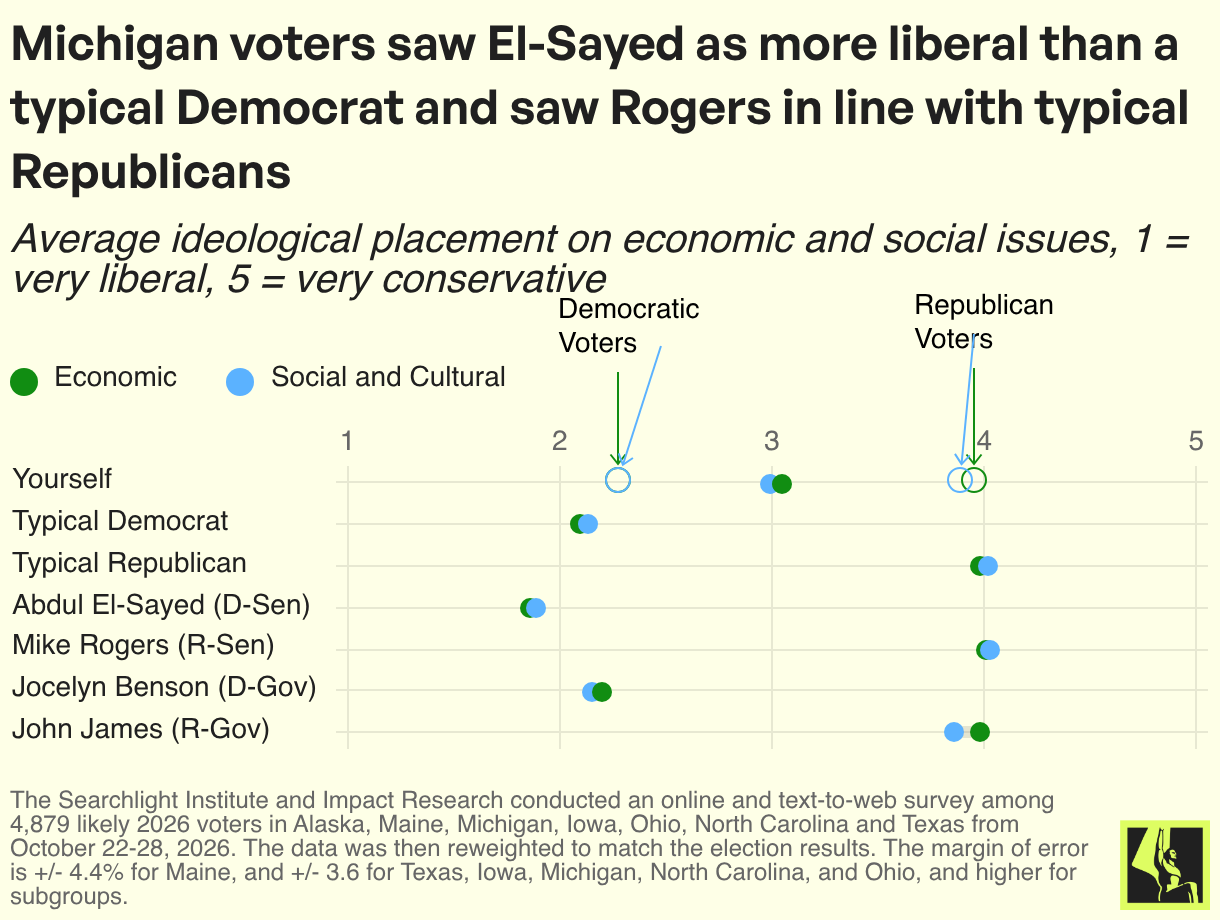
To get a more granular picture of how voters perceived the individual candidates relative to the national parties, we asked them to place themselves, the candidates, and typical politicians of each party on an ideological scale for economic and cultural issues.
Michigan voters saw Mike Rogers as in line with his party ideologically, but thought that El-Sayed was further of the left than his party. The voters placed themselves smack dab in between “a typical Democrat” and “a typical Republican” on economic issues, while they placed themselves somewhat closer to the “typical Democrat” on social issues. Although voters were closer to the Democratic Party’s ideology broadly, they placed themselves closer to Rogers than El-Sayed.
The median voter placed themselves in the center on both economics and culture, while the political parties and individual candidates hovered around “somewhat liberal” (2) and “somewhat conservative” (4), respectively. Notably, El-Sayed was viewed as the furthest away from the median voter on economic and social issues; in contrast, Benson was identified as the closest. John James was viewed as slightly more moderate than Rogers, which helps explain his higher approval rating.
The deciding issues
We asked voters to choose the three issues that were most important to their vote for Senate, and then, from that same list, the three issues that they thought each candidate was focused on. The top issues for Michigan voters were the cost of living (72%), health care (40%), Social Security (30%), and corruption (30%).
Voters viewed El-Sayed to be more in line with their top issues than Rogers; El-Sayed was perceived to be focused on health care (55%), cost of living (47%), and corruption (25%). On the other hand, voters said Rogers’s top issues were immigration (38%), the cost of living (31%), and data centers and AI (24%).
Cost of living was by far the most important issue to voters (72%), and they did not view either candidate to be sufficiently focused on it, although El-Sayed had a substantial advantage over Rogers on the issue by a margin of +16 points. El-Sayed’s supporters were also impacted by cost of living more than Rogers’— 74% of El-Sayed supporters said rising costs were hurting their personal finances, whereas only 59% of Rogers’ said the same. El-Sayed’s consistent message on health care clearly resonated as well— 55% perceived it to be a top three issue vs. 19% for Rogers. In a year where concerns about prices dominated, El-Sayed’s focus on the issue clearly resonated with voters.
El-Sayed was perceived as more focused on the Israel/Gaza conflict than other candidates this cycle (note: Alaska results have been withheld until all votes are counted). 14% of Michigan voters named it as one of his three main issues. Separately, 11% identified it as a top three priority for their own vote, similar to voters in the other states who viewed it as an important issue for themselves and the candidate. Notably, Rogers voters (11%) and El-Sayed voters (11%) did not differ on how much the conflict mattered to them. The primary difference was in how focused El Sayed was perceived to be on the issue; Rodgers voters (24%) were more likely than his own supporters (6%) to see it as a focal point.
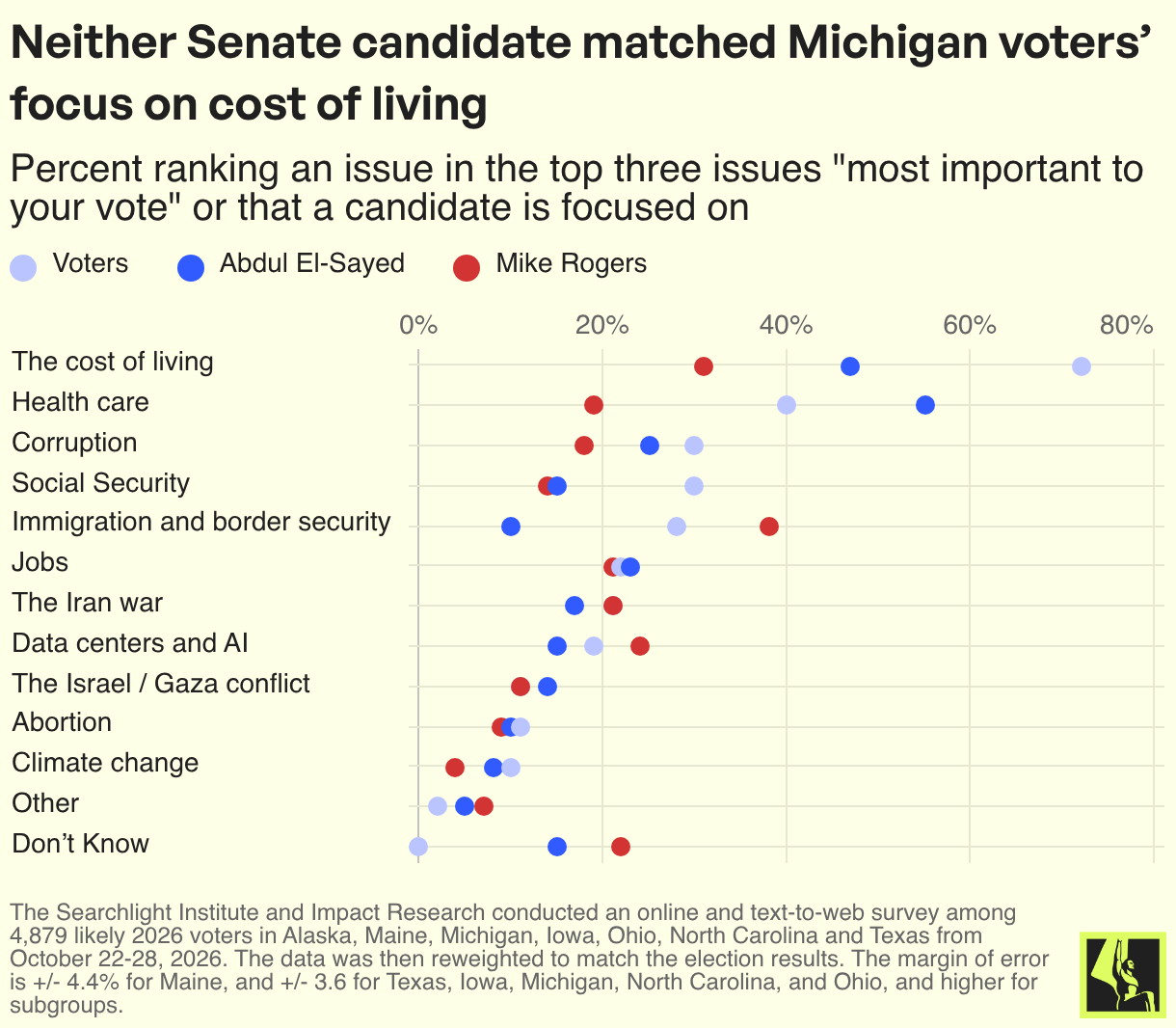
Rogers’s best issues were immigration and Social Security. He was perceived as far more focused on immigration than El-Sayed — 38% of voters said it was one of Rogers’ top three issues, compared to 10% for El-Sayed. While 28% of the voters listed it as a personal top issue, this was primarily driven by Rogers’ own supporters. Social Security, which featured very little in the race, was viewed as an important issue by 30% of voters, Rogers and El-Sayed were seen as equally focused on it (14% each).
El-Sayed had a sizable advantage over Rogers on our four key traits: bringing change to Washington (net +22), lowering costs for regular people (net +20), working with both parties (net +13), and prioritizing what I care about (net +8). However, these margins were largely in line with how other Democratic candidates were perceived across all of the states that we surveyed, an indicator of the nationwide anti-GOP sentiment this election cycle.
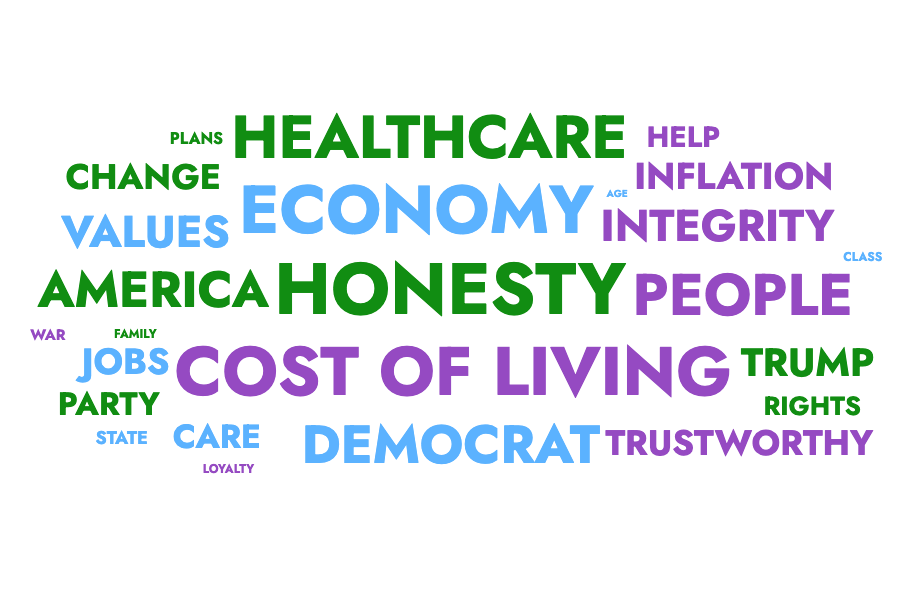
When asked to put in their own words what was their deciding issue in the Senate race, both El-Sayed and Rogers voters frequently cited the cost of living and a candidate who they could trust to represent the interest of Michiganders. Many El-Sayed voters specifically highlighted health care and also said their vote was a check on Trump and Republicans. As one El-Sayed voter put it: “Break the MAGA foothold in the Senate.” Meanwhile, Rogers voters frequently cited traditional conservative policies and values as a deciding factor for them: “Someone who is for America first. Someone who believes in doing what the American people need. Someone that is not corrupt.”
Discussion
Michigan is a purple state that hasn’t elected a Republican to the Senate in 25 years, so given the structural D+13 national environment, it was expected Democrats would be elected statewide once again. Still, El-Sayed’s victory shows that issues like Medicare for All are not deal-breakers when it comes to electability. He also did not prioritize hard-left stances on climate policy, clearly articulated that his health care proposals would not completely abolish private health insurance, and called for a more secure border.
Our polling shows some voters in Michigan still thought he was too liberal and he underperformed Jocelyn Benson statewide, but the blue wave was big enough to sweep him to victory.