
2026 Maine Electorate
After nearly 30 years, Susan Collins’s time in the Senate has come to a close. Maine’s fundamentally blue electorate was simply too much for the indomitable 5-term senator. Despite significantly overperforming once again, Collins lost to Troy Jackson by 7.7 points.
Meanwhile, Democrat Hannah Pingree romped over Republican Bobby Charles to an 18.4 point victory. Pingree ran over 10 points ahead of Jackson and our research finds that 11% of her supporters planned on casting their Senate vote for Collins. In Maine’s second district, the progressive Mike Dunlap is still locked in a tight race against his Republican opponent, after the Democratic incumbent, Jared Golden, decided not to run.
Overall, Maine voters don’t support Trump and don’t feel good about the trajectory of the United States. Two-thirds (65%) of Mainers said that the country was on the wrong track, compared to 30% who said that things are going in the right direction. Trump’s approval in the state was in the gutter: 65% of the electorate disapproved of him and over half (58%) said that they strongly disapprove.
Sharing a party with such an unpopular president would be the kiss of death for most candidates, but Susan Collins has a history of diverging from the party brand. Maine voters were the least likely of those we surveyed to say their vote was a referendum on Trump (note: Alaska results have been withheld until all votes are counted). Fifty-eight percent of voters said their vote was a signal about Trump and 37% said it was not. Unsurprisingly, answers to this question map cleanly onto vote choice. Mainers who said their vote was a signal about Trump backed Jackson 74% to 25%; those who said it was not backed Collins 78% to 19%.
We find a similar tension among the Maine electorate to the one the New York Times found in its September polling: more Maine voters want Democrats to control the Senate than support Troy Jackson. Voters prefer Democratic control of the Senate 55% to 40%, a 15-point margin that runs six points ahead of Jackson (54% Jackson / 45% Collins). This means that one-in-ten voters who want Democratic control of the Senate still back Collins.
The two campaigns told opposite stories. Collins ran on her reputation as a bipartisan dealmaker in Congress, closing with an ad titled “Most Independent Senator.” This argument was harder for Collins to make this year: she struggled to distance herself from the Trump administration amid tariffs, the trade war with Canada that hit Maine especially hard, and rising energy prices driven up by the Iran war. This was also her first race since the Dobbs decision, and her 2018 vote to confirm Justice Brett Kavanaugh. She attempted to overcome this by reinforcing her brand as an independent Senator fighting for Maine interests, but it was not enough.
Jackson’s campaign was focused on tying Susan Collins to Trump and the national Republican Party, closing with an ad that declared, “A vote for Susan Collins is a vote for Trump.” During his short campaign, Jackson held on to progressive stances on issues like Medicare for All, abolishing ICE, and restrictive gun legislation. Rather than practice heterodoxy himself, Jackson focused on trying to undo Collins’ heterodox perception in the state.
How voters perceived the candidates
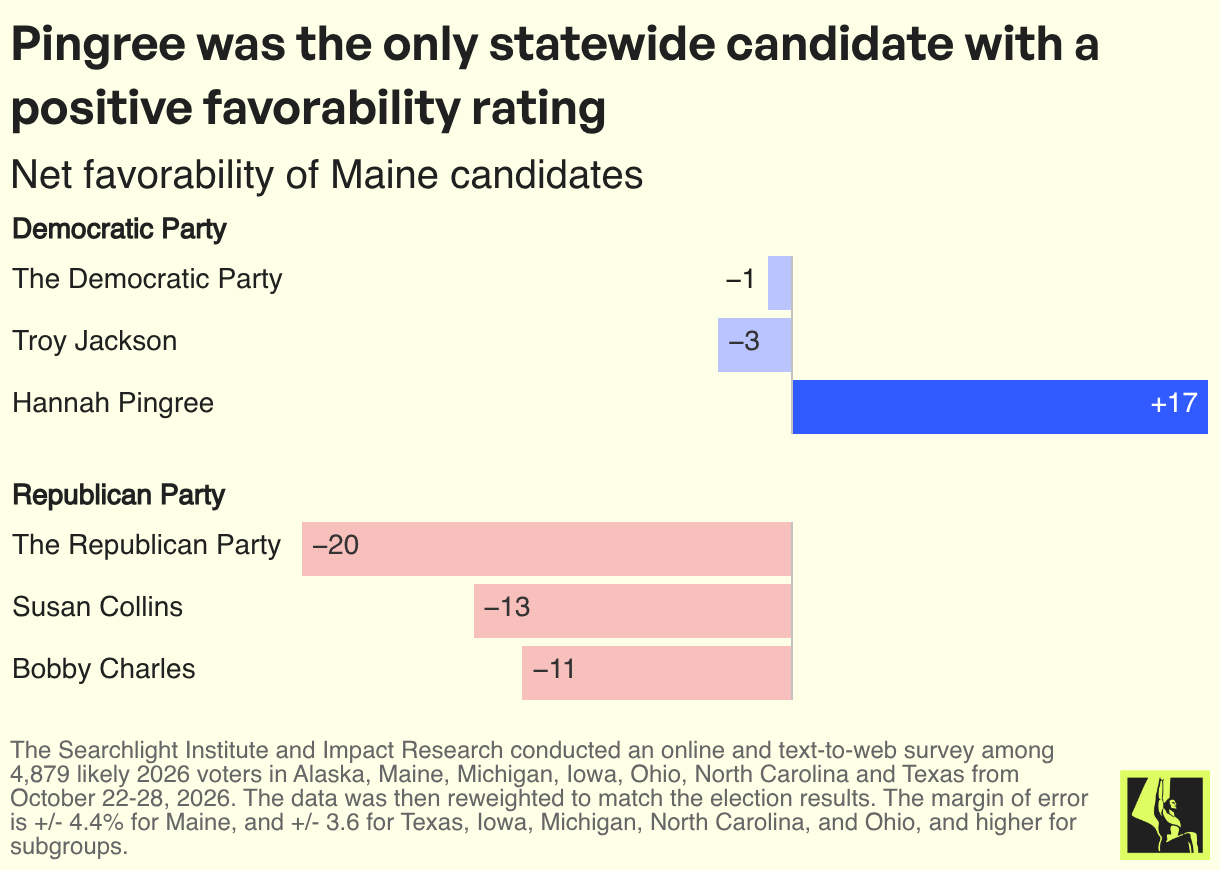
Troy Jackson was more popular among Maine voters than Susan Collins, but both candidates’ favorability was underwater. Jackson at net -3 favorable (47% favorable / 50% unfavorable) was 10-points more popular than Collins at net -13 (43% favorable / 56% unfavorable). Importantly, both candidates consolidated support in their respective parties and Jackson was 17-points more popular than Collins among Independent voters (net -4 Jackson / net -21 Collins). In losing Independents, it was clear that Collins would no longer be able to build a coalition big enough to send her back to Washington.
Despite being less popular than Jackson on net, Susan Collins outperformed her party, while Jackson trailed his. Collins was 7-points more popular than the Republican Party at net -20 (39% favorable / 59% unfavorable), while Jackson was 2-points less popular than the Democratic Party at net -1 (49% favorable / 50% unfavorable). Jackson was the only Democratic Senate candidate in our study who trailed their party.
The Maine governor’s race was a different story There was a vast, 28-point difference between the candidates’ popularity ratings. Pingree was the most popular candidate on Maine’s ballot at net +17 (55% favorable / 38% unfavorable). Charles, on the other hand, was underwater at net -11 (35% favorable / 46% unfavorable). Importantly, Pingree was 18-points more popular than Jackson among Independents, explaining why she ultimately ran so far ahead of Jackson.
The Maine senate race was unusually negative;: 30% of Mainers say that they voted against the other candidate rather than for the candidate they supported, higher than the other states we polled. Most of that energy was against Collins: 43% of Jackson voters said that they voted against Collins rather than for Jackson. In comparison, just 15% of Collins voters said that they were voting against Jackson.
A similar share of voters think that Collins (59%) and Jackson (53%) are typical politicians. The 37% who said she was not a typical politician was the highest among the Republican Senate candidates in the states we polled, though a clear majority thinks she is. The Senate vote maps relatively cleanly onto whether voters think she is a typical politician: Collins lost the voters who thought she was a typical politician (76% Jackson / 23% Collins) but won the voters who did not (18% Jackson / 79% Collins).
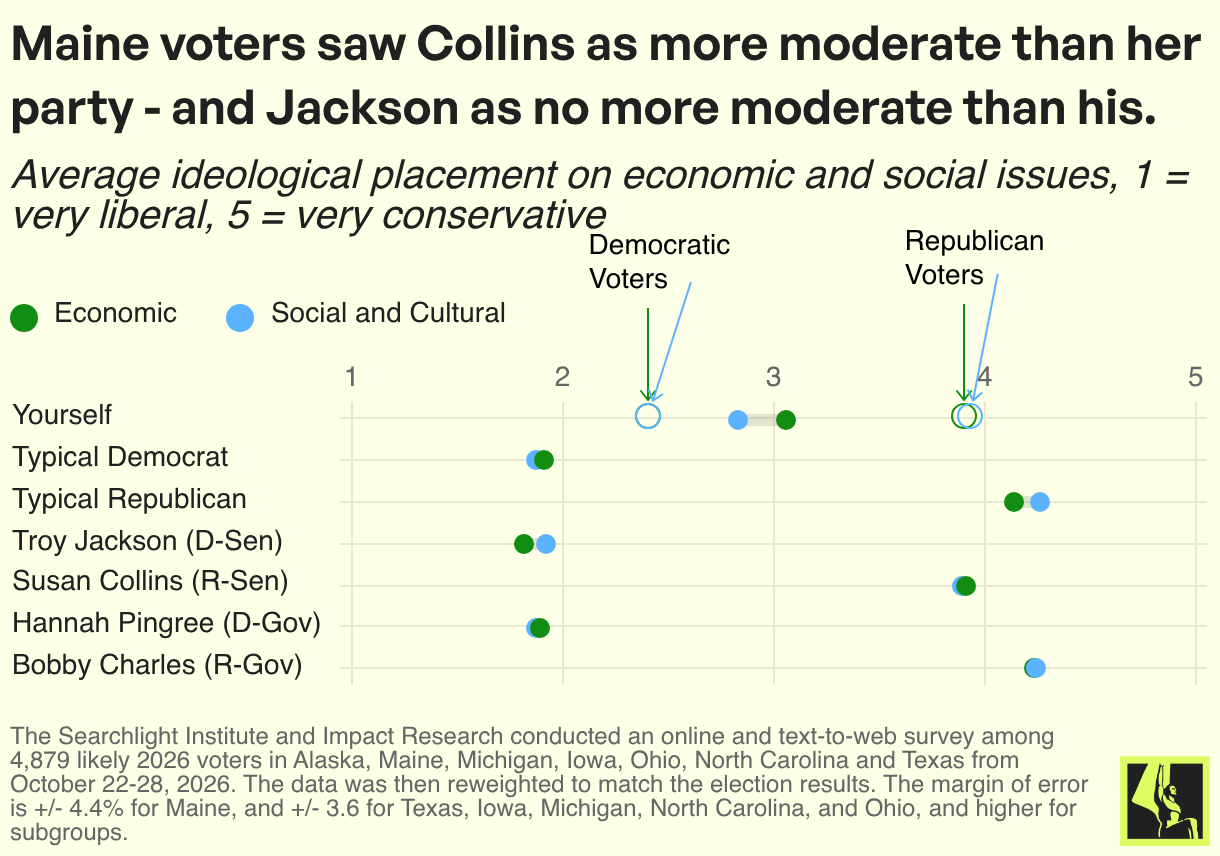
One of the most important factors that explained Collins’ crossover appeal was the fact that Maine voters placed Collins closer to the center on the ideological spectrum than the typical Republican on both economic and social issues — the most moderate placement of any Republican Senate candidate we tested. In fact, a quarter of voters said she was moderate on social issues. Meanwhile, voters placed Jackson slightly to the left of the typical Democrat on economics and closely in line with a typical Democrat on social issues. Forty-four percent of voters said that he was very liberal on economics, compared with 36% who said the same about a typical Democrat and 13% of voters who said the same of themselves. The gap between the candidates matters because voters saw themselves as closer to Collins than to Jackson. On social issues, Collins and Jackson were about the same distance from the median voter. However, given the size of the blue wave this year, Collins’s reputation as being more moderate than the Republican Party was not enough to keep her from being swept away by the tide.
Troy Jackson won on three of our four key traits: He led by 24-points on “will work to bring change to Washington” (52% Jackson / 28% Collins), by 15-points on “will work to lower costs for regular people in Maine” (51% Jackson / 36% Collins), and by 8-points on “will prioritize the things I care about in Washington” (47% Jackson / 39% Collins). Importantly, Collins won on “will work with both parties to get things done” (33% Jackson / 47% Collins); she was the only Republican Senate candidate in our study to do so. Interestingly, this measure was not closely correlated with vote choice: 11% percent of voters gave Collins the edge on this issue and still backed Jackson for Senate.
The deciding issues
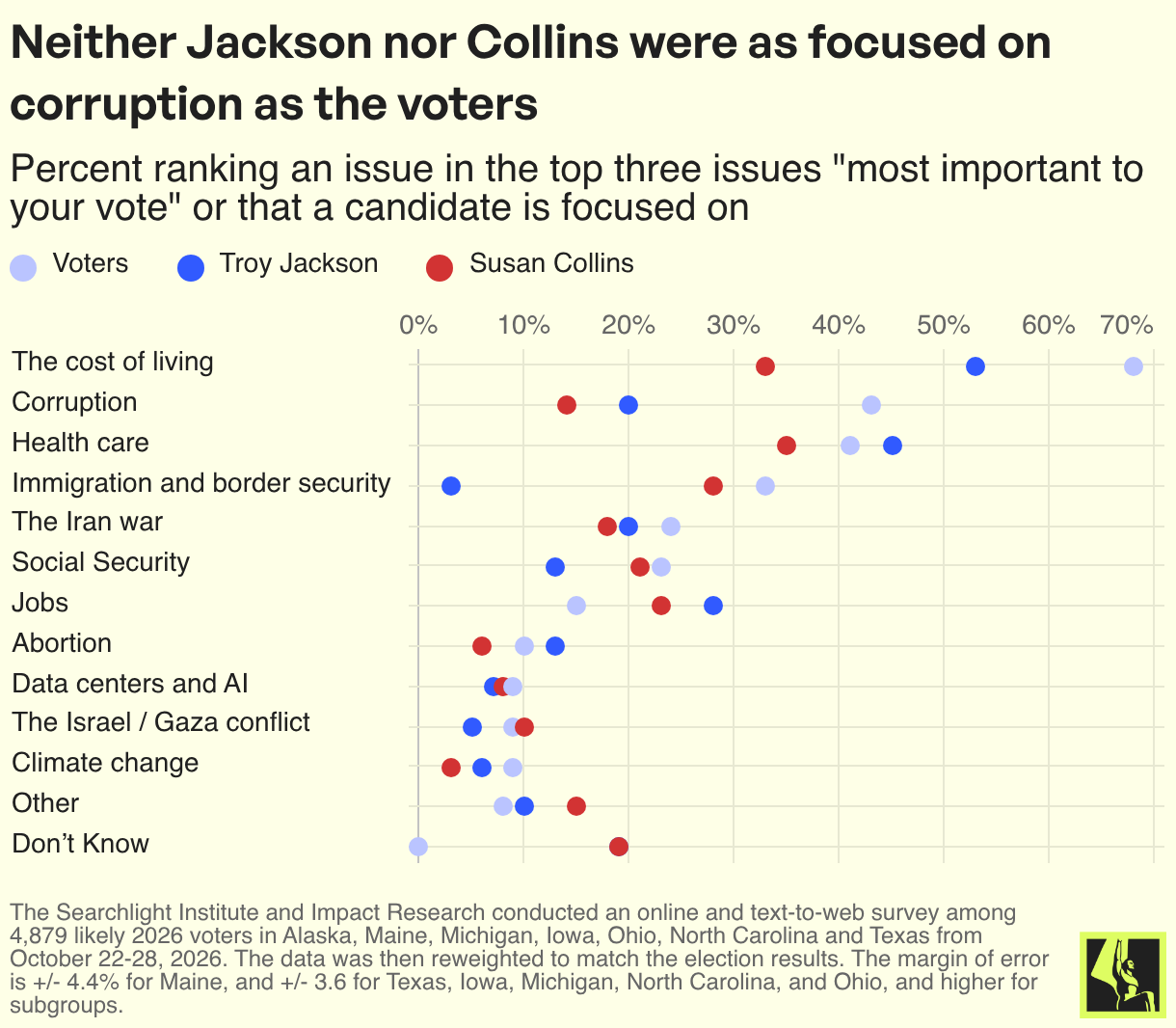
When it comes to the issues animating the election, voters were deeply concerned about the cost of living. We asked voters to choose the three issues that were most important to their vote for Senate, and then, from that same list, the three issues that they thought each candidate was focused on. Over two-thirds (68%) of Maine voters listed it as a top issue, followed by corruption (43%), health care (41%), and immigration (33%). Neither candidate fully matched the voters’ priorities. Voters were most likely to say that Jackson was focused on the cost of living (53%) and health care (45%), while 35% said Collins was focused on health care and 33% perceived her as focused on cost of living. Both candidates trailed the voters on prioritizing cost of living.
The biggest gap between the voters and the candidates was on corruption: 43% of voters were focused on it, but only 20% said Jackson was focused on it and 14% said the same of Collins. Importantly, abortion barely registered. While Dobbs may have hurt voters’ perception of Collins’ independence, it was not a top issue in this election.
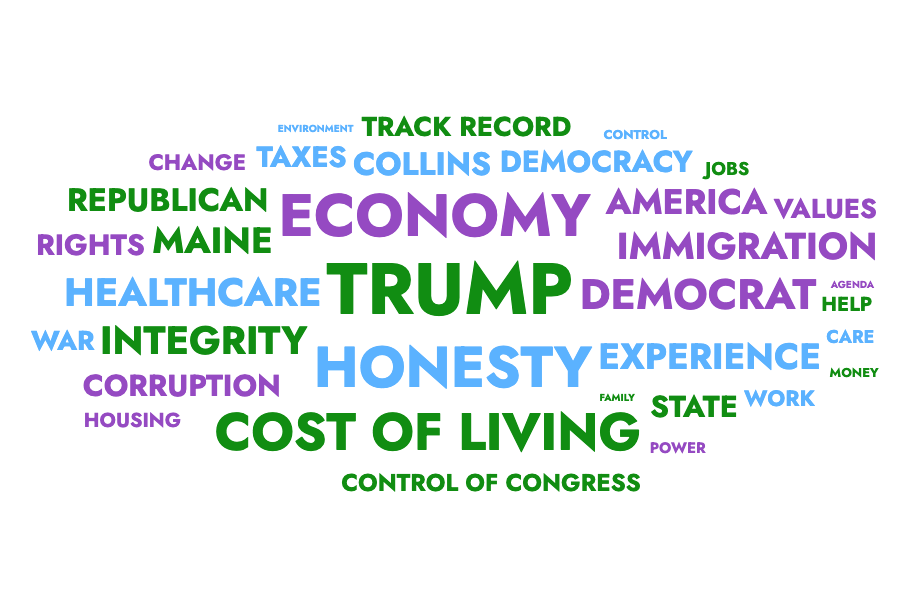
In their own words, Jackson voters frequently cited Trump and his agenda — especially the costly war in Iran — as a deciding factor in their vote choice: “The individual must be willing to stand up to Trump stop the war and stop the tariffs for the state of Maine,” said one voter. Meanwhile, Collins voters frequently cited her track record and experience delivering for Mainers as the deciding factor in their vote choice. As one voter simply put it, “Susan Collins has brought so much money to Maine, and she’s never missed a vote. We need that.”
Discussion
Susan Collins could only defy gravity for so long. She was able to maintain her standing among Maine voters as a relatively independent Republican, but a historic wave year and Maine’s partisan blue fundamentals finally wiped her out.
Troy Jackson was a relatively weak candidate who benefitted from an immensely favorable environment and an opponent that Mainers were ready to move on from. He ran behind Hannah Pingree and was actually viewed as less favorable than the national Democratic Party — the only Senate candidate in the states we polled with that distinction. That being said, Trump was simply too big an albatross for Susan Collins to escape.