
2026 Iowa Electorate
Despite Donald Trump winning Iowa in the past three presidential elections, the state has had a long tradition of embracing heartland Democrats. With diesel over $6 a gallon and Donald Trump’s trade war roiling farmers’ bottom lines, Democrats saw an opening to embrace “prairie populism” and win back the state.
This November, Iowans elected Josh Turek and Rob Sand over Republicans Ashley Hinson and Zach Lahn, sending Democrats to Washington and to the state capital in Des Moines for the first time in nearly 20 years. Sand, the only Democrat in Iowa who currently holds statewide office, blew Lahn out of the water, winning by 11 points. Turek comfortably beat Hinson by 4 points.
The strong Democratic performance at the top of the ticket had crucial effects lower down on the ballot. Democrats flipped three of the four house districts in the state. Democrat Christina Bohannan comfortably flipped IA-01, beating Mariannette Miller-Meeks by over 9 points. Democrat Lindsay James won IA-02 by 4 points, a 14-point blue shift from 2024. Democrat Sarah Trone Garriott, flipped her seat, IA-03, by 7 points, overperforming Harris’s 2024 margin by over 10 points.
After carrying Iowa by 13 points in 2024, President Donald Trump’s job approval rating sat at net -15 points (42% approve / 57% disapprove) in the days before the 2026 midterm elections, including 48% who said they “strongly disapproved” of the president’s job performance. Though Trump’s favorability was slightly higher than his job performance rating, it was still underwater at net -9 (45% favorable / 54% unfavorable), there was also a clear cleavage between loyal MAGA voters and the Republicans and independents who have soured on him. He earned nearly universal positive marks from those who identify as MAGA (98% favorable / 96% job approval), but much harsher views from non-MAGA Republicans (68% favorable / 61% job approval). Just 33% of Iowa voters said that the country was headed in the right direction, while 61% said it was headed in the wrong one.
Trump certainly loomed large in this election, with 66% saying their vote in the Senate race was an opportunity to showcase their feelings about Donald Trump’s presidency; this was on the higher end of the seven states that we surveyed (note: Alaska results have been withheld until all votes are counted). This sentiment was shared by 73% of Turek voters, compared to 59% of Hinson voters.
Turek built his campaign around winning over moderate and conservative Iowans. He ran ads highlighting his opposition to transgender athletes in women’s sports, promised to work with Trump, and pointed to his record as a moderate voice in the state legislature. His campaign also emphasized populist issues on data centers and taxing the rich, and he attacked Hinson for supporting the Big Beautiful Bill. Hinson, for her part, tried to distance herself from Trump, running an ad promising to work with both parties to get things done.
Both Josh Turek and Rob Sand were viewed significantly more favorably than the Democratic Party. While the Democratic brand sat at net 0 favorability, both Turek and Sand enjoyed much better net +14 and net +18 favorability ratings, respectively. On the other hand, Hinson and Lahn were both viewed less favorably than the Republican Party brand, earning net -12 point and net -8 point favorability ratings, respectively.
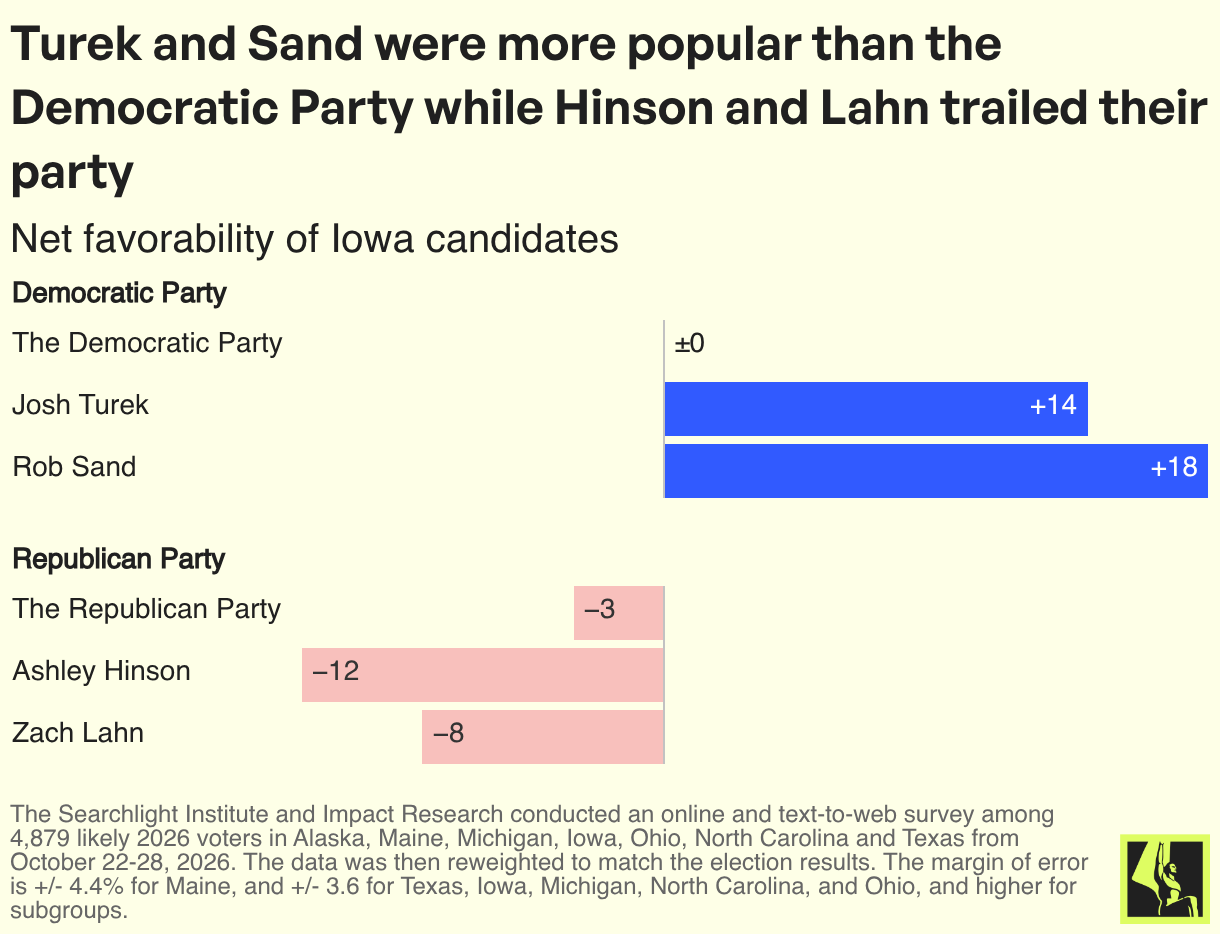
Turek and Sand both differentiated themselves from the Democratic Party brand, but their opponents largely fell in line with national Republicans. Just 48% of voters said Turek was a “typical Democratic politician” — the second-lowest rating of any of the Democratic Senate candidates in the seven states that we tested. Meanwhile, 41% of voters, including 39% of Independents, said Turek was not a typical Democrat. Sand was viewed similarly, with 48% of voters saying he was a typical Democrat, again the lowest rating of any Democratic gubernatorial candidate we tested across the seven states. Like Turek, a significant share of voters (40%), including 42% of independents, said Sand was not a typical Democrat.
On the Republican side, 75% of voters said Hinson was a typical Republican — the highest share of any Republican Senate candidate we tested. Lahn was viewed slightly differently, with 67% saying he was a typical Republican, second only to how voters viewed Greg Abbott in Texas.
How voters perceived the candidates
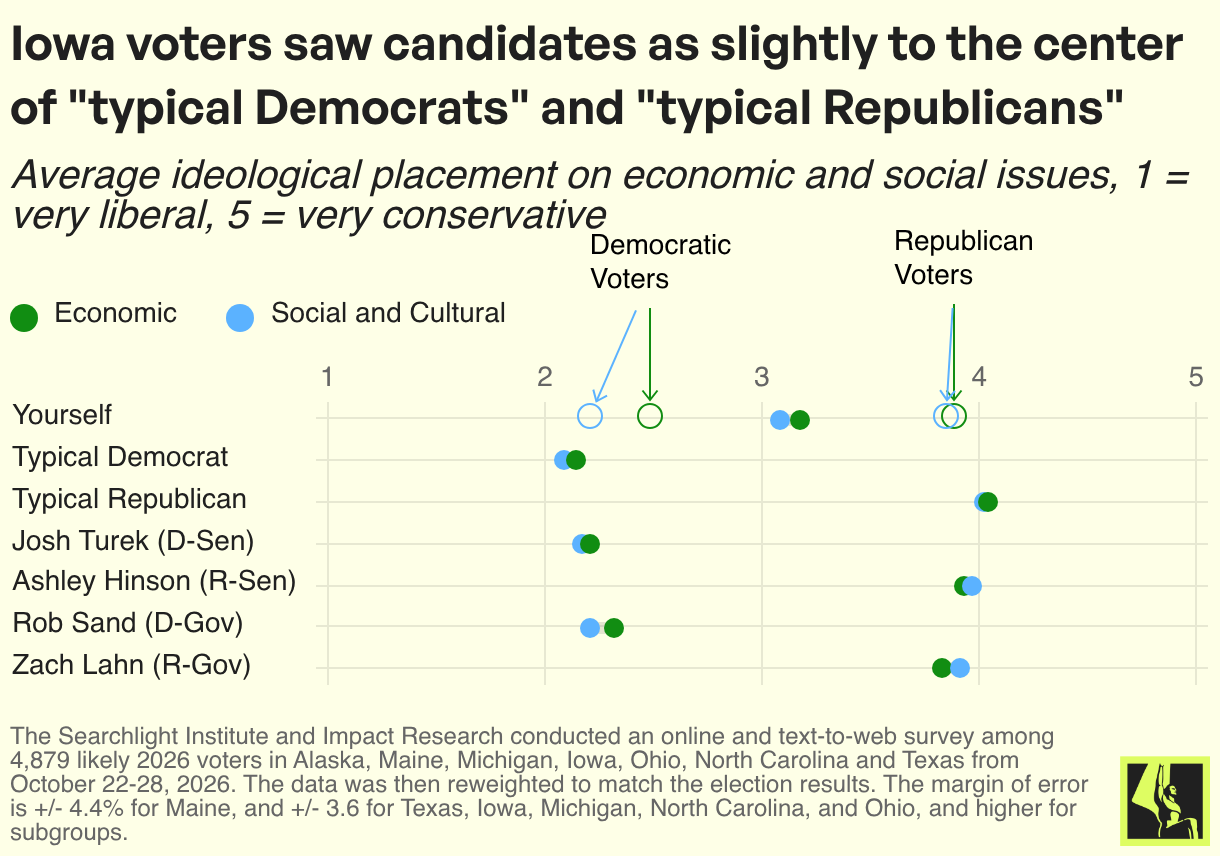
To get a more granular picture of how voters perceived the individual candidates relative to the national parties, we asked them to place themselves, the candidates, and typical politicians of each party on an ideological scale for economic and cultural issues.
Iowa voters placed themselves roughly in the middle on economic and social issues. They also viewed both Turek and Sand as slightly more moderate on social issues compared to national Democrats. While they placed Turek roughly in line with national Democrats on economic issues, they viewed Sand as slightly closer to the center. On the Republican side, voters viewed both Hinson and Lahn as more to the center on both scales compared to a typical Republican, though they placed Lahn slightly more to the center than Hinson on both scales.
The deciding issues
On every attribute that we tested about the Senate candidates, voters were significantly more likely to say they described Turek better than Hinson:
- Lower costs for regular people in Iowa (53% Turek / 28% Hinson)
- Bring change to Washington (53% Turek / 29% Hinson)
- Prioritize the things they care about in Washington (47% Turek / 35% Hinson)
- Work with both parties to get things done (48% Turek / 31% Hinson)
Few voters said neither candidate fit these descriptions. Independents were far more likely to say that Turek would lower costs (44% Turek / 10% Hinson).
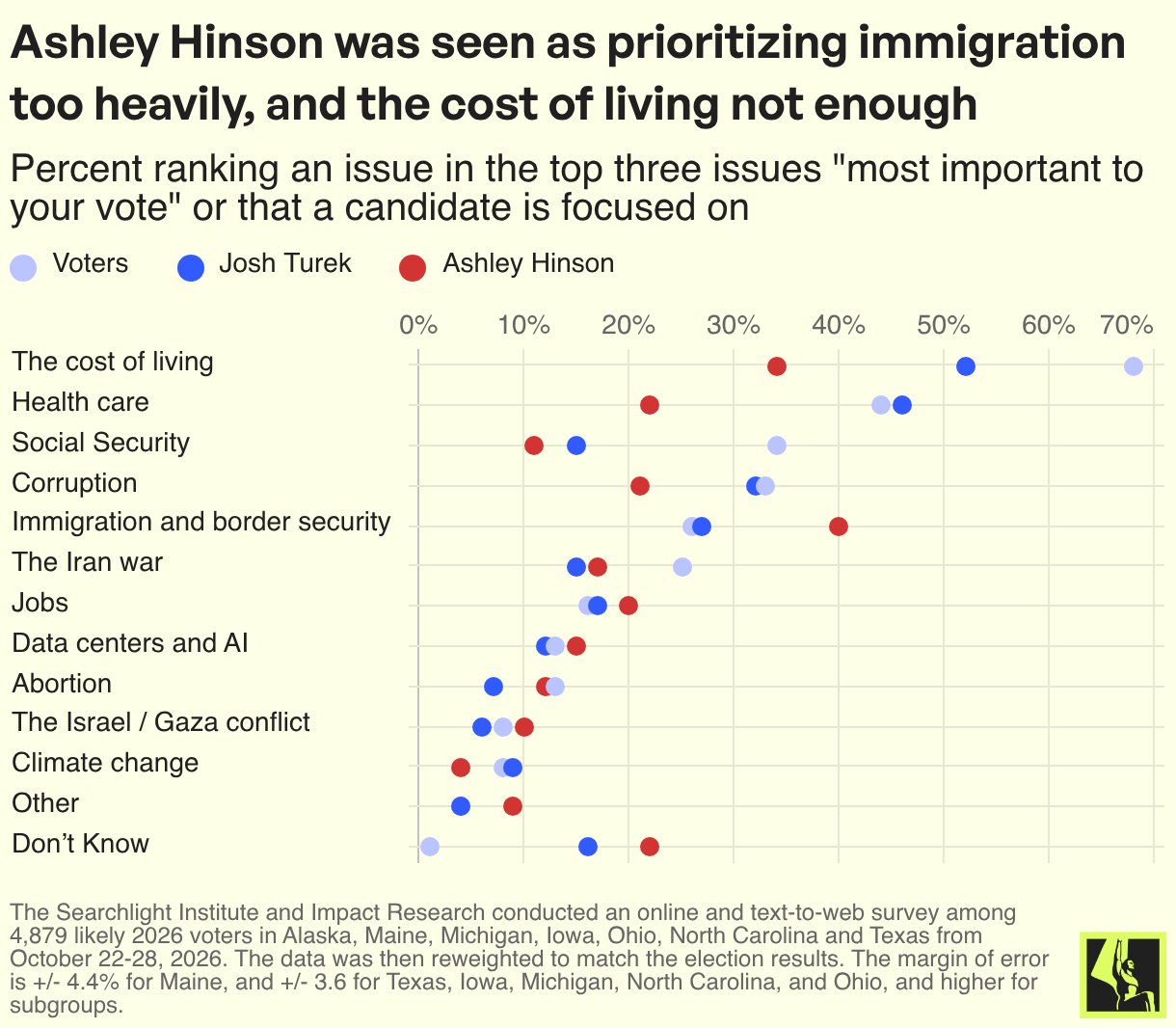
We asked voters to choose the three issues that were most important to their vote for Senate, and then, from that same list, the three issues that they thought each candidate was focused on. On the issues, Turek was more in line with the voters than Hinson. Turek was seen as much more likely than Hinson to prioritize the cost of living, which was a top priority. Hinson was also far behind voters in prioritizing health care and corruption. Turek’s focus on costs clearly came through to voters, and helps explain his strong performance. Of the states in our sample, Iowa voters were most likely to say that health care was an issue in deciding their Senate vote. Turek’s focus on opposing cuts to Medicare broke through, and voters who had health care as a top priority supported him at 63%, with just 33% voting for Hinson.
Iowa voters were also most likely to say the Iran War was an issue, likely because Hinson was tied to the war and the state was uniquely economically impacted. Her prioritization of immigration was the most out of step with voters’, who were among the least likely of any state to be focused on the issue.
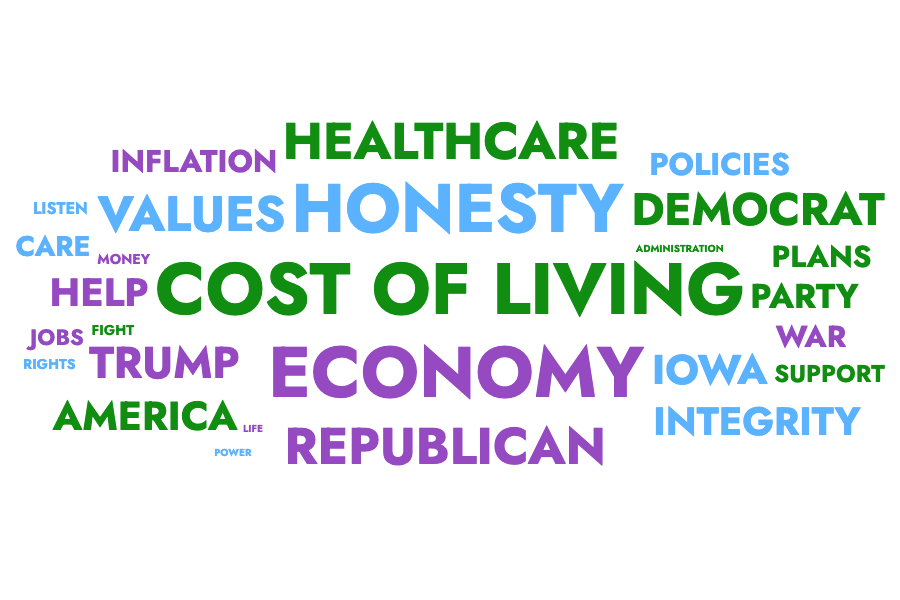
In their own words, both Turek and Hinson voters frequently cited the cost of living as the top factor in their vote choice. With Iowa farmers hit hard by rising diesel prices due to the War in Iran, one Turek voter put it simply: “Improving economy, ending war, opening Strait of Hormuz so we can get gas prices down.”
In addition to the cost of living, Hinson voters frequently cited personal integrity and embracing traditional conservative values: “Honesty, Integrity and America First.”
Discussion
Josh Turek and Rob Sand won in a nominally red state by breaking with their party and staying focused on issues that were most important to voters. Turek and Sand were also able to distance themselves from the Democratic Party brand more than almost any other candidates in our survey. This independence, combined with their perceived moderate ideology, helped deliver decisive victories on election night.